
Dividend Aristocrats List For 2026


Editorial Note: While we adhere to strict Editorial Integrity, this post may contain references to products from our partners. Here's an explanation for How We Make Money. None of the data and information on this webpage constitutes investment advice according to our Disclaimer.
The best dividend aristocrats by yield are:
Altria Group, Inc. (MO) - Dividend Yield: 7.64% - Industry: Tobacco.
Walgreens Boots AllianceInc. (WBA) - Dividend Yield: 6.03% - Industry: Retail Pharmacy.
3M Company (MMM) - Dividend Yield: 5.74% - Industry: Diversified Technology.
VF Corporation (VFC) - Dividend Yield: 5.60% - Industry: Apparel.
Chevron Corporation (CVX) - Dividend Yield: 3.61% - Industry: Oil & Natural Gas.
Dividend aristocrats are a respected group of stocks known for their stable and dependable performance. These stocks have increased their dividends annually for at least 25 years, making them a foundation for many investors seeking reliable income and value appreciation. In this article, we’ll explore what defines a dividend aristocrat, how to find the top ones, and offer practical tips for both new and experienced traders. Let's explore the best dividend aristocrat for your portfolio.
Best dividend aristocrats in 2026
Altria Group Inc. (MO) - Dividend Yield: 7.64% - Industry: Tobacco
Altria Group is one of the world's largest tobacco producers, best known for its flagship Marlboro brand. Despite facing regulatory challenges and declining smoking rates, Altria has maintained strong cash flows, allowing it to offer a high dividend yield.
Why choose it: Altria is a solid choice for investors seeking high current income. Its ability to maintain a substantial dividend despite industry headwinds demonstrates its financial resilience. Moreover, the company's strategic investments in alternative products like e-cigarettes and cannabis could provide additional growth opportunities.
Walgreens Boots Alliance Inc. (WBA) - Dividend Yield: 6.03% - Industry: Retail Pharmacy
Walgreens Boots Alliance is a global leader in retail pharmacy, operating a vast network of stores across the United States and Europe. The company provides essential healthcare services and products, making it a stable and reliable business.
Why choose it: Walgreens is a good pick for investors looking for stability in the healthcare sector. The company’s consistent dividend payments, backed by steady demand for healthcare services and products, make it an attractive option for income-focused investors. Additionally, its ongoing initiatives to expand healthcare services could enhance future growth.
3M Company (MMM) - Dividend Yield: 5.74% - Industry: Diversified Technology
3M is a diversified technology company with a broad product portfolio, including healthcare, industrial, and consumer goods. Known for its innovation, 3M has a long history of delivering consistent dividend growth.
Why choose it: 3M is typically selected for its history of innovation and strong brand portfolio. Although it was recently removed from the Dividend Aristocrats list due to a dividend cut, its high yield and diversified revenue streams still make it a potential choice for those willing to accept some risk in exchange for higher income.
VF Corporation (VFC) - Dividend Yield: 5.60% - Industry: Apparel
VF Corporation is a global leader in lifestyle apparel, with brands like The North Face, Vans, and Timberland under its umbrella. The company has a strong reputation for consistent dividend growth and has been a reliable income provider for investors.
Why choose it: VF Corporation should be considered for its strong brand portfolio and consistent dividend history. The company's focus on lifestyle and outdoor apparel positions it well for growth in a market that increasingly values health, wellness, and sustainability. Its dividend yield provides a solid income stream, supported by its steady performance in the consumer discretionary sector.
Chevron Corporation (CVX) - Dividend Yield: 3.61% - Industry: Oil & Natural Gas
Chevron is one of the largest integrated energy companies globally, involved in oil and natural gas exploration, production, refining, and distribution. The company has a strong track record of dividend growth, supported by its robust cash flows.
Why choose it: Chevron is a strong pick for investors seeking exposure to the energy sector with a focus on income. Its ability to maintain and grow dividends even in the volatile energy market speaks to its financial strength and operational efficiency. Additionally, Chevron’s investments in renewable energy and low-carbon technologies could position it well for the future, making it a forward-looking choice for dividend investors.
| Rank | Company | Ticker | Dividend Yield (%) | Industry |
|---|---|---|---|---|
| 1 | Altria Group, Inc. | MO | 7.64 | Tobacco |
| 2 | Walgreens Boots Alliance, Inc. | WBA | 6.03 | Retail Pharmacy |
| 3 | 3M Company | MMM | 5.74 | Diversified Technology |
| 4 | VF Corporation | VFC | 5.60 | Apparel |
| 5 | Chevron Corporation | CVX | 3.61 | Oil & Natural Gas |
How to choose the best dividend aristocrat
Research. Identify the list of current dividend aristocrats.
Analyze dividend yield. Compare yields to find those with the highest and most consistent returns.
Evaluate financial health. Look at financial metrics such as payout ratio, debt levels, and earnings stability.
Growthpotential. Consider companies with potential for future growth in dividends and share price.
Riskassessment. Assess the risk factors associated with each company.
Historical Performance. Review the historical performance of dividends and stock prices.
Peercomparison: Compare with other dividend-paying stocks and broader market performance.
If you want to invest and trade stocks, it is important to choose a reliable broker who will honor their agreements.
| Demo | Account min. | Signals (Alerts) | Research and data | Basic stock/ETF fee | Min. stock/ETF fee | Open an account | |
|---|---|---|---|---|---|---|---|
| Yes | 50 | Yes | Yes | No | No | Go to broker Your capital is at risk. |
|
| Yes | 2,500 | Yes | Yes | $0.0025/$0,0009 | $0 | Go to broker |
|
| Yes | 500 | Yes | Yes | $0.006 | Not specified | Go to broker 81% of retail CFD accounts lose money. |
|
| Yes | 500 | Yes | Yes | $0,005 | $0.99 | Go to broker Your capital is at risk. |
|
| Yes | No | Yes | Yes | $0 | $0 | Study review |
Tools and resources for dividend aristocrat investors
Useful tools and resources include:
MarketBeat. For updated lists and financial metrics.
Simply safe dividends. For dividend safety scores and analysis.
Yahoo finance. For historical data and stock screeners.
Analyzing dividend aristocrats by sector
Dividend aristocrats span various sectors, each offering unique opportunities and risks. Key sectors include:
Consumer staples. Stable demand and consistent performance.
Industrials. Cyclical but can offer high growth.
Healthcare. Defensive with steady growth.
Financials. Reliable income but sensitive to economic changes.
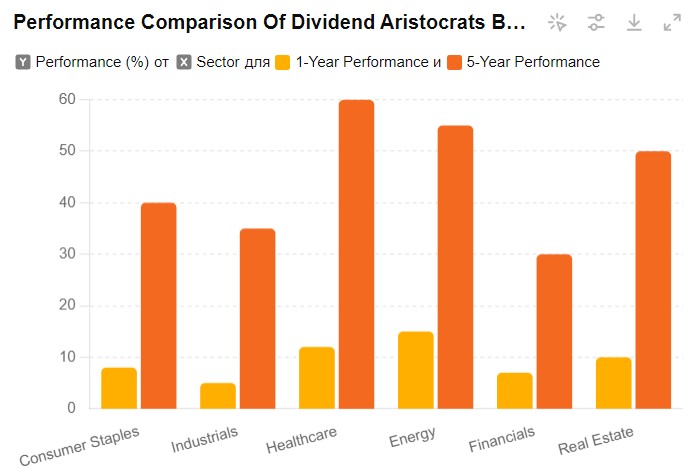
This chart illustrates the 1-year and 5-year performance of dividend aristocrats across various sectors, including Consumer Staples, Industrials, Healthcare, Energy, Financials, and Real Estate. The performance metrics help investors understand which sectors have historically provided higher returns, aiding in diversification and strategic allocation of investments.
Pros and cons of investing in dividend aristocrats
- Pros
- Cons
Steady income from dividends.
Lower volatility compared to non-dividend-paying stocks.
Historical outperformance in bear markets.
Limited capital appreciation potential.
Dividend cuts in economic downturns.
Sector concentration risks.
Real-life examples and case studies
Case studies of successful dividend aristocrat investments provide practical insights. Highlight companies like PepsiCo (PEP) and 3M (MMM), showcasing their consistent performance and dividend growth.
PepsiCo (PEP)
PepsiCo is a global leader in the food and beverage industry. Known for its popular brands like Pepsi, Gatorade, and Quaker, PepsiCo has a strong presence in both the snack and beverage markets. The company has been a dividend aristocrat for over four decades, consistently increasing its dividends.
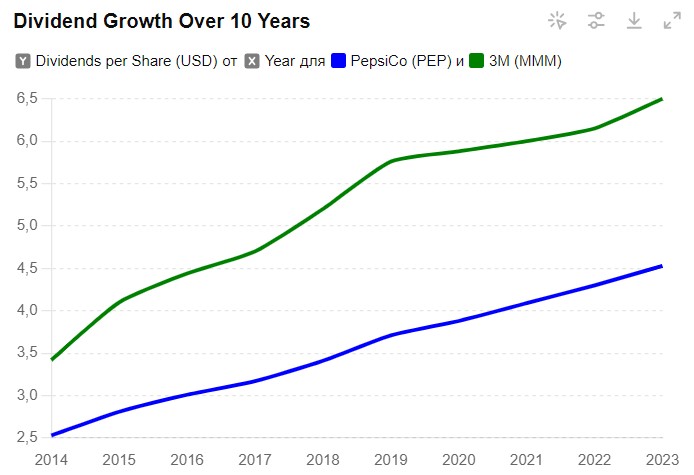
Over the past decade, PepsiCo has shown consistent growth in its dividend payments. Starting from $2.53 per share in 2014, the dividend increased to $4.53 per share by 2023. This steady growth reflects the company’s strong financial health and commitment to returning value to shareholders.
3M (MMM)
3M is a diversified technology company with operations in various industries, including healthcare, consumer goods, and industrial products. Known for its innovation and wide range of products, 3M has been a reliable dividend payer for over 60 years.
3M has also demonstrated strong dividend growth, with dividends increasing from $3.42 per share in 2014 to $6.50 per share in 2023. This growth highlights 3M’s ability to generate consistent earnings and maintain its dividend payout even during challenging economic periods.
Risk and warning
Investing in dividend aristocrats, while generally considered safer than other stocks, still involves various risks that investors should be aware of:
Market risk. The overall stock market can experience volatility due to economic changes, political events, or market sentiment. Even the most reliable dividend aristocrats can see fluctuations in their stock prices during market downturns.
Company-specific risk. Individual companies can face specific risks such as poor management decisions, declining product demand, or industry-specific challenges.
Economic and geopolitical risks. Broader economic downturns, such as recessions, can strain even the most robust companies, potentially leading to dividend cuts.
Regulatory changes. Changes in government policies or industry regulations can impact a company's operations and profitability. This is especially relevant for sectors like healthcare, energy, and finance, which are often heavily regulated.
Inflation risk. High inflation can erode the purchasing power of the dividends you receive. While many dividend aristocrats increase their dividends over time, there is no guarantee that these increases will outpace inflation.
Interest rate risk. Rising interest rates can make dividend-paying stocks less attractive compared to fixed-income investments like bonds. This can lead to a decline in stock prices as investors shift their preferences.
Diversification and thorough research are essential to mitigate these risks.
Dividend aristocrats are about long-term growth and stability

When it comes to dividend aristocrats, here’s my advice.
First, understand that patience is your greatest ally. Dividend aristocrats are about long-term growth and stability. They’re not the stocks that will double your money overnight, but they are the ones that can provide a steady income stream and appreciate steadily over time.
Patience is key with Dividend Aristocrats — they're about long-term growth and stability, not quick gains. I've held stocks like Johnson & Johnson and Procter & Gamble for over 15 years, and their steady dividends and capital growth have kept my portfolio stable. Diversification is crucial; spread your investments across sectors like consumer staples, healthcare, and industrials to balance risk and reward. Reinvesting dividends through a DRIP can significantly grow your investment over time. Focus on long-term growth, diversify, reinvest, stay informed, and manage your emotions for successful investing.
Conclusion
Dividend aristocrats are a solid investment choice for both beginners and advanced traders. These stocks provide reliable income through consistent dividend payments and have a proven track record of weathering economic downturns. By focusing on companies with strong financial health, growth potential, and a history of increasing dividends, you can build a resilient portfolio that offers stability and long-term growth.
Use the tools and resources available, such as stock screeners and financial analysis platforms, to make informed decisions. Expert advice and real-life case studies can provide additional insights and confidence in your investment choices.
FAQs
What is the minimum investment required to start with dividend aristocrats?
The minimum investment required varies by broker, but you can start with as little as $100 to $500, depending on the stock price and broker requirements.
Can I invest in dividend aristocrats through an ETF?
Yes, you can invest in dividend aristocrats through ETFs like the ProShares S&P 500 Dividend Aristocrats ETF (NOBL), which provides exposure to a diversified portfolio of dividend aristocrats.
How often do dividend aristocrats pay dividends?
Most dividend aristocrats pay dividends quarterly, but the exact schedule can vary by company. It's important to check each company's dividend payment schedule for specific details.
Are dividend aristocrats safe during economic downturns?
Dividend aristocrats are generally considered safer during economic downturns due to their strong financial health and history of maintaining dividends.
Editors' Top Picks and Insights






Related Articles
Team that worked on the article
Parshwa is a content expert and finance professional possessing deep knowledge of stock and options trading, technical and fundamental analysis, and equity research. As a Chartered Accountant Finalist, Parshwa also has expertise in Forex, crypto trading, and personal taxation.
Chinmay Soni is a financial analyst with more than 5 years of experience in working with stocks, Forex, derivatives, and other assets. As a founder of a boutique research firm and an active researcher, he covers various industries and fields, providing insights backed by statistical data.
Mirjan Hipolito is a journalist and news editor at Traders Union. She is an expert crypto writer with five years of experience in the financial markets.
Ethereum is a decentralized blockchain platform and cryptocurrency that was proposed by Vitalik Buterin in late 2013 and development began in early 2014. It was designed as a versatile platform for creating decentralized applications (DApps) and smart contracts.
Cryptocurrency is a type of digital or virtual currency that relies on cryptography for security. Unlike traditional currencies issued by governments (fiat currencies), cryptocurrencies operate on decentralized networks, typically based on blockchain technology.
Diversification is an investment strategy that involves spreading investments across different asset classes, industries, and geographic regions to reduce overall risk.
Crypto trading involves the buying and selling of cryptocurrencies, such as Bitcoin, Ethereum, or other digital assets, with the aim of making a profit from price fluctuations.
Fundamental analysis is a method or tool that investors use that seeks to determine the intrinsic value of a security by examining economic and financial factors. It considers macroeconomic factors such as the state of the economy and industry conditions.

-
 Afghanistan
-
 Albania
-
 Algeria
-
 Angola
-
 Argentina
-
 Armenia
-
 Australia
-
 Austria
-
 Azerbaijan
-
 Bahamas
-
 Bahrain
-
 Bangladesh
-
 Belarus
-
 Belgium
-
 Bolivia
-
 Botswana
-
 Brazil
-
 Brunei
-
 Bulgaria
-
 Cambodia
-
 Cameroon
-
 Canada
-
 Chile
Chile
-
 China
China
-
 Colombia
-
 Congo
Congo
-
 Costa Rica
-
 Cote d'Ivoire
-
 Croatia
-
 Cuba
Cuba
-
 Cyprus
-
 Czechia
-
 DR Congo
-
 Denmark
-
 Dominican Republic
-
 Ecuador
-
 Egypt
Egypt
-
 El Salvador
-
 Estonia
-
 Eswatini
-
 Ethiopia
-
 Finland
-
 France
-
 Georgia
-
 Germany
-
 Ghana
Ghana
-
 Greece
-
 Haiti
Haiti
-
 Hong Kong
-
 Hungary
-
 India
India
-
 Indonesia
-
 Iran, Islamic republic
-
 Iraq
Iraq
-
 Ireland
-
 Israel
-
 Italy
Italy
-
 Jamaica
-
 Japan
Japan
-
 Jordan
-
 Kazakhstan
-
 Kenya
Kenya
-
 Korea
Korea
-
 Kuwait
-
 Kyrgyzstan
-
 Laos
Laos
-
 Latvia
-
 Lebanon
-
 Lesotho
-
 Libya
Libya
-
 Lithuania
-
 Luxembourg
-
 Madagascar
-
 Malaysia
-
 Malta
Malta
-
 Mauritius
-
 Mexico
-
 Moldova
-
 Mongolia
-
 Montenegro
-
 Morocco
-
 Mozambique
-
 Myanmar
-
 Namibia
-
 Nepal
Nepal
-
 Netherlands
-
 New Zealand
-
 Nigeria
-
 North Macedonia
-
 Norway
-
 Oman
Oman
-
 Pakistan
-
 Palestine
-
 Panama
-
 Papua New Guinea
-
 Paraguay
-
 Peru
Peru
-
 Philippines
-
 Poland
-
 Portugal
-
 Puerto Rico
-
 Qatar
Qatar
-
 Reunion
-
 Romania
-
 Rwanda
-
 Saudi Arabia
-
 Serbia
-
 Singapore
-
 Slovakia
-
 Slovenia
-
 Somalia
-
 South Africa
-
 Spain
Spain
-
 Sri Lanka
-
 Sweden
-
 Switzerland
-
 Syria
Syria
-
 Taiwan
-
 Tajikistan
-
 Tanzania
-
 Thailand
-
 Trinidad and Tobago
-
 Tunisia
-
 Turkey
-
 UAE
UAE
-
 Uganda
-
 Ukraine
-
 United Kingdom
-
United States
-
 Uruguay
-
 Uzbekistan
-
 Venezuela
-
 Vietnam
-
 Yemen
Yemen
-
 Zambia
-
 Zimbabwe
- Forex
- Crypto












