
BlackRock RWA And Tokenization


Editorial Note: While we adhere to strict Editorial Integrity, this post may contain references to products from our partners. Here's an explanation for How We Make Money. None of the data and information on this webpage constitutes investment advice according to our Disclaimer.
BlackRock is embracing RWA (Real-World Asset) tokenization by exploring blockchain-based solutions to digitize traditional assets like bonds and funds, aiming to improve efficiency, transparency, and accessibility in global finance.
As traditional finance and crypto converge, BlackRock’s embrace of blockchain technology marks a turning point. From launching tokenized funds to exploring crypto-native platforms, the firm is integrating decades of financial expertise with cutting-edge innovation. This article explores what RWA means, why BlackRock is investing in it, and how it could reshape the future of investing.
BlackRock RWA and tokenization

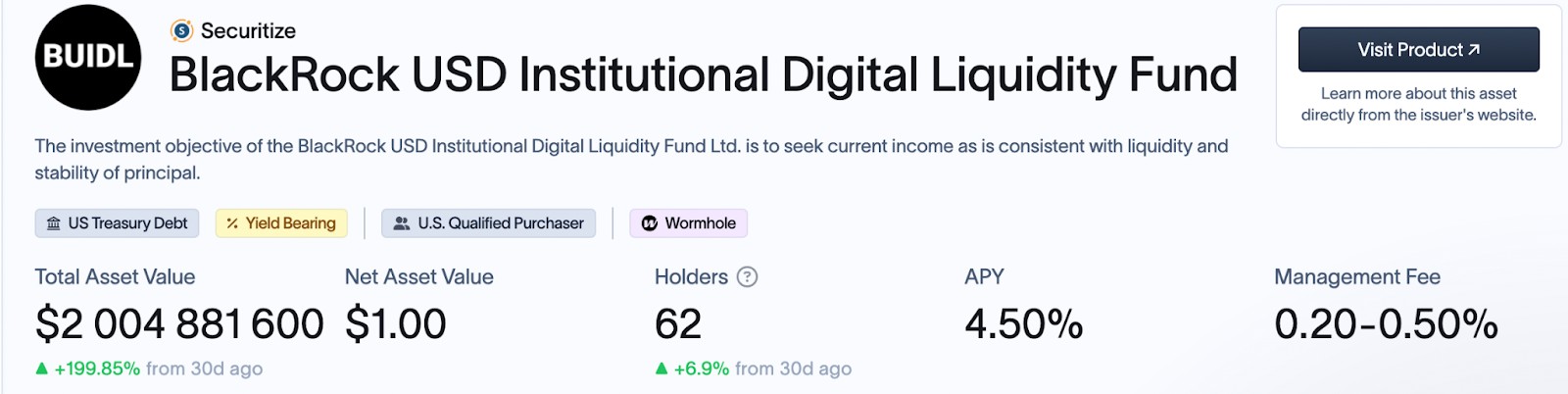
BlackRock, the world’s largest asset manager, made a major move into blockchain-based finance by launching its first tokenized fund in March 2024. The fund, named BlackRock USD Institutional Digital Liquidity Fund (BUIDL), runs on the Ethereum blockchain and offers tokenized exposure to traditional instruments such as U.S. Treasury bills, repurchase agreements, and cash equivalents. This shift toward tokenization is aimed at improving transparency, enhancing liquidity, and reducing operational friction in traditional asset management.
The BUIDL fund gained rapid traction after its launch, surpassing $1 billion in assets under management within a year. Its strong growth reflects rising institutional interest in real-world assets on blockchain networks. To expand reach and accessibility, BlackRock made BUIDL compatible with several blockchain platforms beyond Ethereum, including Aptos, Arbitrum, Avalanche, Optimism, and Polygon. This approach supports interoperability and opens up investment to a broader ecosystem of users.
Larry Fink, CEO of BlackRock, has consistently expressed confidence in the future of tokenization, calling it a key innovation in financial markets. By turning conventional assets into digital tokens, BlackRock aims to simplify the investing process, lower costs, and build a more efficient financial infrastructure. The successful rollout of BUIDL is already influencing other major firms to explore similar strategies, positioning BlackRock at the forefront of the tokenization movement.
The BlackRock tokenized asset fund (BUIDL)
BlackRock, the world’s largest asset manager, took a major step into blockchain-based finance with the launch of the BlackRock USD Institutional Digital Liquidity Fund, known as BUIDL. Rolled out in March 2024, the fund is built on the Ethereum blockchain and represents a significant move toward merging traditional finance with digital asset infrastructure.
Fund structure and purpose
BUIDL is designed for institutional investors looking for stability and liquidity. The fund allocates assets entirely to cash, short-term U.S. Treasury bills, and repurchase agreements. It maintains a target value of $1 per token and pays out daily accrued dividends. These earnings are distributed monthly as additional tokens, sent directly to investors’ digital wallets, combining the predictability of traditional assets with the convenience of blockchain settlement.
Rapid growth and blockchain expansion
Within a year of its launch, BUIDL surpassed $1 billion in assets under management. This rapid growth reflects growing institutional appetite for tokenized financial products. To expand its reach, BlackRock has made BUIDL available on multiple blockchain networks beyond Ethereum, including Aptos, Arbitrum, Avalanche, Optimism, Polygon, and Solana. These integrations help increase accessibility and allow users to interact with the fund through a variety of decentralized ecosystems.
BlackRock’s $10 trillion RWA opportunity
BlackRock is leading a major push to tokenize real-world assets (RWAs), with ambitions to digitize up to $10 trillion of its portfolio over the coming years. This effort represents a significant evolution in asset management, where traditional financial instruments such as bonds, real estate, and short-term treasury assets are converted into digital tokens on blockchain networks.

Strategic actions and partnerships
BUIDL tokenizes highly liquid instruments such as cash and short-term U.S. Treasury bills, allowing investors to gain exposure to these assets through digital tokens. BlackRock’s strategy doesn’t stop there — it is also investing in infrastructure to support large-scale adoption.
One of its most notable moves came in May 2024, when BlackRock led a $47 million investment round into Securitize, a platform that enables compliant tokenization of securities. This partnership is designed to build the backbone of tokenized markets, focusing on investor onboarding, issuance, and secondary trading of tokenized assets. It reflects BlackRock’s belief that tokenization can streamline financial systems and bring greater transparency to the investment process.
Impact on global finance
This $10 trillion tokenization initiative is not just a technological upgrade — it could reshape how institutions and retail investors access assets. Tokenization has the potential to unlock liquidity in traditionally illiquid markets, such as private equity and real estate, and reduce the cost of ownership transfer through programmable smart contracts. It could also enable 24/7 market access and better settlement efficiency.
How tokenization works: Turning real assets into crypto

Tokenization refers to the process of transforming ownership rights of real-world assets into digital tokens on a blockchain. This method aims to improve liquidity, allow fractional ownership, and simplify asset transfers across borders. Here's how the process works in practice.
Identifying and selecting the asset
The process begins by choosing a physical or financial asset that can be represented digitally. This could be real estate, artwork, commodities like gold, or even income-generating contracts. Before tokenization, the asset must be legally validated, with a clear title and valuation. In most cases, the asset is transferred into a special legal structure, such as a Special Purpose Vehicle (SPV) or a trust.
Token creation and blockchain integration
Once the legal setup is complete, digital tokens are created on a blockchain network. These tokens act as digital certificates of ownership. Blockchains like Ethereum are often used due to their ability to support programmable smart contracts. These smart contracts are pre-coded with rules that handle tasks such as transfer of ownership, dividend payouts, and compliance checks.
Investor participation and secondary market trading
After token issuance, the assets are offered to investors via licensed platforms that handle regulatory compliance and investor verification. Investors can buy fractions of the asset, enabling broader participation and lower entry barriers. Once issued, these tokens can also be traded on secondary markets, offering increased liquidity for assets that were once difficult to sell quickly. Blockchain records each transaction transparently, ensuring traceability and reducing fraud.
The impact of BlackRock on RWA crypto adoption
BlackRock has played a key role in legitimizing and accelerating the adoption of real-world assets (RWAs) in the crypto ecosystem. The launch of its tokenized fund, BUIDL, in March 2024 marked a major shift — bringing traditional financial products like Treasury bills and cash equivalents onto the Ethereum blockchain. The fund quickly surpassed $1 billion in assets, proving that institutional demand for blockchain-based finance is not just theoretical.
Its influence goes beyond a single product.
BlackRock expanded BUIDL’s reach by integrating with multiple blockchains including Polygon, Arbitrum, and Solana — showing its focus on interoperability.
It partnered with Securitize to streamline tokenized securities issuance and compliance.
CEO Larry Fink has openly backed tokenization, pushing for regulatory clarity and encouraging broader institutional participation.
Risks and challenges in RWA tokenization
Get to know the risks and challenges in RWA:
Regulatory uncertainty: tokenized assets often fall into legal grey zones across jurisdictions, posing risks for issuers and investors.
Technology limitations: interoperability, scalability, and cross-chain compatibility remain major hurdles for seamless integration.
Custody and ownership rights: legal clarity and secure custody solutions are critical to ensure enforceable rights for token holders.
Is it worth it to invest in crypto?
Cryptocurrency offers high potential returns but comes with significant risk. While assets like Bitcoin surged past $100,000 in 2024, they remain volatile, with sharp drops like the dip below $75,000 in early 2025. For investors, crypto provides diversification and access to a new financial system, but careful risk management and staying informed are crucial.
We have selected a list of trusted exchanges to trade crypto efficiently, based on security, trading volume, supported assets, and user experience.
| Coinbase | OKX | BTCC | Cryptohopper | Crypto.com | |
|---|---|---|---|---|---|
|
Foundation year |
2012 | 2017 | 2011 | 2018 | 2016 |
|
Min. Deposit, $ |
10 | 10 | 10 | No | 1 |
|
Android |
Yes | Yes | Yes | Yes | Yes |
|
iOS |
Yes | Yes | Yes | Yes | Yes |
|
Deposit fee |
No | No | No | No | No |
|
Withdrawal fee |
Fixed fee - 25 USD PayPal - 1.5% USDC - 10 USD | 0.0004 BTC 2.6 USDT | 0.0004 BTC 0.005 ETH 6%. if there was no futures trading | No | 0.0005 BTC |
|
Demo account |
No | Yes | Yes | No | No |
|
Open an account |
Go to broker Your capital is at risk. |
Go to broker Your capital is at risk. |
Go to broker Your capital is at risk.
|
Go to broker Your capital is at risk. |
Go to broker Your capital is at risk. |
Why trust us
15+ years of independent market analysis
140+ evaluation criteria, reviewed by 50+ experts
Data-driven reviews of 200+ platforms, updated regularly
20+ industry awards & a wide network of global media partners
Learn more about our methodology and editorial policies.


Look for real-world value and long-term utility before jumping into tokenized assets

Before diving into tokenized assets, one of the smartest moves a beginner can make is to look beyond the hype and assess whether the underlying asset has true economic relevance. Don’t just check what blockchain it’s on — ask what problem it’s solving offline. For example, a token representing equity in a revenue-generating solar farm or a commercial building with tenants has built-in economic activity behind it.
That’s very different from a tokenized painting sitting idle in a vault. Real-world usage translates into regular cash flows, stronger investor confidence, and more predictable demand for the token. In simple terms, if the asset can’t earn in the real world, its digital twin probably won’t perform in the long run either.
Also, pay close attention to how easy it is to exit. Most new investors look only at entry price, but you should be studying secondary market liquidity and exit windows. Tokenized real estate may offer impressive yields, but if it takes 60 days and three approvals to exit your position, you’re not liquid — you’re stuck.
Conclusion
BlackRock’s investment in RWA tokenization is a major signal that the future of finance is going on-chain. With $10 trillion in assets potentially heading toward blockchain, the implications for crypto, investing, and global markets are huge.
From BUIDL to blockchain partnerships, BlackRock is building a new model for asset management that combines the security of traditional finance with the efficiency of digital innovation. As this trend continues, it could transform how investors interact with the financial system.
FAQs
What role does blockchain security play in tokenizing real-world assets?
Blockchain security is essential in tokenization. It ensures that ownership records are tamper-proof, transactions are transparent, and data is protected from unauthorized access. This creates trust in digital assets and makes compliance easier.
How do regulators view RWA tokenization in traditional finance?
Regulators are cautiously optimistic but still developing rules. Some countries support it with clear frameworks, while others are in the early stages. Firms like BlackRock help influence regulation by demonstrating how tokenization can work within legal boundaries.
Can retail investors access tokenized BlackRock assets?
Access depends on the fund structure. Some tokenized assets may be limited to accredited investors due to regulations. However, future products may expand access as rules evolve and platforms become more inclusive.
How is RWA tokenization different from stablecoins or NFTs?
RWA tokens represent ownership of real-world assets like real estate or bonds. Stablecoins are pegged to fiat currency for stability, while NFTs are unique digital collectibles. RWAs combine real value with blockchain, making them useful for investing.
Editors' Top Picks and Insights



Related Articles
Team that worked on the article
Alamin Morshed is a contributor at Traders Union. He specializes in writing articles for businesses that want to improve their Google search rankings to compete with their competition.
Chinmay Soni is a financial analyst with more than 5 years of experience in working with stocks, Forex, derivatives, and other assets. As a founder of a boutique research firm and an active researcher, he covers various industries and fields, providing insights backed by statistical data.
Mirjan Hipolito is a journalist and news editor at Traders Union. She is an expert crypto writer with five years of experience in the financial markets.
Diversification is an investment strategy that involves spreading investments across different asset classes, industries, and geographic regions to reduce overall risk.
Index in trading is the measure of the performance of a group of stocks, which can include the assets and securities in it.
CFD is a contract between an investor/trader and seller that demonstrates that the trader will need to pay the price difference between the current value of the asset and its value at the time of contract to the seller.
Cryptocurrency is a type of digital or virtual currency that relies on cryptography for security. Unlike traditional currencies issued by governments (fiat currencies), cryptocurrencies operate on decentralized networks, typically based on blockchain technology.
Ethereum is a decentralized blockchain platform and cryptocurrency that was proposed by Vitalik Buterin in late 2013 and development began in early 2014. It was designed as a versatile platform for creating decentralized applications (DApps) and smart contracts.

-
 Afghanistan
-
 Albania
-
 Algeria
-
 Angola
-
 Argentina
-
 Armenia
-
 Australia
-
 Austria
-
 Azerbaijan
-
 Bahamas
-
 Bahrain
-
 Bangladesh
-
 Belarus
-
 Belgium
-
 Bolivia
-
 Botswana
-
 Brazil
-
 Brunei
-
 Bulgaria
-
 Cambodia
-
 Cameroon
-
 Canada
-
 Chile
Chile
-
 China
China
-
 Colombia
-
 Congo
Congo
-
 Costa Rica
-
 Cote d'Ivoire
-
 Croatia
-
 Cuba
Cuba
-
 Cyprus
-
 Czechia
-
 DR Congo
-
 Denmark
-
 Dominican Republic
-
 Ecuador
-
 Egypt
Egypt
-
 El Salvador
-
 Estonia
-
 Eswatini
-
 Ethiopia
-
 Finland
-
 France
-
 Georgia
-
 Germany
-
 Ghana
Ghana
-
 Greece
-
 Haiti
Haiti
-
 Hong Kong
-
 Hungary
-
 India
India
-
 Indonesia
-
 Iran, Islamic republic
-
 Iraq
Iraq
-
 Ireland
-
 Israel
-
 Italy
Italy
-
 Jamaica
-
 Japan
Japan
-
 Jordan
-
 Kazakhstan
-
 Kenya
Kenya
-
 Korea
Korea
-
 Kuwait
-
 Kyrgyzstan
-
 Laos
Laos
-
 Latvia
-
 Lebanon
-
 Lesotho
-
 Libya
Libya
-
 Lithuania
-
 Luxembourg
-
 Madagascar
-
 Malaysia
-
 Malta
Malta
-
 Mauritius
-
 Mexico
-
 Moldova
-
 Mongolia
-
 Montenegro
-
 Morocco
-
 Mozambique
-
 Myanmar
-
 Namibia
-
 Nepal
Nepal
-
 Netherlands
-
 New Zealand
-
 Nigeria
-
 North Macedonia
-
 Norway
-
 Oman
Oman
-
 Pakistan
-
 Palestine
-
 Panama
-
 Papua New Guinea
-
 Paraguay
-
 Peru
Peru
-
 Philippines
-
 Poland
-
 Portugal
-
 Puerto Rico
-
 Qatar
Qatar
-
 Reunion
-
 Romania
-
 Rwanda
-
 Saudi Arabia
-
 Serbia
-
 Singapore
-
 Slovakia
-
 Slovenia
-
 Somalia
-
 South Africa
-
 Spain
Spain
-
 Sri Lanka
-
 Sweden
-
 Switzerland
-
 Syria
Syria
-
 Taiwan
-
 Tajikistan
-
 Tanzania
-
 Thailand
-
 Trinidad and Tobago
-
 Tunisia
-
 Turkey
-
 UAE
UAE
-
 Uganda
-
 Ukraine
-
 United Kingdom
-
United States
-
 Uruguay
-
 Uzbekistan
-
 Venezuela
-
 Vietnam
-
 Yemen
Yemen
-
 Zambia
-
 Zimbabwe
- Forex
- Crypto












