Low Investment Business Ideas


Editorial Note: While we adhere to strict Editorial Integrity, this post may contain references to products from our partners. Here's an explanation for How We Make Money. None of the data and information on this webpage constitutes investment advice according to our Disclaimer.
Best business options to start with little or no money:
Freelance services and virtual assistant work. Sell your skills online with zero upfront cost through platforms like Fiverr and Upwork.
Online tutoring and coaching. Turn knowledge into daily income with flexible scheduling and no investment.
Handmade products and crafts. A creative small business you can launch from home for under $500.
Print-on-demand and dropshipping. Sell products online without holding inventory or spending on stock.
Cleaning and household services. A practical low investment option with fast local demand and repeat clients.
You do not need a large budget to start a real business. Many of the most reliable models today require little money upfront, and some can be launched with no investment at all. What matters more than capital is picking the right direction, testing it quickly, and staying consistent through the first few months.
The rise of online platforms has made this even more accessible. You can offer freelance services, sell handmade goods, or teach a skill to clients worldwide, all from home, with no startup cost beyond a laptop and internet. At the same time, offline options like local services and small-scale trade remain strong for anyone who prefers hands-on work.
In this article, we break down the best low investment business ideas for 2026, explain how to choose between them, and cover the most common mistakes that stop beginners from gaining traction. Whether you are a student, a parent working part-time, or someone ready to go all in, these options are built for real budgets and real life.
Risk warning: All investments carry risk, including potential capital loss. Economic fluctuations and market changes affect returns, and 40-50% of investors underperform benchmarks. Diversification helps but does not eliminate risks. Invest wisely and consult professional financial advisors.
Best low investment business ideas
The best way to start a business with little money is to pick a model where your time and skills are the main asset, not your budget. The options below are proven, practical, and can be launched quickly. Each one includes a realistic cost estimate so you know exactly what to expect. These are among the easiest and cheapest business directions to start with no money or a minimum investment.
Freelance services and virtual assistant work
If you are organized and comfortable with basic digital tools, freelance work is one of the best online business options without investment. Tasks include email management, scheduling, data entry, bookkeeping, and customer support. Clients range from solo entrepreneurs to growing companies.
Platforms like Fiverr, Upwork, and Belay connect you with work immediately. As you build experience, you can specialize in higher-paying areas like project management or executive support. This is also a strong side business idea with low investment for anyone already working a full-time job.
Startup cost: $0 to $50. A laptop and internet are the only requirements.
Online tutoring and coaching
Teaching what you already know is one of the most accessible no cost business ideas available. Academic subjects, languages, professional skills, fitness coaching, and career consulting all have steady demand. You can run sessions through Zoom or Google Meet and find clients on platforms like Preply, Italki, and Udemy.
The format scales well. Start with one-on-one sessions, then move to group classes, recorded courses, or subscription models. For students, this works especially well since you can teach subjects you recently studied. It is also a realistic free home based business for parents or retirees.
Startup cost: $0 to $100.
Social media management
Helping small businesses grow their online presence is one of the fastest-growing business ideas with zero investment. If you understand how Instagram, TikTok, Facebook, or LinkedIn work, companies will pay you to plan content, write posts, run ads, and engage with their audiences.
You need no upfront spending. Build a portfolio with sample work or volunteer projects, then pitch to local shops and small brands directly. This is a practical part-time business direction without investment that grows as your client list grows. Many people in this space also expand into paid advertising management, which raises income significantly.
Startup cost: $0.
Handmade products and crafts
Turning a creative hobby into income is a proven low investment home small business idea. Jewelry, candles, soaps, knitted goods, home decor, and custom gifts all sell well on platforms like Etsy, Amazon Handmade, and local craft markets.
Success depends on product quality, photography, and the story behind your brand. This is one of the more satisfying DIY small business ideas because you control every detail. Many people start as a side project and grow it into a profitable business with low investment over time.
Startup cost: $100 to $500 for materials, packaging, and platform fees.
Print-on-demand and dropshipping
If you want to sell products online without holding inventory, print-on-demand and dropshipping are among the best business models to start with low investment. With print-on-demand, you design graphics for t-shirts, mugs, or phone cases, and a supplier prints and ships them only when a customer orders. With dropshipping, you list products from a supplier and they handle fulfillment.
Platforms like Shopify, Printful, Redbubble, and Gelato make setup simple. The main challenge is standing out in a competitive space, so marketing and niche selection matter. This model works well as a zero investment business online since most platforms charge nothing until you make a sale.
Startup cost: $0 to $200 depending on platform and marketing spend.
Home bakery and food preparation
Custom cakes, cupcakes, and desserts for birthdays, holidays, and corporate events remain one of the most reliable small business ideas with low investment. Clients choose home bakers for quality, unique design, and personal attention that mass production cannot match.
You need basic baking equipment, quality ingredients, and a workspace that meets local food safety rules. Most orders come through social media and word of mouth. Growth comes from seasonal products, repeat clients, and raising your average order value. This is one of the best business options to start with little money if you already enjoy cooking.
Startup cost: $200 to $500 for equipment and initial supplies.
Pet care and dog walking
Pet care is a simple, in-demand business with no investment beyond your time and reliability. Dog walking, pet sitting, home visits, and basic grooming are services that pet owners actively search for. Trust matters more than branding in this space, which makes it easy for beginners to get started.
List your services on Rover or Wag, or advertise in your neighborhood. This is one of the free home business options that builds fast through referrals and repeat clients. It works well as a daily income business without large investment since you can take on multiple bookings per day.
Startup cost: $0 to $100.
Cleaning and household services
Offering cleaning, organizing, or general household help is one of the most straightforward business ideas with no money required upfront. Demand is constant, clients are local, and first jobs can come within days of listing your services.
You can start with supplies you already own and upgrade as you earn. Platforms like TaskRabbit and Thumbtack connect you with local clients quickly. This is a strong no start up cost business that suits anyone looking for a practical, hands-on direction. Over time, you can hire helpers and turn it into a small team operation with low overhead.
Startup cost: $50 to $300 for cleaning supplies and basic marketing.
Content creation and blogging
Starting a blog, YouTube channel, or newsletter is a new business idea with low investment that can generate income through ads, sponsorships, affiliate links, and digital products. If you have knowledge or passion in a specific niche, content creation turns that into a long-term asset.
The catch is that income takes time. Most creators see meaningful revenue after 6 to 12 months of consistent output. But the upfront cost is close to zero, and once content is published, it can earn passively. This is one of the few low investment high profit business ideas where a single piece of content can keep generating returns for years.
Startup cost: $0 to $100 for hosting or basic equipment.
Small-scale local trade and reselling
Buying products at a lower price and reselling them at a markup is one of the oldest and most proven business ideas in low investment. This includes reselling popular items locally, sourcing from wholesalers, flipping thrift store finds, or working on a pre-order basis in your community.
Platforms like eBay, Facebook Marketplace, and Amazon make it easy to reach buyers beyond your neighborhood. The key is finding items with consistent demand and manageable competition. Start with small batches to test what sells before committing more capital. This is a practical business opportunity without investment in complex infrastructure.
Startup cost: $200 to $1,000 depending on product type and volume.
| Direction | Startup cost | Time to first income | Income potential (monthly) | Best for |
|---|---|---|---|---|
| Freelance and VA work | $0 to $50 | 1 to 2 weeks | $500 to $3,000+ | Organized, detail-oriented people |
| Online tutoring | $0 to $100 | 1 to 3 weeks | $500 to $4,000+ | Experts, teachers, students |
| Social media management | $0 | 2 to 4 weeks | $500 to $4,000+ | Digital-savvy beginners |
| Handmade crafts | $100 to $500 | 2 to 6 weeks | $200 to $2,000+ | Creative makers |
| Print-on-demand | $0 to $200 | 2 to 6 weeks | $200 to $3,000+ | Designers and marketers |
| Home bakery | $200 to $500 | 1 to 3 weeks | $500 to $3,000+ | Skilled bakers |
| Pet care | $0 to $100 | 1 to 2 weeks | $300 to $2,500+ | Animal lovers |
| Cleaning services | $50 to $300 | 1 to 7 days | $400 to $2,500+ | Hands-on, reliable workers |
| Content creation | $0 to $100 | 3 to 12 months | $100 to $5,000+ | Patient, niche-focused creators |
| Local trade and reselling | $200 to $1,000 | 1 to 3 weeks | $300 to $3,000+ | Research-driven, analytical people |
Important! Income figures are estimates based on typical ranges. Actual earnings depend on your location, hours, client base, and skill level. Most directions take 1 to 3 months to reach consistent income.
How to choose the right business to start
Having a list of ideas is only the first step. The real question is what business can you start with no money or a tight budget that actually fits your life. Many beginners waste months chasing trends instead of honestly matching their skills to a direction. Here is what matters most.
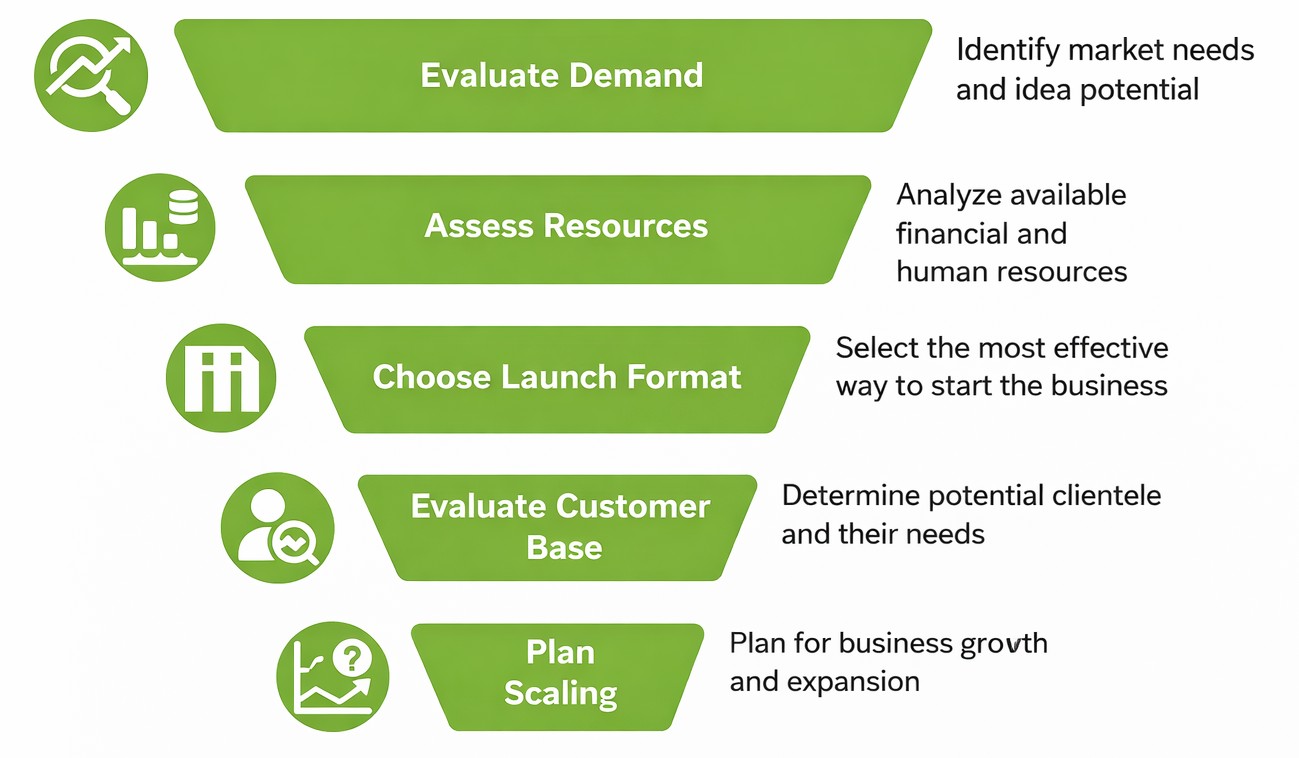
Key factors to evaluate:
Your skills. A business built on what you already know launches faster and costs less. If you write well, try content or freelancing. If you are good with people, consider services.
Your budget. Be honest about what you can spend. If the answer is close to zero, stick with free options like tutoring, freelancing, or social media management. If you have a few hundred dollars, handmade crafts, baking, or reselling become realistic.
Your time. A part-time direction looks different from a full-time one. Students and parents need flexible models. Local services require fixed hours.
Local demand vs. online reach. Cleaning and pet care depend on where you live. Online directions like tutoring and freelancing remove location limits entirely.
Growth potential. The best low investment business lets you scale, whether that means raising prices, adding new services, or hiring help.
If you are unsure where to begin, start with the option that has the lowest risk and the fastest path to your first paying client. One real client teaches you more than weeks of planning. Test small, learn fast, and adjust.
Trading and investing as an alternative income path
Not every path to income requires building a business from scratch. Trading and investing in financial markets offer a different model where you work with capital instead of clients. This includes currency trading on Forex, long-term stock and bond investing, cryptocurrency trading, and copy trading where you follow experienced traders automatically.
This direction is not a guaranteed income stream. Losses are real, especially for beginners. But for people with discipline and a willingness to learn, it can become a meaningful source of profit alongside or instead of a traditional business. Many beginners start with copy trading or small positions while learning the basics.
If this direction interests you, choosing a reliable broker is an important first step. Below are companies that offer a wide range of assets, competitive conditions, and a range of tools for beginners and experienced traders.
| Trading.com USA | Plus500 | OANDA | FOREX.com | IG Markets | |
|---|---|---|---|---|---|
|
Currency pairs |
69 | 60 | 68 | 80 | 80 |
|
Crypto |
No | Yes | Yes | Yes | Yes |
|
Stocks |
No | Yes | Yes | Yes | Yes |
|
Min. deposit, $ |
50 | 100 | No | 100 | 1 |
|
Max. leverage |
1:50 | 1:300 | 1:200 | 1:50 | 1:200 |
|
Regulation |
CFTC, NFA | CySEC, FCA, ASIC, FMA, FSCA, FSA Seychelles, EFSA, MAS, DFSA, SCB | FSC (BVI), ASIC, IIROC, FCA, CFTC, NFA | CIMA, FCA, FSA (Japan), NFA, IIROC, ASIC, CFTC | FCA, BaFin, ASIC, MAS, CySec, FINMA, BMA, CFTC, NFA |
|
TU overall score |
6.88 | 6.67 | 6.63 | 6.47 | 6.38 |
|
Open an account |
Go to broker Your capital is at risk. |
Go to broker 81% of retail CFD accounts lose money. |
Go to broker Your capital is at risk. |
Study review | Study review |
Common mistakes and how to avoid them
Even a strong idea can fail if you fall into the same traps that stop most beginners. These are the mistakes that come up again and again, regardless of the direction.
Expecting fast results. Most directions take 1 to 3 months before income becomes consistent. Do not quit too early.
Spending before earning. Beginners often buy tools, courses, or ads before landing a single client. Get your first sale first, then reinvest.
Skipping the numbers. Track income, expenses, and hours from day one. A business you do not measure is a business you cannot improve.
Doing everything alone. Taking on every role leads to burnout fast. Delegate or automate where you can, even at the start.
Relying on one channel. If all your clients come from one platform, a single policy change can wipe your income. Diversify early.
Ignoring feedback. Your first clients will tell you exactly what to fix. Listen to them instead of guessing.
These mistakes happen to almost everyone. A structured approach and gradual growth help you avoid most of them in the first few months.
Start simple, track numbers, and treat month one as education

When I look at what separates beginners who gain traction from those who stall, it almost always comes down to one thing: they picked something simple and actually started. Not the "perfect" idea, not the most profitable model on paper, just the easiest thing they could test within a week. I have seen someone launch a cleaning service with a single social media post, land three clients in the first week, and grow from there. No website, no branding, no plan beyond "do a great job and ask for referrals."
The other pattern I notice is that people who track their numbers from the beginning make better decisions at every stage. Even if your business earns nothing in month one, knowing exactly where your time goes and what your real costs are puts you ahead of anyone guessing. Start before you feel ready, measure everything, and treat the first three months as a paid education. The business you build after that will be much stronger for it.
Conclusion
Starting a business with little or no money in 2026 is more accessible than ever, thanks to practical models that rely on your skills and determination rather than large investments. Whether it's freelancing online or launching a local cleaning service, the secret to success is taking immediate action and adapting quickly as you learn. The most successful entrepreneurs are those who track their progress from day one and aren't afraid to start small, like the individual who grew a client list from a simple social media post. Your first few months are not just about profit but about building a strong foundation, proving that bold action and consistency matter more than having the perfect idea from the start.
FAQs
What are typical startup costs for the best business to start with little money in 2026?
How long does it usually take to earn a steady income from a new low investment business?
What are key mistakes to avoid when starting a business with little money?
How important is specialization for success in low-budget business ideas?
Editors' Top Picks and Insights






Related Articles
Team that worked on the article
Dan Blystone began his trading career in 1998 as an arbitrage clerk on the floor of the Chicago Mercantile Exchange (CME). He later traded bond and Eurex futures at proprietary firms such as Altea Trading, gaining valuable experience in high-frequency trading and risk management.
Chinmay Soni is a financial analyst with more than 5 years of experience in working with stocks, Forex, derivatives, and other assets. As a founder of a boutique research firm and an active researcher, he covers various industries and fields, providing insights backed by statistical data.
Bitcoin is a decentralized digital cryptocurrency that was created in 2009 by an anonymous individual or group using the pseudonym Satoshi Nakamoto. It operates on a technology called blockchain, which is a distributed ledger that records all transactions across a network of computers.
Forex trading, short for foreign exchange trading, is the practice of buying and selling currencies in the global foreign exchange market with the aim of profiting from fluctuations in exchange rates. Traders speculate on whether one currency will rise or fall in value relative to another currency and make trading decisions accordingly. However, beware that trading carries risks, and you can lose your whole capital.
CFD is a contract between an investor/trader and seller that demonstrates that the trader will need to pay the price difference between the current value of the asset and its value at the time of contract to the seller.
Copy trading is an investing tactic where traders replicate the trading strategies of more experienced traders, automatically mirroring their trades in their own accounts to potentially achieve similar results.
Ethereum is a decentralized blockchain platform and cryptocurrency that was proposed by Vitalik Buterin in late 2013 and development began in early 2014. It was designed as a versatile platform for creating decentralized applications (DApps) and smart contracts.

-
 Afghanistan
-
 Albania
-
 Algeria
-
 Angola
-
 Argentina
-
 Armenia
-
 Australia
-
 Austria
-
 Azerbaijan
-
 Bahamas
-
 Bahrain
-
 Bangladesh
-
 Belarus
-
 Belgium
-
 Bolivia
-
 Botswana
-
 Brazil
-
 Brunei
-
 Bulgaria
-
 Cambodia
-
 Cameroon
-
 Canada
-
 Chile
Chile
-
 China
China
-
 Colombia
-
 Congo
Congo
-
 Costa Rica
-
 Cote d'Ivoire
-
 Croatia
-
 Cuba
Cuba
-
 Cyprus
-
 Czechia
-
 DR Congo
-
 Denmark
-
 Dominican Republic
-
 Ecuador
-
 Egypt
Egypt
-
 El Salvador
-
 Estonia
-
 Eswatini
-
 Ethiopia
-
 Finland
-
 France
-
 Georgia
-
 Germany
-
 Ghana
Ghana
-
 Greece
-
 Haiti
Haiti
-
 Hong Kong
-
 Hungary
-
 India
India
-
 Indonesia
-
 Iran, Islamic republic
-
 Iraq
Iraq
-
 Ireland
-
 Israel
-
 Italy
Italy
-
 Jamaica
-
 Japan
Japan
-
 Jordan
-
 Kazakhstan
-
 Kenya
Kenya
-
 Korea
Korea
-
 Kuwait
-
 Kyrgyzstan
-
 Laos
Laos
-
 Latvia
-
 Lebanon
-
 Lesotho
-
 Libya
Libya
-
 Lithuania
-
 Luxembourg
-
 Madagascar
-
 Malaysia
-
 Malta
Malta
-
 Mauritius
-
 Mexico
-
 Moldova
-
 Mongolia
-
 Montenegro
-
 Morocco
-
 Mozambique
-
 Myanmar
-
 Namibia
-
 Nepal
Nepal
-
 Netherlands
-
 New Zealand
-
 Nigeria
-
 North Macedonia
-
 Norway
-
 Oman
Oman
-
 Pakistan
-
 Palestine
-
 Panama
-
 Papua New Guinea
-
 Paraguay
-
 Peru
Peru
-
 Philippines
-
 Poland
-
 Portugal
-
 Puerto Rico
-
 Qatar
Qatar
-
 Reunion
-
 Romania
-
 Rwanda
-
 Saudi Arabia
-
 Serbia
-
 Singapore
-
 Slovakia
-
 Slovenia
-
 Somalia
-
 South Africa
-
 Spain
Spain
-
 Sri Lanka
-
 Sweden
-
 Switzerland
-
 Syria
Syria
-
 Taiwan
-
 Tajikistan
-
 Tanzania
-
 Thailand
-
 Trinidad and Tobago
-
 Tunisia
-
 Turkey
-
 UAE
UAE
-
 Uganda
-
 Ukraine
-
 United Kingdom
-
United States
-
 Uruguay
-
 Uzbekistan
-
 Venezuela
-
 Vietnam
-
 Yemen
Yemen
-
 Zambia
-
 Zimbabwe
- Forex
- Crypto