
What Is The Best Time Of Day To Trade GBP/USD?


Editorial Note: While we adhere to strict Editorial Integrity, this post may contain references to products from our partners. Here's an explanation for How We Make Money. None of the data and information on this webpage constitutes investment advice according to our Disclaimer.
GBP/USD is a widely traded currency with extensive trading time. However, experts suggest that the best time of day to trade GBP/USD is between 12:00 to 15:00 GMT.
The Forex market, known as the largest financial market in the world, offers traders a multitude of currency pairs to choose from. Among these, the GBP/USD pair is a popular choice, but is it always a good time to trade it? This article explores the best times to trade GBP/USD, taking into account various factors such as volatility, economic events, and liquidity. Whether you're an experienced trader or just starting out, understanding the optimal timing for this pair can have a meaningful impact on your trading results.
Is GBP/USD a good pair to trade?
Yes, GBP/USD is a popular and highly regarded currency pair for trading in the Forex market, contributing roughly 11% of the total trading volume. It offers several advantages that make it a good choice for both novice and experienced traders. One key advantage of trading the GBP/USD pair is its liquidity. It is one of the most heavily traded currency pairs globally, ensuring that traders can easily enter and exit positions without causing significant price disruptions. Additionally, GBP/USD usually offers relatively low spreads, which can help reduce transaction costs and enhance profitability, especially for those engaging in short-term trading strategies.
Also, the overlap of trading hours for GBP/USD with the London session, which is the most active time for this pair, is another advantage. This aligns well with European trading hours, making it convenient for traders in Europe to actively monitor and trade the currency pair during their regular business hours.
GBP/USD trading hours
The GBP/USD market open time is 24 hours a day, five days a week from Monday to Friday. However, trading hours for GBP/USD can be broken down into different sessions, each with its own level of market activity and volatility. Understanding these hours and their corresponding market conditions is crucial for traders looking to make informed decisions.
Asian session - This session includes trading centres like Tokyo and Singapore. It typically spans from 00:00 to 09:00 GMT. During the Asian session, GBP/USD trading activity is relatively low, leading to narrower price movements and lower volatility. Traders often consider this session as a period of consolidation and preparation for more significant market moves
European session - The European session, covering cities like London and Frankfurt, occurs from 08:00 to 17:00 GMT. This is when the trading activity for GBP/USD sees a notable uptick. The London session is known for its high liquidity and increased price fluctuations. Traders frequently focus on this session for opportunities due to the substantial trading volume
American session - The American session includes New York and operates from 12:00 to 22:00 GMT. This session is marked by continued high trading volume, especially during the overlap with the European session. As a result, GBP/USD can experience heightened volatility during this time
Overlapping sessions - The most significant market movements in GBP/USD often occur during session overlaps, such as the European and American overlap from 12:00 to 17:00 GMT. These periods are characterized by robust trading activity, as both sessions are operational simultaneously. Traders look to capitalize on the increased volatility and liquidity during these overlaps
The best times to trade GBP/USD
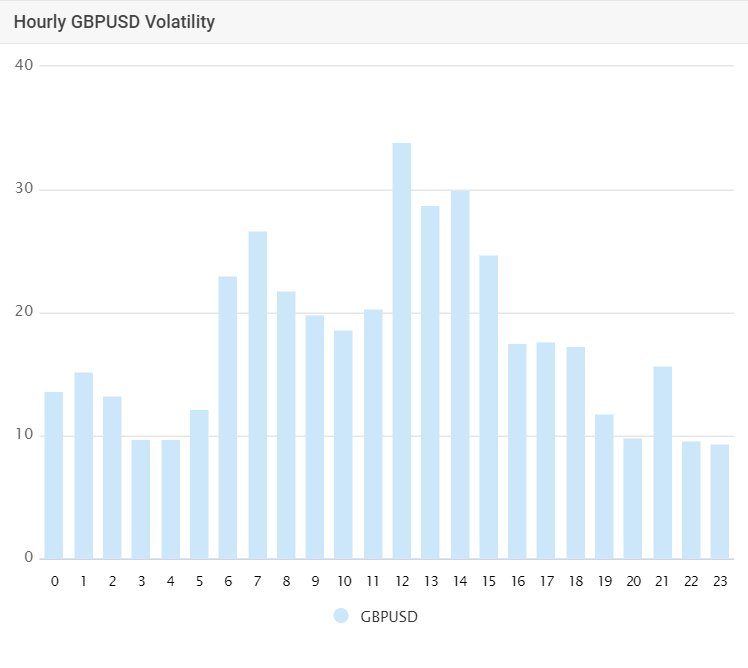 GBP/USD volatility by hour, GMT Time Zone (Source: Myfxbook)
The best time to trade GBP/USD will vary depending on a lot of factors but historically it is seen that the Forex markets experience highest volatility on Wednesday and Friday and lowest volatility on Monday.
Also, the volatility is lower during initial trading hours of 00:00 to 06:00 GMT and then starts increasing from 06:00 to 12:00 GMT with the highest volatility of the day coming from 12:00 to 15:00 GMT. After that, the volatility experiences a downward trend for the remaining hours of the day, i.e., from 15:00 to 23:00 GMT.
What affects GBP/USD?
GBP/USD, like all currency pairs, is influenced by a variety of factors. Understanding these factors is important for traders looking to make informed decisions when trading this pair.
News trading - News releases from key central banks and economic institutions significantly impact GBP/USD. For example, the Bank of England's policy decisions and statements can have a profound effect on the pound's value. Similarly, the U.S. Federal Reserve (FED) plays a crucial role in shaping the U.S. dollar's performance. Traders often closely monitor interest rate decisions, monetary policy statements, and economic outlooks from these institutions to gauge future currency movements
Intraday trading using patterns - Many traders rely on technical analysis and patterns to make intraday trading decisions. Patterns like head and shoulders, double tops or bottoms, and candlestick patterns are used to identify potential trend reversals or continuation. These patterns help traders determine entry and exit points during short-term trading
Long-Term trading using fundamentals - Fundamental analysis involves assessing the underlying economic and financial factors influencing a currency pair. For GBP/USD, this includes studying the overall health of the UK and U.S. economies. Indicators like GDP growth, employment figures, inflation rates, and trade balances can provide insight into long-term trends. Additionally, factors like political stability and trade relationships can also influence the currency pair over extended periods
Geopolitical events - Geopolitical events, such as elections, trade negotiations, and international conflicts, can significantly impact GBP/USD. For instance, Brexit developments had a profound effect on the pound, leading to significant fluctuations. Traders should stay informed about such events and their potential implications
Market sentiment - Market sentiment, often reflected in economic indicators like consumer confidence or the Purchasing Managers' Index (PMI), can impact currency movements. A positive outlook on the UK or U.S. economy can boost the pound or the dollar, while negative sentiment may lead to depreciation
Pros of trading the GBP/USD currency pair
Trading the GBP/USD currency pair offers several advantages that attract traders from various parts of the world, especially those with an interest in European and American markets. Here are some of the key benefits of trading GBP/USD.
Low spreads - The GBP/USD pair typically offers lower spreads compared to many other currency pairs. Low spreads reduce trading costs, making it more attractive for traders, especially those engaged in short-term trading strategies. This feature can potentially result in lower transaction costs and increased profitability
Ideal for Europe-based traders - GBP/USD trading hours align well with European trading hours. The London session, which overlaps with the end of the Asian session and the beginning of the American session, is the most active time for GBP/USD trading. This period is particularly advantageous for traders in Europe, making it easier for them to monitor and trade this pair during their regular business hours
Abundance of fundamental data - The GBP/USD pair offers a wealth of fundamental data and news events. This abundance of information allows traders to make well-informed decisions. Major economic events from both the UK and the U.S., such as GDP reports, employment data, inflation figures, and central bank statements, provide traders with ample opportunities for analysis and trading strategies
Diverse trading strategies - GBP/USD is versatile, accommodating a wide range of trading strategies. Whether you prefer short-term, intraday trading or long-term investments, this currency pair can suit your trading style
Diverse trading hours - Due to the overlapping trading hours of the London and New York sessions, traders have flexibility in choosing when to trade GBP/USD, ensuring that trading opportunities are not confined to a specific time of day
While trading GBP/USD offers numerous advantages, traders should also be aware of the potential risks involved, including market volatility and economic uncertainties. It's essential to employ risk management strategies and stay informed about relevant news and events that may impact the currency pair.
Best Forex brokers
Trading GBP/USD effectively requires not only good timing but also a reliable broker with fast execution and tight spreads, especially during high-volatility periods like session overlaps. The brokers listed below offer suitable conditions for trading this pair across different strategies and experience levels.
| Plus500 | OANDA | Trading.com USA | FOREX.com | IG Markets | |
|---|---|---|---|---|---|
|
Min. deposit, $ |
100 | No | 50 | 100 | 1 |
|
Tradable assets |
2800 | 129 | 69 | 5500 | 20000 |
|
Standard EUR/USD spread |
0.7 | 0.3 | 1.1 | 1.0 | 0.9 |
|
Max. leverage |
1:300 | 1:200 | 1:50 | 1:50 | 1:200 |
|
Max. Regulation Level |
Tier-1 | Tier-1 | Tier-1 | Tier-1 | Tier-1 |
|
TU overall score |
7.7 | 7.24 | 6.22 | 7.12 | 7.04 |
|
Open an account |
Go to broker 81% of retail CFD accounts lose money. |
Go to broker Your capital is at risk. |
Go to broker Your capital is at risk. |
Study review | Study review |
Timing works best when combined with structure and consistency

The most active period for GBP/USD is well known, but simply trading during high-volatility hours is not enough on its own. I would say that the real advantage comes from combining these peak periods with a clear strategy and predefined entry and exit rules.
In practice, traders who align their approach with session overlaps, while also managing risk and avoiding impulsive decisions, tend to achieve more consistent outcomes. Strong market activity creates opportunities, but how those opportunities are used makes the difference.
Conclusion
The best time to trade GBP/USD is when market volatility and liquidity peak—specifically from 12:00 to 15:00 GMT during the London and New York session overlap. This window consistently offers the most significant trading opportunities due to high trading volumes and dynamic price movements. However, trading effectively goes beyond choosing the right hours; success hinges on disciplined strategies, robust risk management, and staying informed about market-moving news. For example, monitoring central bank announcements or major economic releases can provide critical trading edges. Ultimately, aligning your trading structure with these optimal periods can turn market volatility into your competitive advantage.
FAQs
How does volatility vary throughout the trading day for GBP/USD?
What economic events most strongly influence GBP/USD price movements?
Why are overlapping sessions important for GBP/USD traders?
What are some risk considerations when trading GBP/USD during peak hours?
Editors' Top Picks and Insights






Related Articles
Team that worked on the article
Parshwa is a content expert and finance professional possessing deep knowledge of stock and options trading, technical and fundamental analysis, and equity research. As a Chartered Accountant Finalist, Parshwa also has expertise in Forex, crypto trading, and personal taxation.
Chinmay Soni is a financial analyst with more than 5 years of experience in working with stocks, Forex, derivatives, and other assets. As a founder of a boutique research firm and an active researcher, he covers various industries and fields, providing insights backed by statistical data.
Mirjan Hipolito is a journalist and news editor at Traders Union. She is an expert crypto writer with five years of experience in the financial markets.
Crypto trading involves the buying and selling of cryptocurrencies, such as Bitcoin, Ethereum, or other digital assets, with the aim of making a profit from price fluctuations.
Forex leverage is a tool enabling traders to control larger positions with a relatively small amount of capital, amplifying potential profits and losses based on the chosen leverage ratio.
Risk management is a risk management model that involves controlling potential losses while maximizing profits. The main risk management tools are stop loss, take profit, calculation of position volume taking into account leverage and pip value.
Options trading is a financial derivative strategy that involves the buying and selling of options contracts, which give traders the right (but not the obligation) to buy or sell an underlying asset at a specified price, known as the strike price, before or on a predetermined expiration date. There are two main types of options: call options, which allow the holder to buy the underlying asset, and put options, which allow the holder to sell the underlying asset.
CFD is a contract between an investor/trader and seller that demonstrates that the trader will need to pay the price difference between the current value of the asset and its value at the time of contract to the seller.

-
 Afghanistan
-
 Albania
-
 Algeria
-
 Angola
-
 Argentina
-
 Armenia
-
 Australia
-
 Austria
-
 Azerbaijan
-
 Bahamas
-
 Bahrain
-
 Bangladesh
-
 Belarus
-
 Belgium
-
 Bolivia
-
 Botswana
-
 Brazil
-
 Brunei
-
 Bulgaria
-
 Cambodia
-
 Cameroon
-
 Canada
-
 Chile
-
 China
-
 Colombia
-
 Congo
-
 Costa Rica
-
 Cote d'Ivoire
-
 Croatia
-
 Cuba
-
 Cyprus
-
 Czechia
-
 DR Congo
-
 Denmark
-
 Dominican Republic
-
 Ecuador
-
 Egypt
-
 El Salvador
-
 Estonia
-
 Eswatini
-
 Ethiopia
-
 Finland
-
 France
-
 Georgia
-
 Germany
-
 Ghana
-
 Greece
-
 Haiti
-
 Hong Kong
-
 Hungary
-
 India
-
 Indonesia
-
 Iran, Islamic republic
-
 Iraq
-
 Ireland
-
 Israel
-
 Italy
-
 Jamaica
-
 Japan
-
 Jordan
-
 Kazakhstan
-
 Kenya
-
 Korea
-
 Kuwait
-
 Kyrgyzstan
-
 Laos
-
 Latvia
-
 Lebanon
-
 Lesotho
-
 Libya
-
 Lithuania
-
 Luxembourg
-
 Madagascar
-
 Malaysia
-
 Malta
-
 Mauritius
-
 Mexico
-
 Moldova
-
 Mongolia
-
 Montenegro
-
 Morocco
-
 Mozambique
-
 Myanmar
-
 Namibia
-
 Nepal
-
 Netherlands
-
 New Zealand
-
 Nigeria
-
 North Macedonia
-
 Norway
-
 Oman
-
 Pakistan
-
 Palestine
-
 Panama
-
 Papua New Guinea
-
 Paraguay
-
 Peru
-
 Philippines
-
 Poland
-
 Portugal
-
 Puerto Rico
-
 Qatar
-
 Reunion
-
 Romania
-
 Rwanda
-
 Saudi Arabia
-
 Serbia
-
 Singapore
-
 Slovakia
-
 Slovenia
-
 Somalia
-
 South Africa
-
 Spain
-
 Sri Lanka
-
 Sweden
-
 Switzerland
-
 Syria
-
 Taiwan
-
 Tajikistan
-
 Tanzania
-
 Thailand
-
 Trinidad and Tobago
-
 Tunisia
-
 Turkey
-
 UAE
-
 Uganda
-
 Ukraine
-
 United Kingdom
-
United States
-
 Uruguay
-
 Uzbekistan
-
 Venezuela
-
 Vietnam
-
 Yemen
-
 Zambia
-
 Zimbabwe
- Forex
- Crypto












