

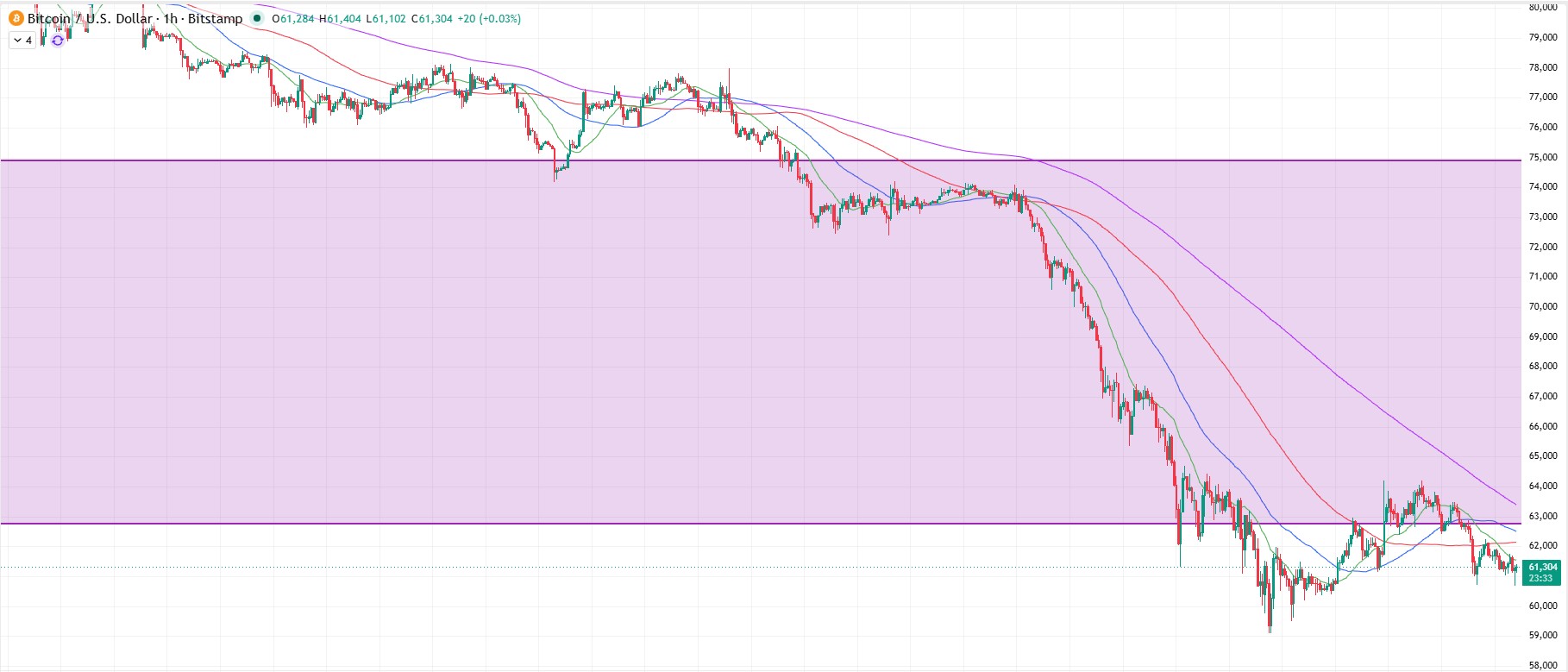
Bitcoin continues to trade under pressure in early June following a sharp correction that pushed prices to their lowest levels in months. The cryptocurrency is currently trading around $60,000–62,000, reflecting a combination of negative factors ranging from declining institutional demand to increased selling activity from large holders.
ETFs continue to lose capital
One of the key drivers behind the decline remains the ongoing outflows from U.S. spot Bitcoin ETFs. After attracting record inflows in previous periods, the funds have recently experienced a series of substantial withdrawals, signaling cooling interest from institutional investors. The pressure is being reinforced by persistent uncertainty surrounding Federal Reserve monetary policy and a broader decline in risk appetite across financial markets.
Market participants note that institutional demand has been one of the primary drivers of Bitcoin's growth during recent market cycles. Any weakening of this demand inevitably affects the balance between supply and demand.
Long-term investors take profits
Additional pressure is coming from long-term holders. After months of accumulation, some investors have begun reducing their positions, using periods of price recovery to lock in profits. The increase in supply has coincided with weaker inflows of new capital, amplifying the ongoing correction.
On-chain metrics indicate a noticeable increase in the volume of coins being transferred to exchanges from wallets associated with long-term holders, which is traditionally viewed as a signal of potential selling pressure ahead.
Market tests key support level
From a technical perspective, Bitcoin has approached one of the most important support zones of the current cycle. Market participants are closely watching the area around the long-term 200-week moving average, which has historically served as a dividing line between correction phases and recovery periods.
As long as the price remains below the $64,000–66,000 range, the risk of another test of the $60,000 level remains elevated. A loss of this support could trigger further downside and increase pressure across the broader cryptocurrency market.
What could change the outlook
Despite the prevailing bearish sentiment, analysts do not rule out the possibility of a local bottom forming if institutional flows stabilize. For a more constructive scenario to emerge, the market will need to see renewed inflows into Bitcoin ETFs, reduced selling activity from large holders, and a sustained move above nearby technical resistance levels.
For now, market participants remain cautious. In the short term, the key factor will be not the long-term valuation outlook for Bitcoin, but whether buyers can defend critical support levels and halt the outflow of capital from cryptocurrency-related investment products.
Near-term outlook
The current correction serves as another reminder of the cryptocurrency market's high sensitivity to changes in liquidity conditions and investor sentiment. In the coming weeks, investors will focus on ETF flow dynamics, the actions of major holders, and signals from the global economy. These factors will determine whether the current decline develops into a full-fledged bear market or proves to be another consolidation phase before a recovery.
For now, as I previously noted in Bitcoin remains under pressure amid record capital outflows, the risks of a decline below $60,000 remain elevated, while a breakout above the $64,000 resistance level would likely pave the way for a continuation of the current recovery rally.








-
 Afghanistan
-
 Albania
-
 Algeria
-
 Angola
-
 Argentina
-
 Armenia
-
 Australia
-
 Austria
-
 Azerbaijan
-
 Bahamas
-
 Bahrain
-
 Bangladesh
-
 Belarus
-
 Belgium
-
 Bolivia
-
 Botswana
-
 Brazil
-
 Brunei
-
 Bulgaria
-
 Cambodia
-
 Cameroon
-
 Canada
-
 Chile
Chile
-
 China
China
-
 Colombia
-
 Congo
Congo
-
 Costa Rica
-
 Cote d'Ivoire
-
 Croatia
-
 Cuba
Cuba
-
 Cyprus
-
 Czechia
-
 DR Congo
-
 Denmark
-
 Dominican Republic
-
 Ecuador
-
 Egypt
Egypt
-
 El Salvador
-
 Estonia
-
 Eswatini
-
 Ethiopia
-
 Finland
-
 France
-
 Georgia
-
 Germany
-
 Ghana
Ghana
-
 Greece
-
 Haiti
Haiti
-
 Hong Kong
-
 Hungary
-
 India
India
-
 Indonesia
-
 Iran, Islamic republic
-
 Iraq
Iraq
-
 Ireland
-
 Israel
-
 Italy
Italy
-
 Jamaica
-
 Japan
Japan
-
 Jordan
-
 Kazakhstan
-
 Kenya
Kenya
-
 Korea
Korea
-
 Kuwait
-
 Kyrgyzstan
-
 Laos
Laos
-
 Latvia
-
 Lebanon
-
 Lesotho
-
 Libya
Libya
-
 Lithuania
-
 Luxembourg
-
 Madagascar
-
 Malaysia
-
 Malta
Malta
-
 Mauritius
-
 Mexico
-
 Moldova
-
 Mongolia
-
 Montenegro
-
 Morocco
-
 Mozambique
-
 Myanmar
-
 Namibia
-
 Nepal
Nepal
-
 Netherlands
-
 New Zealand
-
 Nigeria
-
 North Macedonia
-
 Norway
-
 Oman
Oman
-
 Pakistan
-
 Palestine
-
 Panama
-
 Papua New Guinea
-
 Paraguay
-
 Peru
Peru
-
 Philippines
-
 Poland
-
 Portugal
-
 Puerto Rico
-
 Qatar
Qatar
-
 Reunion
-
 Romania
-
 Rwanda
-
 Saudi Arabia
-
 Serbia
-
 Singapore
-
 Slovakia
-
 Slovenia
-
 Somalia
-
 South Africa
-
 Spain
Spain
-
 Sri Lanka
-
 Sweden
-
 Switzerland
-
 Syria
Syria
-
 Taiwan
-
 Tajikistan
-
 Tanzania
-
 Thailand
-
 Trinidad and Tobago
-
 Tunisia
-
 Turkey
-
 UAE
UAE
-
 Uganda
-
 Ukraine
-
 United Kingdom
-
United States
-
 Uruguay
-
 Uzbekistan
-
 Venezuela
-
 Vietnam
-
 Yemen
Yemen
-
 Zambia
-
 Zimbabwe
- Forex
- Crypto











