

Bitcoin continues to trade under pressure following the sharp decline seen in June. The primary drivers behind the sell-off have been record outflows from spot Bitcoin ETFs, liquidations of overheated long positions, and investor caution ahead of upcoming Federal Reserve decisions.
Over the past several weeks, institutional funds have recorded their largest streak of ETF outflows since the products were launched, significantly weakening demand from major market participants.
Despite several attempts to recover, the market has yet to show convincing signs of a sustainable reversal. Bitcoin recently rebounded toward the $66,000–$67,000 area amid improving global risk sentiment and easing geopolitical tensions. However, buyers have so far failed to regain full control of the trend.
What the chart shows
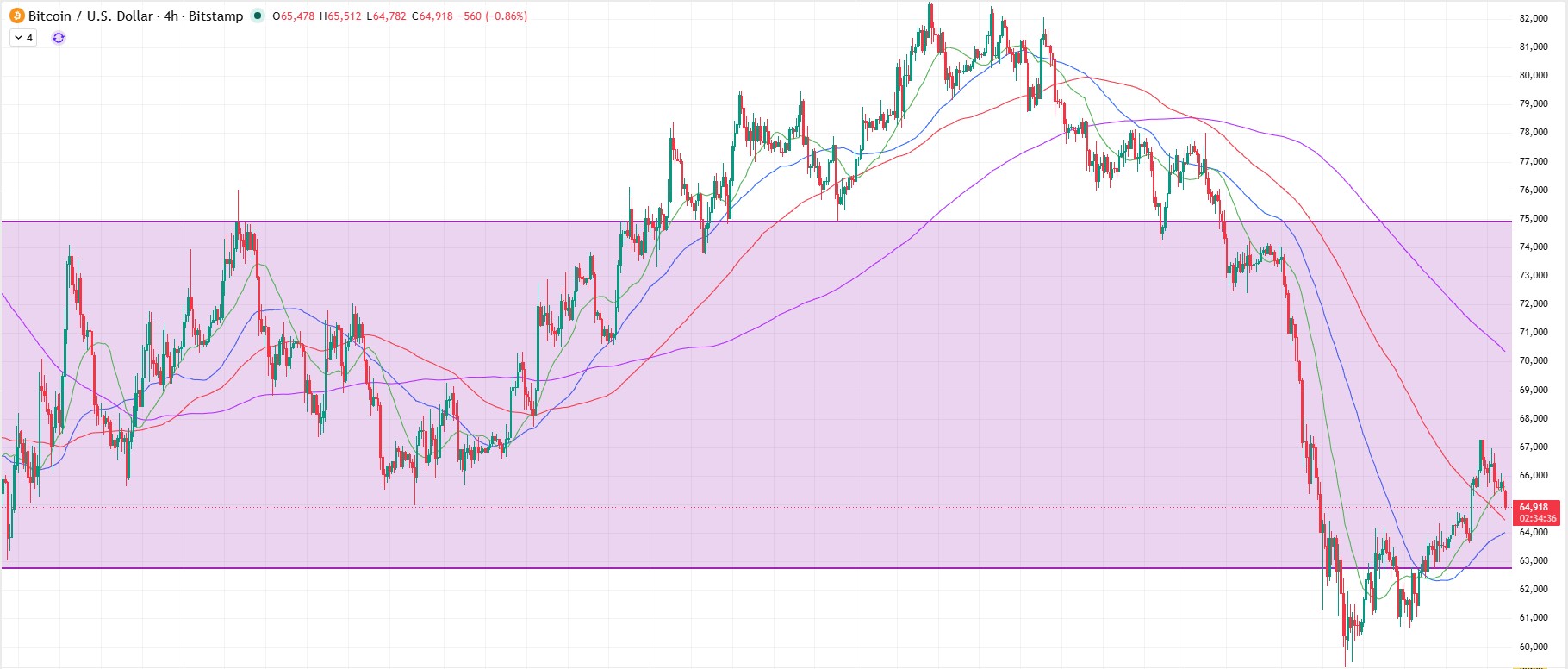
From a technical perspective, the outlook remains neutral to bearish. On the 4-hour chart, Bitcoin continues to trade within a broad support zone between $63,000 and $75,000. Following the sharp breakdown below $70,000, the market established a local bottom around $60,000–$61,000, triggering a relief rally.
However, with the price currently hovering around $65,000, Bitcoin remains below several key moving averages, while the $66,500–$68,000 area continues to act as immediate resistance. Until BTC secures a sustained breakout above this zone, any recovery is likely to be viewed as a corrective rebound within a broader downtrend. On the downside, the $63,000–$64,000 range remains the key support area, and a breakdown below it could reopen the path toward the June lows near $60,000–$61,000.
Key factors to watch
In the coming weeks, investors will be closely monitoring Bitcoin ETF flows and any signals from the Federal Reserve regarding future monetary policy. A return of consistent inflows into spot Bitcoin ETFs could become the main catalyst for renewed demand and improved market sentiment.
Another supportive factor would be a reduction in macroeconomic uncertainty and easing concerns over interest rates. For now, however, the market remains in a consolidation phase following a significant correction, with elevated volatility expected within the $63,000–$68,000 range.
Conclusion
The medium-term market structure has deteriorated noticeably compared to the highs above $80,000 recorded in May. Nevertheless, as long as the $60,000–$63,000 support zone remains intact, the current move can still be viewed as a deep correction rather than the end of the broader bullish cycle.
For a more convincing recovery to develop, Bitcoin needs to reclaim and hold the $68,000–$70,000 area — a scenario I previously discussed in the article Bitcoin remains below $67,250 as downside risks persist. Conversely, a loss of support at $63,000 would significantly increase the risk of a renewed decline toward the June lows.


Latest Bitcoin News






-
 Afghanistan
-
 Albania
-
 Algeria
-
 Angola
-
 Argentina
-
 Armenia
-
 Australia
-
 Austria
-
 Azerbaijan
-
 Bahamas
-
 Bahrain
-
 Bangladesh
-
 Belarus
-
 Belgium
-
 Bolivia
-
 Botswana
-
 Brazil
-
 Brunei
-
 Bulgaria
-
 Cambodia
-
 Cameroon
-
 Canada
-
 Chile
Chile
-
 China
China
-
 Colombia
-
 Congo
Congo
-
 Costa Rica
-
 Cote d'Ivoire
-
 Croatia
-
 Cuba
Cuba
-
 Cyprus
-
 Czechia
-
 DR Congo
-
 Denmark
-
 Dominican Republic
-
 Ecuador
-
 Egypt
Egypt
-
 El Salvador
-
 Estonia
-
 Eswatini
-
 Ethiopia
-
 Finland
-
 France
-
 Georgia
-
 Germany
-
 Ghana
Ghana
-
 Greece
-
 Haiti
Haiti
-
 Hong Kong
-
 Hungary
-
 India
India
-
 Indonesia
-
 Iran, Islamic republic
-
 Iraq
Iraq
-
 Ireland
-
 Israel
-
 Italy
Italy
-
 Jamaica
-
 Japan
Japan
-
 Jordan
-
 Kazakhstan
-
 Kenya
Kenya
-
 Korea
Korea
-
 Kuwait
-
 Kyrgyzstan
-
 Laos
Laos
-
 Latvia
-
 Lebanon
-
 Lesotho
-
 Libya
Libya
-
 Lithuania
-
 Luxembourg
-
 Madagascar
-
 Malaysia
-
 Malta
Malta
-
 Mauritius
-
 Mexico
-
 Moldova
-
 Mongolia
-
 Montenegro
-
 Morocco
-
 Mozambique
-
 Myanmar
-
 Namibia
-
 Nepal
Nepal
-
 Netherlands
-
 New Zealand
-
 Nigeria
-
 North Macedonia
-
 Norway
-
 Oman
Oman
-
 Pakistan
-
 Palestine
-
 Panama
-
 Papua New Guinea
-
 Paraguay
-
 Peru
Peru
-
 Philippines
-
 Poland
-
 Portugal
-
 Puerto Rico
-
 Qatar
Qatar
-
 Reunion
-
 Romania
-
 Rwanda
-
 Saudi Arabia
-
 Serbia
-
 Singapore
-
 Slovakia
-
 Slovenia
-
 Somalia
-
 South Africa
-
 Spain
Spain
-
 Sri Lanka
-
 Sweden
-
 Switzerland
-
 Syria
Syria
-
 Taiwan
-
 Tajikistan
-
 Tanzania
-
 Thailand
-
 Trinidad and Tobago
-
 Tunisia
-
 Turkey
-
 UAE
UAE
-
 Uganda
-
 Ukraine
-
 United Kingdom
-
United States
-
 Uruguay
-
 Uzbekistan
-
 Venezuela
-
 Vietnam
-
 Yemen
Yemen
-
 Zambia
-
 Zimbabwe
- Forex
- Crypto











