
Pyth drops 7.56% as sellers drive price near $0.0354 support

Pyth (PYTH) is trading at $0.0367, down 7.56% for the day. The asset sits below its key moving averages, highlighting short-term technical weakness.
 0.0505
0.0524
0.0505
0.0524
Highlights
- Pyth Network introduced Pyth Pro on Cardano, delivering millisecond-level price feeds from 125+ institutions to Cardano-based projects.
- Indigo Protocol became the first adopter of Pyth Pro, while support from the Cardano Foundation and Intersect is accelerating ecosystem integration.
- PYTH/USD remains in a bearish trend, trading below major moving averages with an 80% probability of further decline toward the $0.0354–$0.0420 range.
Ecosystem expansion on Cardano as developer adoption grows
Pyth Network has launched Pyth Pro on Cardano, introducing millisecond-level price feeds sourced from over 125 institutions and providing enhanced data capabilities within the Cardano ecosystem. The rollout enables Cardano-based projects to freely request API keys, streamlining integration with Pyth’s data services and improving accessibility for developers. Initial adoption was recorded as Indigo Protocol became the first project to leverage this feature, while technical collaboration from both the Cardano Foundation and Intersect has added further support to the initiative. These developments reflect Pyth’s ongoing ecosystem expansion, though price action has remained under broader selling pressure.
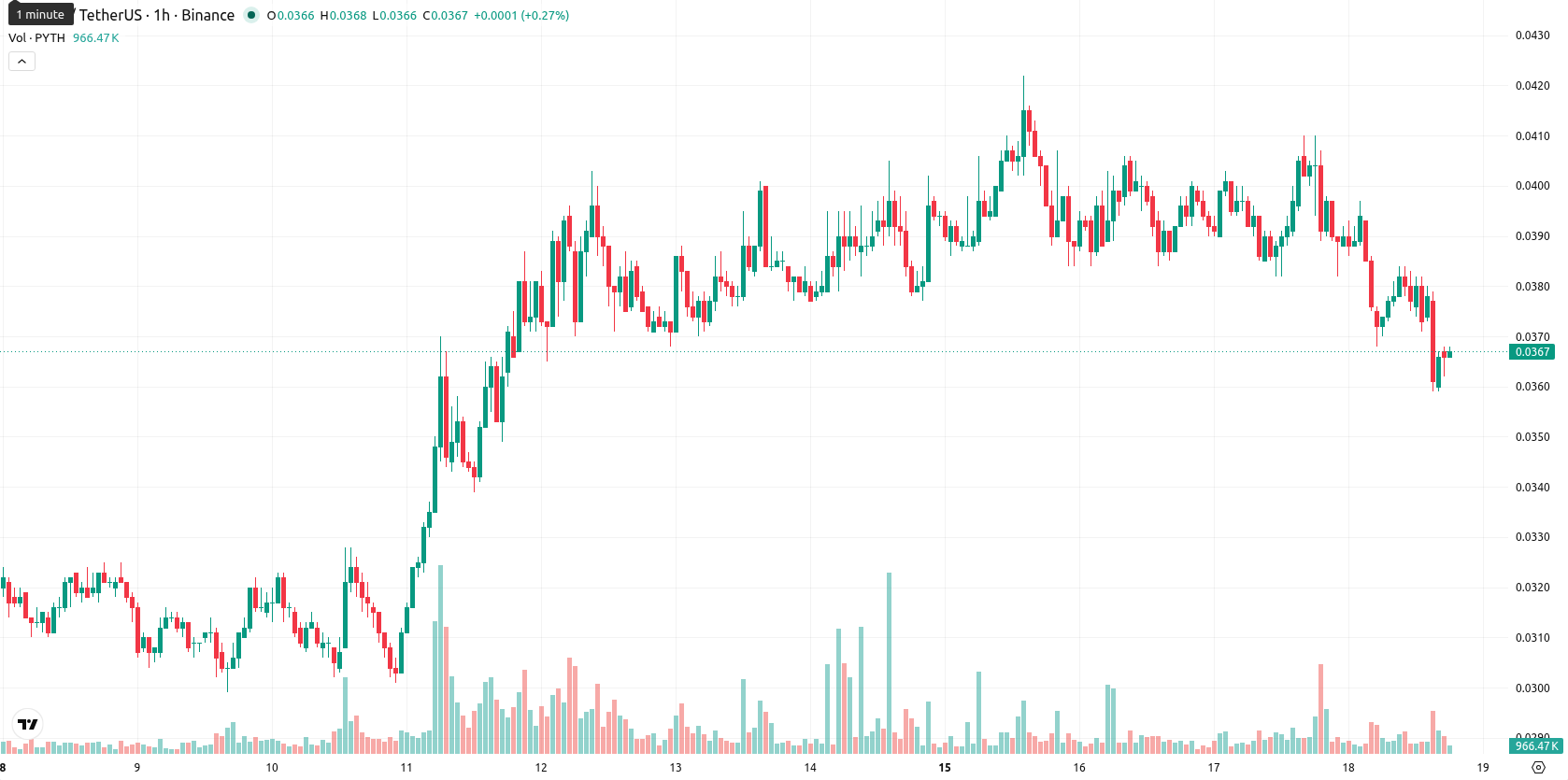
Persistent negative momentum as resistance limits rebounds
PYTH/USD is positioned below key technical markers on the working timeframe, with MA-20 at $0.0379, MA-50 at $0.0388, and MA-200 at $0.0510. The Ichimoku Kijun currently sits at $0.0385, establishing immediate resistance for intraday rebounds. Among oscillators, the MACD signals Sell, ADX is Neutral, and the RSI resides at 38, which is considered a Sell reading. The CCI indicates oversold conditions, while the Stoch RSI is Neutral. BBP also presents a Sell signal, with the Awesome Oscillator supporting ongoing negative momentum.
Range-bound trading favored as breakout risk remains low
Over the next 2–3 trading days, PYTH/USD is expected to trade within a volatility band of $0.0354 to $0.0420. The probability of an upward breakout above the $0.0385 resistance remains very low, estimated at less than 20%. The dominant scenario is continued consolidation within this range. Should price fall below the $0.0354 support region, the risk of further downside would increase substantially.
Previously it was reported that Pyth was experiencing persistent selling pressure and a generally bearish outlook. With the technical and sentiment landscape still skewed negative despite recent ecosystem developments, traders should closely monitor the $0.0354 support zone, as a breakdown below this level could trigger a deeper pullback in the coming sessions.









-
 Afghanistan
-
 Albania
-
 Algeria
-
 Angola
-
 Argentina
-
 Armenia
-
 Australia
-
 Austria
-
 Azerbaijan
-
 Bahamas
-
 Bahrain
-
 Bangladesh
-
 Belarus
-
 Belgium
-
 Bolivia
-
 Botswana
-
 Brazil
-
 Brunei
-
 Bulgaria
-
 Cambodia
-
 Cameroon
-
 Canada
-
 Chile
Chile
-
 China
China
-
 Colombia
-
 Congo
Congo
-
 Costa Rica
-
 Cote d'Ivoire
-
 Croatia
-
 Cuba
Cuba
-
 Cyprus
-
 Czechia
-
 DR Congo
-
 Denmark
-
 Dominican Republic
-
 Ecuador
-
 Egypt
Egypt
-
 El Salvador
-
 Estonia
-
 Eswatini
-
 Ethiopia
-
 Finland
-
 France
-
 Georgia
-
 Germany
-
 Ghana
Ghana
-
 Greece
-
 Haiti
Haiti
-
 Hong Kong
-
 Hungary
-
 India
India
-
 Indonesia
-
 Iran, Islamic republic
-
 Iraq
Iraq
-
 Ireland
-
 Israel
-
 Italy
Italy
-
 Jamaica
-
 Japan
Japan
-
 Jordan
-
 Kazakhstan
-
 Kenya
Kenya
-
 Korea
Korea
-
 Kuwait
-
 Kyrgyzstan
-
 Laos
Laos
-
 Latvia
-
 Lebanon
-
 Lesotho
-
 Libya
Libya
-
 Lithuania
-
 Luxembourg
-
 Madagascar
-
 Malaysia
-
 Malta
Malta
-
 Mauritius
-
 Mexico
-
 Moldova
-
 Mongolia
-
 Montenegro
-
 Morocco
-
 Mozambique
-
 Myanmar
-
 Namibia
-
 Nepal
Nepal
-
 Netherlands
-
 New Zealand
-
 Nigeria
-
 North Macedonia
-
 Norway
-
 Oman
Oman
-
 Pakistan
-
 Palestine
-
 Panama
-
 Papua New Guinea
-
 Paraguay
-
 Peru
Peru
-
 Philippines
-
 Poland
-
 Portugal
-
 Puerto Rico
-
 Qatar
Qatar
-
 Reunion
-
 Romania
-
 Rwanda
-
 Saudi Arabia
-
 Serbia
-
 Singapore
-
 Slovakia
-
 Slovenia
-
 Somalia
-
 South Africa
-
 Spain
Spain
-
 Sri Lanka
-
 Sweden
-
 Switzerland
-
 Syria
Syria
-
 Taiwan
-
 Tajikistan
-
 Tanzania
-
 Thailand
-
 Trinidad and Tobago
-
 Tunisia
-
 Turkey
-
 UAE
UAE
-
 Uganda
-
 Ukraine
-
 United Kingdom
-
United States
-
 Uruguay
-
 Uzbekistan
-
 Venezuela
-
 Vietnam
-
 Yemen
Yemen
-
 Zambia
-
 Zimbabwe
- Forex
- Crypto











