

Rocket Pool technical analysis: Rebound targets $1.5762 resistance

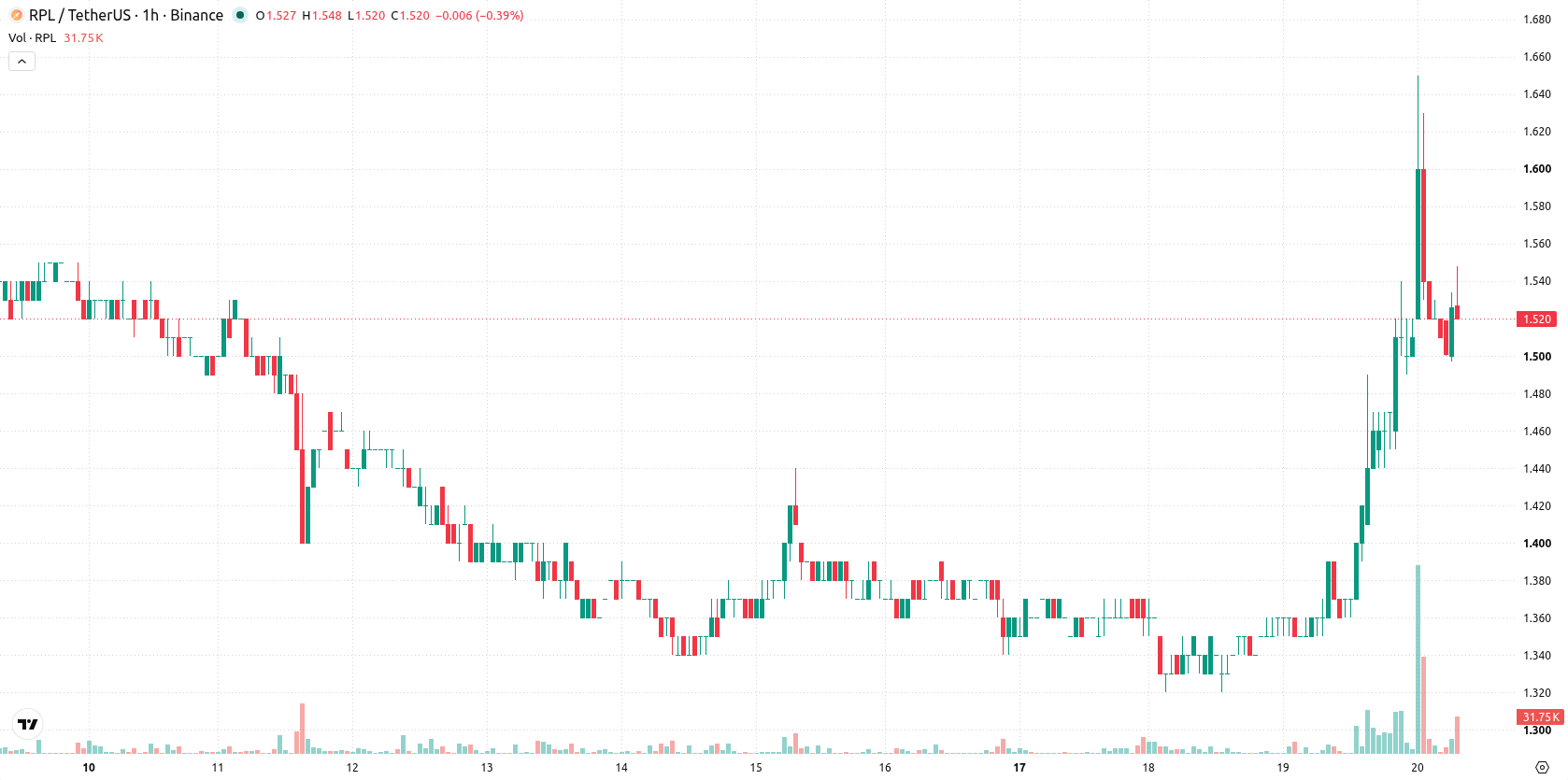
Rocket Pool (RPL) is trading at $1.527, having risen 13.11% on the day. The asset is currently positioned above its short- and medium-term moving averages, while remaining below the long-term trend gauge.
 1.487
1.5410
Highlights
- RPL/USD trades with short- and medium-term bullish momentum but remains below long-term resistance, indicating persistent selling pressure.
- Momentum indicators show strong buy signals but divergence in oscillators suggests the current breakout may face exhaustion.
- Expected price range for RPL/USD in the next 2 to 3 days is $1.4778 to $1.5762, with immediate support at $1.5.
Momentum split as bullish signals clash with overbought risks
Technically, RPL is trading above its MA-20 and MA-50 levels but remains below the MA-200, illustrating short- and medium-term strength while longer-term sellers remain active. Key support is defined by the Ichimoku Kijun at $1.5. Momentum indicators paint a mixed picture: MACD and ADX both signal bullish momentum, with RSI and CCI also in buy territory, but the Stoch RSI is oversold, implying possible short-term exhaustion. Bull/Bear Power shows a strong presence from buyers, while the Awesome Oscillator is neutral and does not confirm the trend. The divergence between buy signals and oversold oscillator readings suggests caution despite intraday strength.
Bullish breakout risk as tight range dominates outlook
In the near term, RPL is expected to trade within a range of $1.4778 to $1.5762 over the next 2–3 trading days. The probability of an upward move is classified as very high, while the likelihood of a decline is low. Baseline scenario anticipates sideways movement within this volatility band. A decisive break above $1.5762 would trigger a bullish scenario, whereas a fall below the immediate Kijun support at $1.5 could lead to additional selling.
Earlier, analysts noted that Rocket Pool was facing persistent technical resistance and weak momentum, which limited its upside potential despite signs of a short-term rebound. The current analysis indicates an improvement in short- and medium-term technical strength but highlights that sustained gains depend on a decisive move above the established resistance band.











-
 Afghanistan
-
 Albania
-
 Algeria
-
 Angola
-
 Argentina
-
 Armenia
-
 Australia
-
 Austria
-
 Azerbaijan
-
 Bahamas
-
 Bahrain
-
 Bangladesh
-
 Belarus
-
 Belgium
-
 Bolivia
-
 Botswana
-
 Brazil
-
 Brunei
-
 Bulgaria
-
 Cambodia
-
 Cameroon
-
 Canada
-
 Chile
-
 China
-
 Colombia
-
 Congo
-
 Costa Rica
-
 Cote d'Ivoire
-
 Croatia
-
 Cuba
-
 Cyprus
-
 Czechia
-
 DR Congo
-
 Denmark
-
 Dominican Republic
-
 Ecuador
-
 Egypt
-
 El Salvador
-
 Estonia
-
 Eswatini
-
 Ethiopia
-
 Finland
-
 France
-
 Georgia
-
 Germany
-
 Ghana
-
 Greece
-
 Haiti
-
 Hong Kong
-
 Hungary
-
 India
-
 Indonesia
-
 Iran, Islamic republic
-
 Iraq
-
 Ireland
-
 Israel
-
 Italy
-
 Jamaica
-
 Japan
-
 Jordan
-
 Kazakhstan
-
 Kenya
-
 Korea
-
 Kuwait
-
 Kyrgyzstan
-
 Laos
-
 Latvia
-
 Lebanon
-
 Lesotho
-
 Libya
-
 Lithuania
-
 Luxembourg
-
 Madagascar
-
 Malaysia
-
 Malta
-
 Mauritius
-
 Mexico
-
 Moldova
-
 Mongolia
-
 Montenegro
-
 Morocco
-
 Mozambique
-
 Myanmar
-
 Namibia
-
 Nepal
-
 Netherlands
-
 New Zealand
-
 Nigeria
-
 North Macedonia
-
 Norway
-
 Oman
-
 Pakistan
-
 Palestine
-
 Panama
-
 Papua New Guinea
-
 Paraguay
-
 Peru
-
 Philippines
-
 Poland
-
 Portugal
-
 Puerto Rico
-
 Qatar
-
 Reunion
-
 Romania
-
 Rwanda
-
 Saudi Arabia
-
 Serbia
-
 Singapore
-
 Slovakia
-
 Slovenia
-
 Somalia
-
 South Africa
-
 Spain
-
 Sri Lanka
-
 Sweden
-
 Switzerland
-
 Syria
-
 Taiwan
-
 Tajikistan
-
 Tanzania
-
 Thailand
-
 Trinidad and Tobago
-
 Tunisia
-
 Turkey
-
 UAE
-
 Uganda
-
 Ukraine
-
 United Kingdom
-
United States
-
 Uruguay
-
 Uzbekistan
-
 Venezuela
-
 Vietnam
-
 Yemen
-
 Zambia
-
 Zimbabwe
- Forex
- Crypto












