

Will Fetch.ai avoid deeper losses amid dominant bearish momentum?

Fetch.ai (FET) is trading at $0.134, down 8.91% for the day. The price remains below its key moving averages, indicating pressure across multiple timeframes.
 0.1492
0.1544
Highlights
- FET/USD trades below all key moving averages, indicating strong control by sellers across all timeframes.
- Multiple technical indicators remain in oversold territory with negative momentum and a highly volatile session near intraday lows.
- Forecast range for the next 2 to 3 days is $0.1275 to $0.1385, with a high probability of further downside unless price reclaims $0.1439.
Oversold signals and technical barriers reinforce downside pressure
Below $0.1433 (MA-20), $0.1451 (MA-50), and $0.1828 (MA-200), FET/USD shows strong technical resistance. The Ichimoku Kijun at $0.1439 remains a clear upside hurdle, while the current session is tracking close to the day's low. MACD and ADX indicate an ongoing selling environment. RSI stands deeply oversold at 28.70, Stoch RSI is at 0, and CCI prints -121.69, confirming downside extremes. Bull/Bear Power at -0.0023 and the Awesome Oscillator both reinforce dominant bearish momentum. All signals point to sustained downside with no immediate reversal flagged.
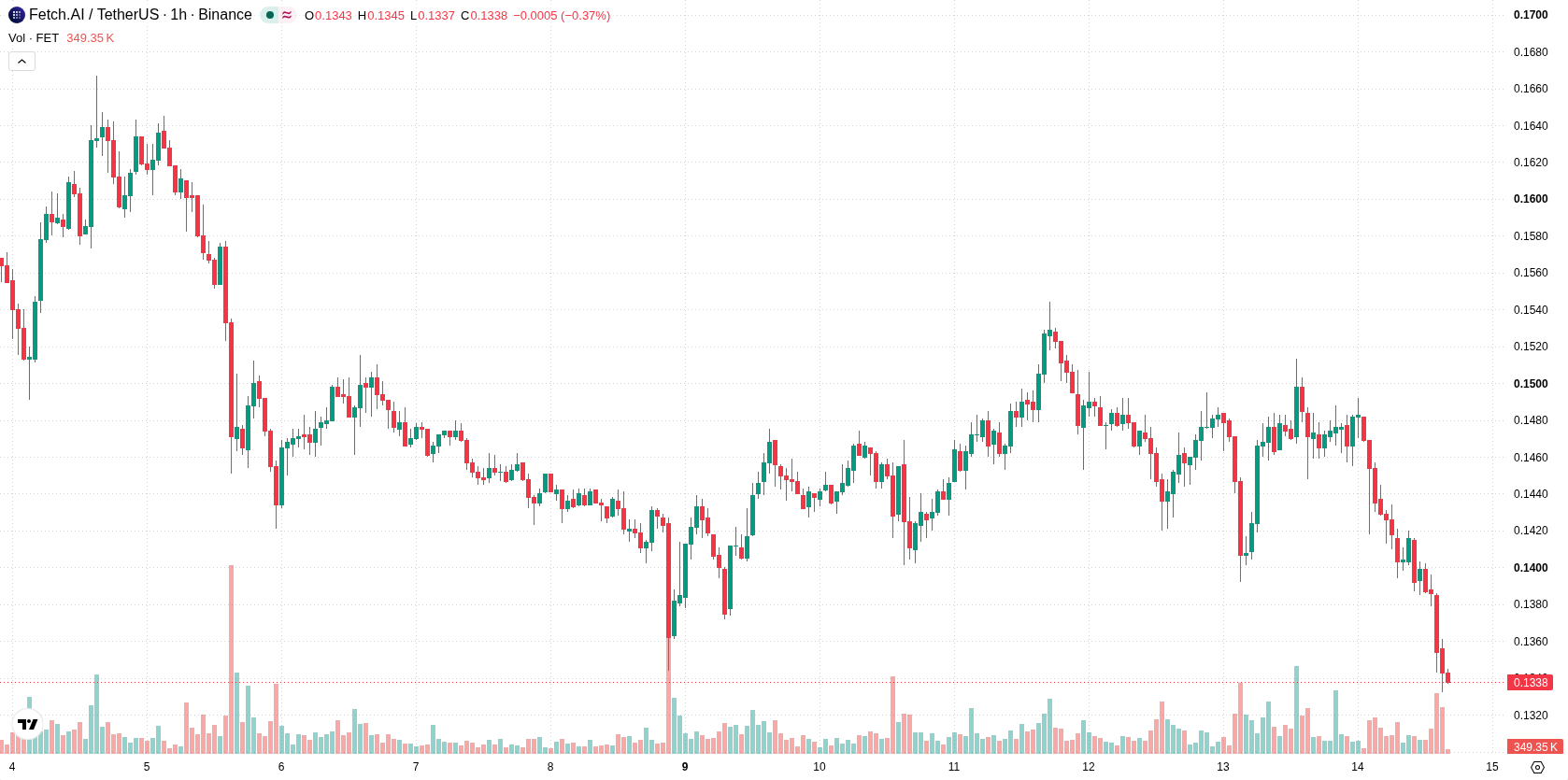
Continued losses likely as bearish momentum curbs rebound potential
Over the next 2–3 trading days, FET/USD is expected to trade between $0.1275 and $0.1385, reflecting the lower band of its recent volatility range. The probability of an upward move remains very low, while chances of continued downside are high. A short-term bounce is unlikely given prevailing momentum. Should FET/USD break and maintain levels above $0.1439, a bullish scenario could emerge, while a drop below $0.1275 would confirm further downside potential.
Previously it was reported that renewed upward momentum and alliance-driven demand had positioned Fetch.ai for potential consolidation above key support. However, with all major indicators now signaling persistent bearish pressure, the prevailing scenario is further downside risk, making a potential break below $0.1275 the primary level to monitor in the coming sessions.










-
 Afghanistan
-
 Albania
-
 Algeria
-
 Angola
-
 Argentina
-
 Armenia
-
 Australia
-
 Austria
-
 Azerbaijan
-
 Bahamas
-
 Bahrain
-
 Bangladesh
-
 Belarus
-
 Belgium
-
 Bolivia
-
 Botswana
-
 Brazil
-
 Brunei
-
 Bulgaria
-
 Cambodia
-
 Cameroon
-
 Canada
-
 Chile
-
 China
-
 Colombia
-
 Congo
-
 Costa Rica
-
 Cote d'Ivoire
-
 Croatia
-
 Cuba
-
 Cyprus
-
 Czechia
-
 DR Congo
-
 Denmark
-
 Dominican Republic
-
 Ecuador
-
 Egypt
-
 El Salvador
-
 Estonia
-
 Eswatini
-
 Ethiopia
-
 Finland
-
 France
-
 Georgia
-
 Germany
-
 Ghana
-
 Greece
-
 Haiti
-
 Hong Kong
-
 Hungary
-
 India
-
 Indonesia
-
 Iran, Islamic republic
-
 Iraq
-
 Ireland
-
 Israel
-
 Italy
-
 Jamaica
-
 Japan
-
 Jordan
-
 Kazakhstan
-
 Kenya
-
 Korea
-
 Kuwait
-
 Kyrgyzstan
-
 Laos
-
 Latvia
-
 Lebanon
-
 Lesotho
-
 Libya
-
 Lithuania
-
 Luxembourg
-
 Madagascar
-
 Malaysia
-
 Malta
-
 Mauritius
-
 Mexico
-
 Moldova
-
 Mongolia
-
 Montenegro
-
 Morocco
-
 Mozambique
-
 Myanmar
-
 Namibia
-
 Nepal
-
 Netherlands
-
 New Zealand
-
 Nigeria
-
 North Macedonia
-
 Norway
-
 Oman
-
 Pakistan
-
 Palestine
-
 Panama
-
 Papua New Guinea
-
 Paraguay
-
 Peru
-
 Philippines
-
 Poland
-
 Portugal
-
 Puerto Rico
-
 Qatar
-
 Reunion
-
 Romania
-
 Rwanda
-
 Saudi Arabia
-
 Serbia
-
 Singapore
-
 Slovakia
-
 Slovenia
-
 Somalia
-
 South Africa
-
 Spain
-
 Sri Lanka
-
 Sweden
-
 Switzerland
-
 Syria
-
 Taiwan
-
 Tajikistan
-
 Tanzania
-
 Thailand
-
 Trinidad and Tobago
-
 Tunisia
-
 Turkey
-
 UAE
-
 Uganda
-
 Ukraine
-
 United Kingdom
-
United States
-
 Uruguay
-
 Uzbekistan
-
 Venezuela
-
 Vietnam
-
 Yemen
-
 Zambia
-
 Zimbabwe
- Forex
- Crypto












