

Ethereum slips as Fed official signals higher rates could limit liquidity

Ethereum (ETH) is trading lower at $1,812 as of November 15, 2026. Market sentiment is leaning cautious after recent statements pointing to continued policy tightening in the US. Traders are watching upcoming inflation data and Federal Reserve guidance for further signals on interest rate direction and its effects on crypto demand.
 1845.18
2160.50
Highlights
- Boston Fed President Susan Collins states higher US interest rates may be required to curb inflation, supporting a restrictive policy outlook.
- Elevated rates increase the opportunity cost of holding Ethereum, reducing institutional demand for non-yielding crypto assets.
- ETH trades below key moving averages with negative momentum signals on the 4-hour chart, facing resistance near $1,907 and lacking reversal signs.
Fed rate-hike risk weighs on Ethereum demand
According to Crypto, on November 13, 2026, Boston Fed President Susan Collins stated that higher interest rates may be needed to control inflation, adding to market expectations for ongoing restrictive monetary policy in the US.
This stance increases the opportunity cost of holding Ethereum and other non-yielding crypto assets, as higher rates boost the appeal of traditional interest-bearing investments and generally tighten overall liquidity. The risk context outlined by Collins suggests reduced institutional demand for ETH while the interest rate outlook remains restrictive.
No directly offsetting policy or macro developments were reported at the same time, so US central bank tone remains a key condition for short-term crypto appetite.
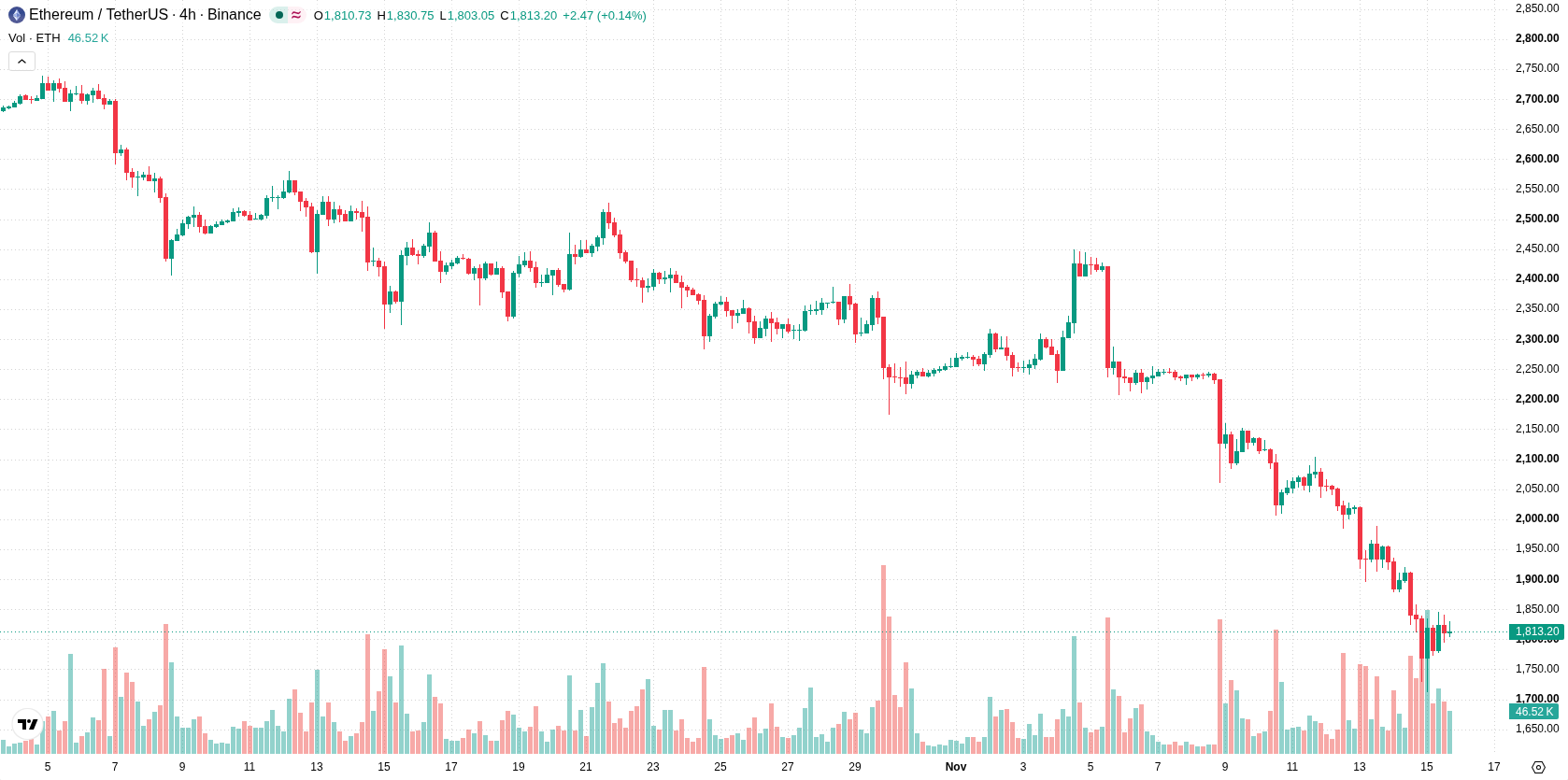
Downtrend persists below 4H moving averages and Kijun resistance
On the 4-hour chart, ETH remains positioned below its primary 50-period and 200-period SMA levels, indicating technical challenges under prevailing macro pressure. Momentum signals are negative, with both MACD and ADX supporting a continuation of the weak setup.
The Kijun on the 4H timeframe is acting as resistance around $1,907, adding to the technical headwinds. No signs of a reversal are present, and the price remains well beneath key moving averages.
US monetary policy and Kijun resistance direct the next move
As long as US monetary policy signals the possibility of further rate hikes, ETH may continue to face a cautious demand environment. A move above the 4H Kijun resistance around $1,907 would be the first sign of a potential shift in sentiment. Otherwise, macro risks remain the prevailing factor. Traders should monitor for changes in inflation data and any evolving policy language from Federal Reserve officials.
Earlier, analysts noted that persistent ETF outflows and ongoing macroeconomic risks were weighing heavily on Ethereum and the broader crypto market. The current environment reinforces these concerns, with restrictive US monetary policy and forthcoming inflation data remaining the primary factors to monitor for any shift in Ethereum demand.











-
 Afghanistan
-
 Albania
-
 Algeria
-
 Angola
-
 Argentina
-
 Armenia
-
 Australia
-
 Austria
-
 Azerbaijan
-
 Bahamas
-
 Bahrain
-
 Bangladesh
-
 Belarus
-
 Belgium
-
 Bolivia
-
 Botswana
-
 Brazil
-
 Brunei
-
 Bulgaria
-
 Cambodia
-
 Cameroon
-
 Canada
-
 Chile
-
 China
-
 Colombia
-
 Congo
-
 Costa Rica
-
 Cote d'Ivoire
-
 Croatia
-
 Cuba
-
 Cyprus
-
 Czechia
-
 DR Congo
-
 Denmark
-
 Dominican Republic
-
 Ecuador
-
 Egypt
-
 El Salvador
-
 Estonia
-
 Eswatini
-
 Ethiopia
-
 Finland
-
 France
-
 Georgia
-
 Germany
-
 Ghana
-
 Greece
-
 Haiti
-
 Hong Kong
-
 Hungary
-
 India
-
 Indonesia
-
 Iran, Islamic republic
-
 Iraq
-
 Ireland
-
 Israel
-
 Italy
-
 Jamaica
-
 Japan
-
 Jordan
-
 Kazakhstan
-
 Kenya
-
 Korea
-
 Kuwait
-
 Kyrgyzstan
-
 Laos
-
 Latvia
-
 Lebanon
-
 Lesotho
-
 Libya
-
 Lithuania
-
 Luxembourg
-
 Madagascar
-
 Malaysia
-
 Malta
-
 Mauritius
-
 Mexico
-
 Moldova
-
 Mongolia
-
 Montenegro
-
 Morocco
-
 Mozambique
-
 Myanmar
-
 Namibia
-
 Nepal
-
 Netherlands
-
 New Zealand
-
 Nigeria
-
 North Macedonia
-
 Norway
-
 Oman
-
 Pakistan
-
 Palestine
-
 Panama
-
 Papua New Guinea
-
 Paraguay
-
 Peru
-
 Philippines
-
 Poland
-
 Portugal
-
 Puerto Rico
-
 Qatar
-
 Reunion
-
 Romania
-
 Rwanda
-
 Saudi Arabia
-
 Serbia
-
 Singapore
-
 Slovakia
-
 Slovenia
-
 Somalia
-
 South Africa
-
 Spain
-
 Sri Lanka
-
 Sweden
-
 Switzerland
-
 Syria
-
 Taiwan
-
 Tajikistan
-
 Tanzania
-
 Thailand
-
 Trinidad and Tobago
-
 Tunisia
-
 Turkey
-
 UAE
-
 Uganda
-
 Ukraine
-
 United Kingdom
-
United States
-
 Uruguay
-
 Uzbekistan
-
 Venezuela
-
 Vietnam
-
 Yemen
-
 Zambia
-
 Zimbabwe
- Forex
- Crypto












