

Can ZEC withstand mounting ETF withdrawals amid fading institutional appetite?

Zcash (ZEC) is trading lower at $712.85 as of November 24, 2026, down 14.67% on the day. Recent institutional outflows have amplified selling pressure on ZEC, turning attention to continued liquidity withdrawals in the near term. Traders are watching if these ETF outflows persist into December, which could align with historic seasonal trends for further losses.
 791.07
971.32
Highlights
- Grayscale's spot Zcash ETF saw $61 million in net outflows so far in November 2026, indicating reduced institutional demand for ZEC.
- Seasonal data suggests that losses for ZEC in November are often followed by additional declines in December, with no conflicting catalysts present.
- ZEC continues to trade below key moving averages on the 4H chart as technical indicators maintain a bearish outlook and downside momentum.
Institutional ETF outflows drive downside risk for Zcash
According to Beincrypto, Grayscale's spot Zcash ETF recorded about $61 million in net outflows so far in November 2026. Historical data reported by the same source suggests that years when ZEC finishes November with losses are often followed by further declines in December.
These ETF outflows reflect diminished institutional demand and reduced access to large-scale liquidity, which directly increase sell-side pressure on ZEC. The withdrawal of funds from a major ETF often signals a waning appetite from larger players, raising the risk of further market weakness.
No significant conflicting catalysts are noted, making the institutional withdrawal from the ETF the primary risk context for ZEC at this time. Any continuation or acceleration of these outflows could reinforce the seasonal pattern of losses reported in previous years.
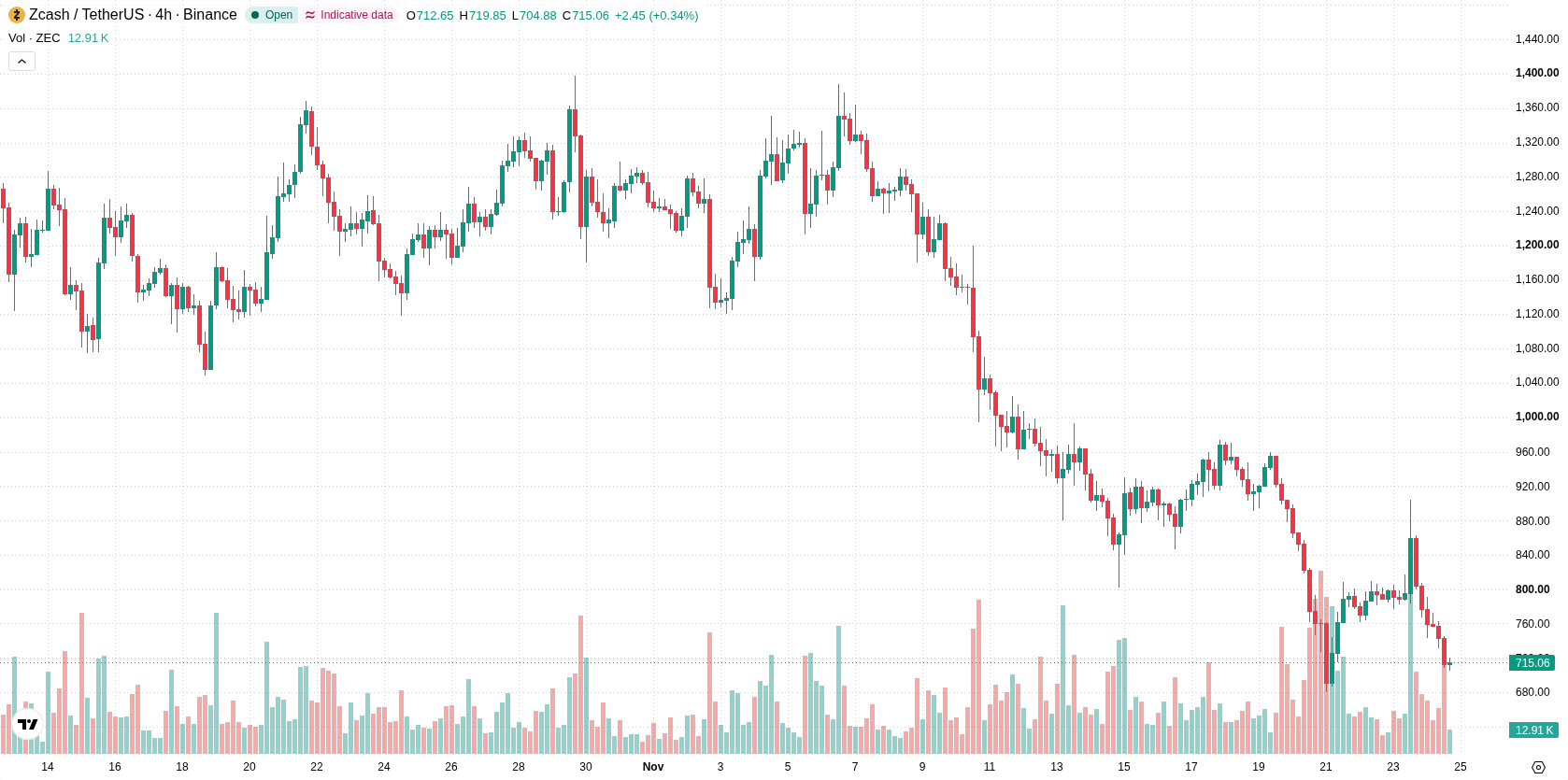
ZEC struggles as sell signals align with major moving averages
On the 4H chart, ZEC remains below the key H4 SMA-50 at $844.89 and the H4 SMA-200 at $1,092, reflecting ongoing bearish momentum. The H4 Kijun at $791.48 acts as resistance, limiting upward recovery attempts for now.
Bearish signals from both MACD and ADX indicate a lack of buying interest, reinforcing the sell-side bias set by institutional outflows. Short-term trend momentum also remains negative, with ZEC trading beneath all key moving averages on the 4H timeframe.
Decisive fund flows will shape the risk scenario into December
Sustained ETF outflows into December could reinforce the seasonal tendency for further losses, while stabilization above the H4 Kijun around $791 would be needed to reduce downside risk. Traders should monitor for any shift in fund flow trends that could break this risk context. Failure to regain momentum above resistance keeps ZEC vulnerable to further declines if liquidity outflows persist.
Previously it was reported that Zcash faced persistent selling pressure and a bearish technical outlook as leveraged ETF activity and network changes weighed on price action. The ongoing institutional withdrawals highlighted in the current article reinforce this downside scenario, with the next decisive move expected to depend on whether ETF outflows continue or subside in the weeks ahead.









-
 Afghanistan
-
 Albania
-
 Algeria
-
 Angola
-
 Argentina
-
 Armenia
-
 Australia
-
 Austria
-
 Azerbaijan
-
 Bahamas
-
 Bahrain
-
 Bangladesh
-
 Belarus
-
 Belgium
-
 Bolivia
-
 Botswana
-
 Brazil
-
 Brunei
-
 Bulgaria
-
 Cambodia
-
 Cameroon
-
 Canada
-
 Chile
-
 China
-
 Colombia
-
 Congo
-
 Costa Rica
-
 Cote d'Ivoire
-
 Croatia
-
 Cuba
-
 Cyprus
-
 Czechia
-
 DR Congo
-
 Denmark
-
 Dominican Republic
-
 Ecuador
-
 Egypt
-
 El Salvador
-
 Estonia
-
 Eswatini
-
 Ethiopia
-
 Finland
-
 France
-
 Georgia
-
 Germany
-
 Ghana
-
 Greece
-
 Haiti
-
 Hong Kong
-
 Hungary
-
 India
-
 Indonesia
-
 Iran, Islamic republic
-
 Iraq
-
 Ireland
-
 Israel
-
 Italy
-
 Jamaica
-
 Japan
-
 Jordan
-
 Kazakhstan
-
 Kenya
-
 Korea
-
 Kuwait
-
 Kyrgyzstan
-
 Laos
-
 Latvia
-
 Lebanon
-
 Lesotho
-
 Libya
-
 Lithuania
-
 Luxembourg
-
 Madagascar
-
 Malaysia
-
 Malta
-
 Mauritius
-
 Mexico
-
 Moldova
-
 Mongolia
-
 Montenegro
-
 Morocco
-
 Mozambique
-
 Myanmar
-
 Namibia
-
 Nepal
-
 Netherlands
-
 New Zealand
-
 Nigeria
-
 North Macedonia
-
 Norway
-
 Oman
-
 Pakistan
-
 Palestine
-
 Panama
-
 Papua New Guinea
-
 Paraguay
-
 Peru
-
 Philippines
-
 Poland
-
 Portugal
-
 Puerto Rico
-
 Qatar
-
 Reunion
-
 Romania
-
 Rwanda
-
 Saudi Arabia
-
 Serbia
-
 Singapore
-
 Slovakia
-
 Slovenia
-
 Somalia
-
 South Africa
-
 Spain
-
 Sri Lanka
-
 Sweden
-
 Switzerland
-
 Syria
-
 Taiwan
-
 Tajikistan
-
 Tanzania
-
 Thailand
-
 Trinidad and Tobago
-
 Tunisia
-
 Turkey
-
 UAE
-
 Uganda
-
 Ukraine
-
 United Kingdom
-
United States
-
 Uruguay
-
 Uzbekistan
-
 Venezuela
-
 Vietnam
-
 Yemen
-
 Zambia
-
 Zimbabwe
- Forex
- Crypto












