

Walrus falls further as seller pressure dominates the short-term trend

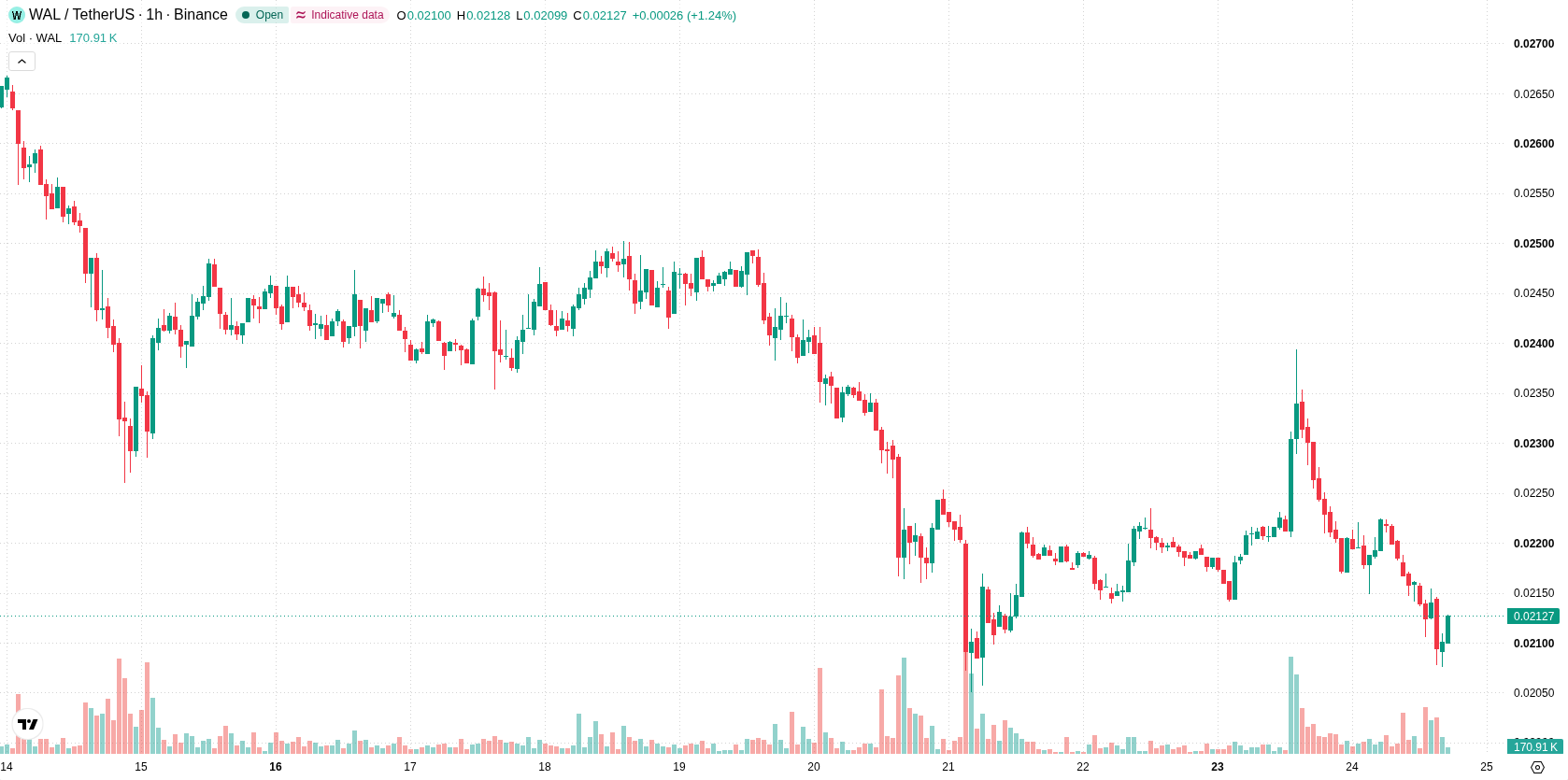
Walrus (WAL) is trading at $0.0213 after a daily decline of 6.92%. The asset currently sits below its key moving averages, reflecting ongoing seller control.
 0.0223
0.0250
Highlights
- WAL/USD trades below key short-, medium-, and long-term moving averages, signaling persistent seller control across all timeframes.
- Bearish momentum dominates as daily decline reaches 6.92 percent with high volatility and negative bull-bear power.
- Short-term range is projected between $0.0203 and $0.0223, with very low probability of reversal and downside risk remaining elevated.
Technical barriers hold as momentum and indicators point to bearish pressure
On the technical front, WAL/USD remains below the H1 SMA-20 at $0.0217, the H1 SMA-50 at $0.022, and significantly under the D1 SMA-200 at $0.0354. The Ichimoku Kijun level at $0.0221 sets the closest immediate resistance. Momentum indicators, including MACD, ADX, and the Awesome Oscillator, all reflect selling pressure, while RSI shows neutral conditions. Both Stoch RSI and CCI are in oversold territory, indicating potential for exhaustion in the recent selling, though this is not yet confirmed. Intraday, sellers maintain dominance, evidenced by a negative Bull/Bear Power reading of -0.0005 and price trading close to session lows.
Limited upside seen as volatility skews toward continued weakness
Looking ahead to the next two to three sessions, WAL/USD is expected to fluctuate between $0.0203 and $0.0223, reflecting the typical volatility band relative to current levels. The likelihood of an upward breakout is assessed as very low, while the probability of continued downside is high. The prevailing expectation is for sideways or lower trading unless price can reclaim resistance at $0.0221, whereas a loss of support at $0.0203 could accelerate further declines.
Earlier, analysts noted that Walrus remained under sustained bearish pressure, with technical signals pointing to continued downside risks. The latest data reinforce this negative outlook, making the $0.0203 support level critical to monitor for signs of further weakness or a potential shift in short-term momentum.










-
 Afghanistan
-
 Albania
-
 Algeria
-
 Angola
-
 Argentina
-
 Armenia
-
 Australia
-
 Austria
-
 Azerbaijan
-
 Bahamas
-
 Bahrain
-
 Bangladesh
-
 Belarus
-
 Belgium
-
 Bolivia
-
 Botswana
-
 Brazil
-
 Brunei
-
 Bulgaria
-
 Cambodia
-
 Cameroon
-
 Canada
-
 Chile
-
 China
-
 Colombia
-
 Congo
-
 Costa Rica
-
 Cote d'Ivoire
-
 Croatia
-
 Cuba
-
 Cyprus
-
 Czechia
-
 DR Congo
-
 Denmark
-
 Dominican Republic
-
 Ecuador
-
 Egypt
-
 El Salvador
-
 Estonia
-
 Eswatini
-
 Ethiopia
-
 Finland
-
 France
-
 Georgia
-
 Germany
-
 Ghana
-
 Greece
-
 Haiti
-
 Hong Kong
-
 Hungary
-
 India
-
 Indonesia
-
 Iran, Islamic republic
-
 Iraq
-
 Ireland
-
 Israel
-
 Italy
-
 Jamaica
-
 Japan
-
 Jordan
-
 Kazakhstan
-
 Kenya
-
 Korea
-
 Kuwait
-
 Kyrgyzstan
-
 Laos
-
 Latvia
-
 Lebanon
-
 Lesotho
-
 Libya
-
 Lithuania
-
 Luxembourg
-
 Madagascar
-
 Malaysia
-
 Malta
-
 Mauritius
-
 Mexico
-
 Moldova
-
 Mongolia
-
 Montenegro
-
 Morocco
-
 Mozambique
-
 Myanmar
-
 Namibia
-
 Nepal
-
 Netherlands
-
 New Zealand
-
 Nigeria
-
 North Macedonia
-
 Norway
-
 Oman
-
 Pakistan
-
 Palestine
-
 Panama
-
 Papua New Guinea
-
 Paraguay
-
 Peru
-
 Philippines
-
 Poland
-
 Portugal
-
 Puerto Rico
-
 Qatar
-
 Reunion
-
 Romania
-
 Rwanda
-
 Saudi Arabia
-
 Serbia
-
 Singapore
-
 Slovakia
-
 Slovenia
-
 Somalia
-
 South Africa
-
 Spain
-
 Sri Lanka
-
 Sweden
-
 Switzerland
-
 Syria
-
 Taiwan
-
 Tajikistan
-
 Tanzania
-
 Thailand
-
 Trinidad and Tobago
-
 Tunisia
-
 Turkey
-
 UAE
-
 Uganda
-
 Ukraine
-
 United Kingdom
-
United States
-
 Uruguay
-
 Uzbekistan
-
 Venezuela
-
 Vietnam
-
 Yemen
-
 Zambia
-
 Zimbabwe
- Forex
- Crypto












