

MOVE drops as sellers dominate and downside momentum strengthens

Movement (MOVE) is trading at $0.0053, down 7.63% on the day. The price is positioned below its key short- and long-term moving averages, reflecting sustained downward pressure.
 0.0059
0.00777
Highlights
- MOVE/USD trades below key short- and long-term moving averages, confirming sustained selling pressure and a bearish bias.
- Recent price action saw a 7.63% drop to $0.0053 with high volatility and selling dominating intraday moves.
- Technical indicators show downside momentum and a high probability of further declines, with a forecast range of $0.0046 to $0.006 for the next session.
Decisive seller control amid neutral momentum and breached supports
MOVE/USD remains below the H1 SMA-20 at $0.0056, H1 SMA-50 at $0.0058, and D1 SMA-200 at $0.0095. The Ichimoku Kijun at $0.0056 stands as immediate resistance. MACD maintains downside momentum, while ADX is neutral, indicating an unclear trend strength. Both RSI and CCI are in neutral zones, but Stochastic RSI has entered oversold territory, hinting at possible selling exhaustion. Bull/Bear Power is negative, consistent with intraday seller dominance, and the Awesome Oscillator supports strong selling activity. The price opened with a small gap lower and remains near today’s low amid heightened volatility.
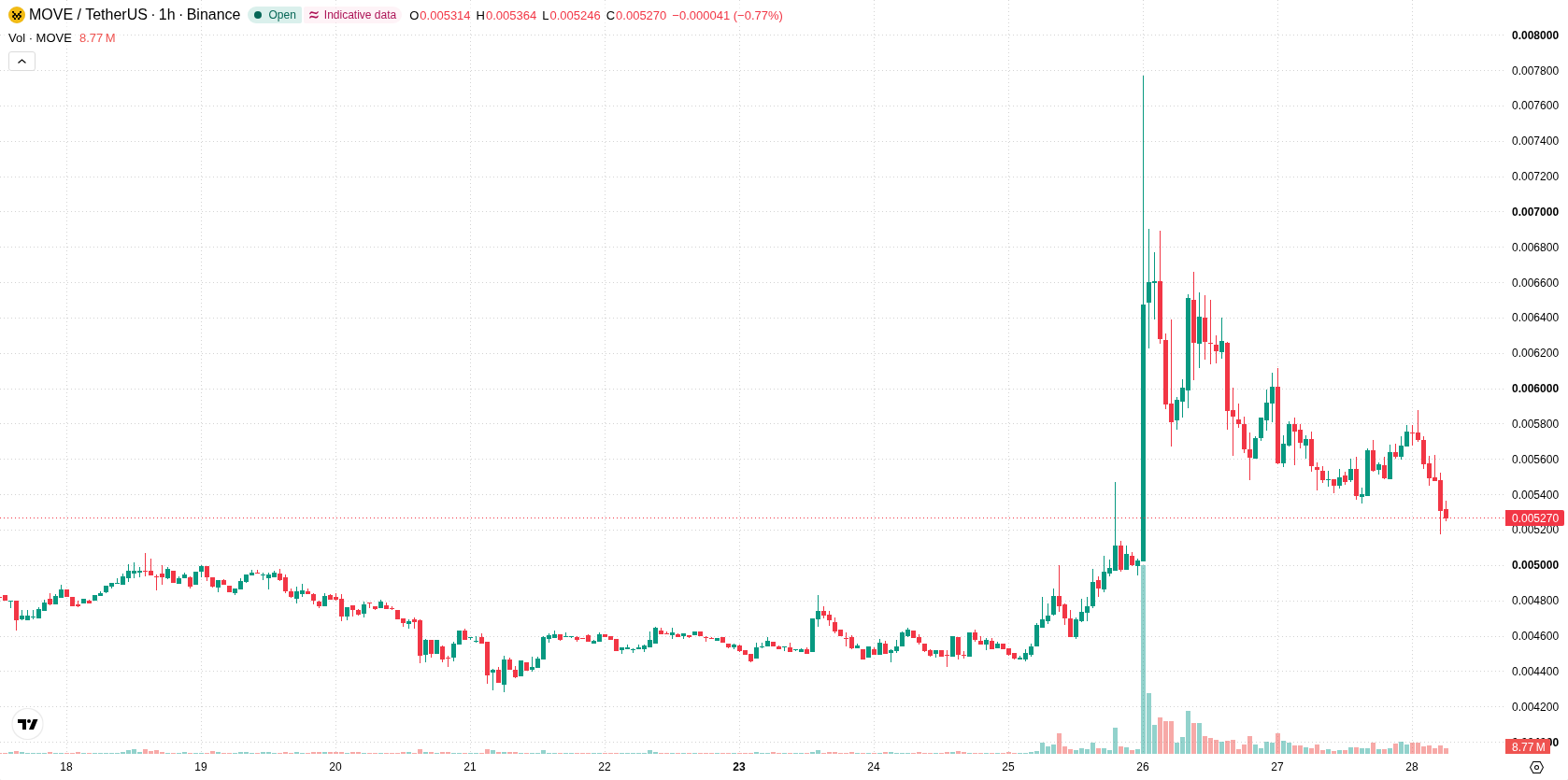
Bearish bias prevails unless resistance is overcome
For the next trading day, the projected MOVE/USD range is $0.0046 to $0.006, with a 25% probability of an upward move and a higher likelihood of continued downside. The baseline scenario is for price to hold within this range. A bullish outlook would require a decisive break above resistance at the Ichimoku Kijun, while a fall below support at $0.0046 would signal an extension of the bearish move.
Earlier, analysts noted that Movement (MOVE) was under consistent downside pressure, with technical barriers and volatility heightening the risk of continued weakness. Fresh technical readings affirm the bearish outlook, and traders should closely watch the $0.0046 support level, as a decisive breakdown could accelerate further declines.










-
 Afghanistan
-
 Albania
-
 Algeria
-
 Angola
-
 Argentina
-
 Armenia
-
 Australia
-
 Austria
-
 Azerbaijan
-
 Bahamas
-
 Bahrain
-
 Bangladesh
-
 Belarus
-
 Belgium
-
 Bolivia
-
 Botswana
-
 Brazil
-
 Brunei
-
 Bulgaria
-
 Cambodia
-
 Cameroon
-
 Canada
-
 Chile
-
 China
-
 Colombia
-
 Congo
-
 Costa Rica
-
 Cote d'Ivoire
-
 Croatia
-
 Cuba
-
 Cyprus
-
 Czechia
-
 DR Congo
-
 Denmark
-
 Dominican Republic
-
 Ecuador
-
 Egypt
-
 El Salvador
-
 Estonia
-
 Eswatini
-
 Ethiopia
-
 Finland
-
 France
-
 Georgia
-
 Germany
-
 Ghana
-
 Greece
-
 Haiti
-
 Hong Kong
-
 Hungary
-
 India
-
 Indonesia
-
 Iran, Islamic republic
-
 Iraq
-
 Ireland
-
 Israel
-
 Italy
-
 Jamaica
-
 Japan
-
 Jordan
-
 Kazakhstan
-
 Kenya
-
 Korea
-
 Kuwait
-
 Kyrgyzstan
-
 Laos
-
 Latvia
-
 Lebanon
-
 Lesotho
-
 Libya
-
 Lithuania
-
 Luxembourg
-
 Madagascar
-
 Malaysia
-
 Malta
-
 Mauritius
-
 Mexico
-
 Moldova
-
 Mongolia
-
 Montenegro
-
 Morocco
-
 Mozambique
-
 Myanmar
-
 Namibia
-
 Nepal
-
 Netherlands
-
 New Zealand
-
 Nigeria
-
 North Macedonia
-
 Norway
-
 Oman
-
 Pakistan
-
 Palestine
-
 Panama
-
 Papua New Guinea
-
 Paraguay
-
 Peru
-
 Philippines
-
 Poland
-
 Portugal
-
 Puerto Rico
-
 Qatar
-
 Reunion
-
 Romania
-
 Rwanda
-
 Saudi Arabia
-
 Serbia
-
 Singapore
-
 Slovakia
-
 Slovenia
-
 Somalia
-
 South Africa
-
 Spain
-
 Sri Lanka
-
 Sweden
-
 Switzerland
-
 Syria
-
 Taiwan
-
 Tajikistan
-
 Tanzania
-
 Thailand
-
 Trinidad and Tobago
-
 Tunisia
-
 Turkey
-
 UAE
-
 Uganda
-
 Ukraine
-
 United Kingdom
-
United States
-
 Uruguay
-
 Uzbekistan
-
 Venezuela
-
 Vietnam
-
 Yemen
-
 Zambia
-
 Zimbabwe
- Forex
- Crypto












