

When silence met horsepower: How Ferrari and Dodge nearly lost their soul
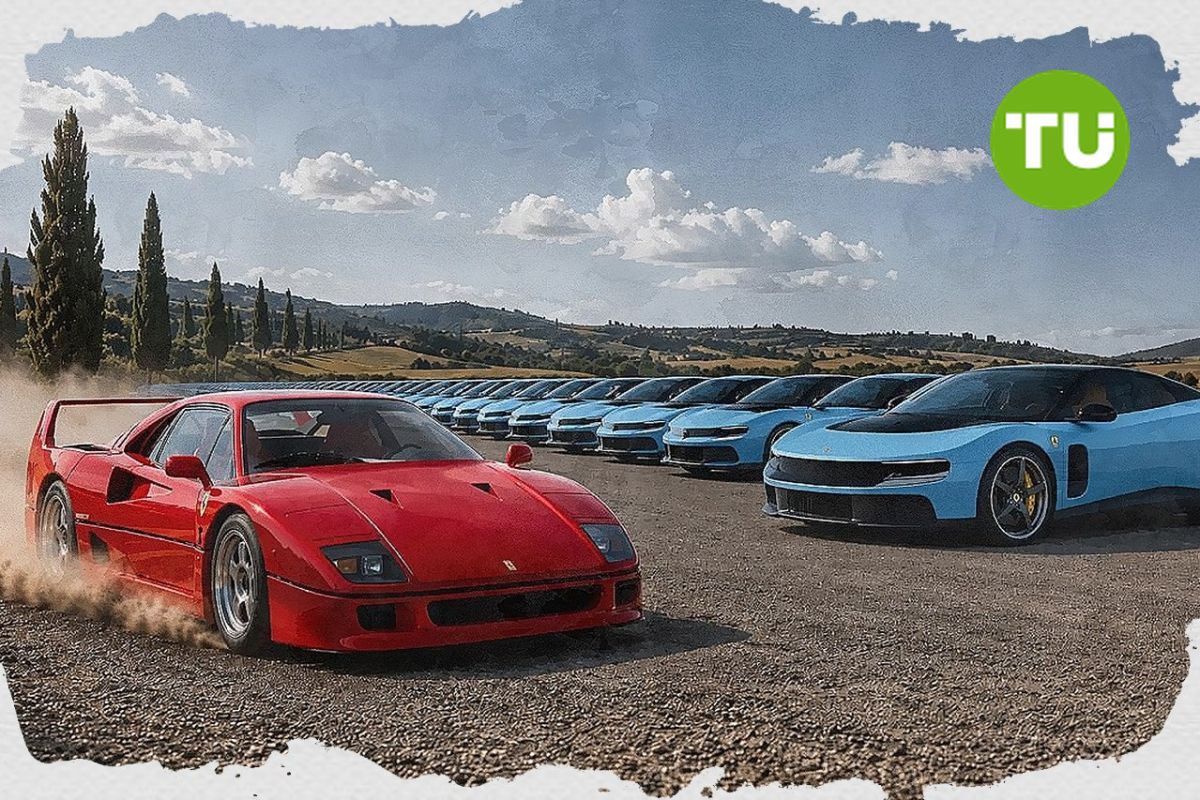
The supercar world is facing the biggest rebellion in its history. The attempt to move fans of gasoline-powered cars to “clean electric” models has turned into a real fiasco. It turned out that without the signature roar of an engine, even the fastest electric car becomes just another gadget. How are auto giants trying to bring back “character,” and why may the future actually belong to hybrids?
How a $640,000 electric Ferrari rattled the Milan stock exchange
The first fully electric Ferrari Luce was supposed to become rock-solid proof that Maranello could step into a new era without losing its status or grandeur. On paper, the numbers looked impressive: four motors, acceleration to 100 km/h in a cosmic 2.5 seconds, a range of 329 miles, and a price tag of around $640,000.But the financial market read this loud presentation very differently. Instead of applause, the company faced a harsh stock-market stress test, while Ferrari shares instantly fell by almost 8%.
For a luxury automaker, this is not just daily volatility or a temporary fluctuation on the chart. Ferrari’s entire business and reputation have long rested on artificial scarcity, ultra-high margins, and the ability to sell customers not a means of transportation, but an unattainable symbol. When investors see a new model as a risk to the brand’s DNA, it is not one specific electric car that comes under threat, but the very brand premium the company has built into its capitalization for decades.
Former Ferrari chairman Luca Cordero di Montezemolo had already sharply criticized this direction, warning that such experiments could irreversibly damage the company’s heritage. Today, the market, loyal fans, and the old guard of the Italian marque are united on one question: Ferrari can certainly build an ultra-fast electric car, but can it create an EV that makes the heart beat the way a legendary gasoline engine does?
Why a silent Daytona could not replace the wild roar of Hellcat and Demon
The American case proved even harsher and more painful than the European one. The Dodge Charger Daytona EV was supposed to triumphantly lead the electric evolution of American muscle cars, but real sales figures quickly sobered up management. According to Carscoops, in 2025 the company managed to sell only 7,421 Charger Daytona EVs, while demand collapsed catastrophically toward the end of the year.For an ordinary family electric crossover, instant torque is a rock-solid argument. But for a true muscle car, dry acceleration figures are not enough. For decades, Dodge sold not just horsepower, but pure cultural rebellion. The names Hellcat and Demon alone made the heart tighten, while the brand’s unmistakable supercharger whine and the rough, dirty rumble of the V8 formed the foundation of this cult. It was loud, unecological, and sometimes irrational — but that is precisely why it was so wildly attractive.
The electric Charger Daytona may be three times as fast in a straight line, but it struggles badly to remain the same hooligan. Having lost its signature beastly character, the model suddenly found itself on foreign ground. Now Daytona is forced to compete not with the legendary gasoline-powered Challenger, but with Tesla models and the global EV market, where Chinese and Korean manufacturers are relentlessly applying pressure with technology and much lower prices.
How family values saved Mustang Mach-E sales
Ford chose a fundamentally different path and, unlike its peers, managed to win financially. The electric Mustang Mach-E crossover can hardly be called a failure: in 2025, a solid 51,620 units were sold in the US. But this success was driven not by fans of classic pony cars, but by an entirely new family audience for the lineup.Ford’s marketers went all in. They used the cult name as a battering ram to enter the EV segment quickly and loudly, offering practical users a tall, comfortable urban SUV. From the standpoint of quick profits, the strategy worked perfectly — the money was made.
Still, the reputational risks remain enormous. When the wild mustang badge is placed on a practical family electric car, it helps the reports here and now, but inevitably dilutes the very essence of the brand. For investors, this is a classic trap: short-term monetization of a legend versus its long-term value.
Why super hybrids became a lifeline for Lamborghini and Koenigsegg
While others were mostly bruising themselves on pure electric cars, Lamborghini hit the brakes in time. The company quickly shifted its future Lanzador project, originally planned as a pure EV, into a plug-in hybrid format. In Sant’Agata, they understood early that demand for fully electric supercars among their customers was currently zero.This is not fear of technology, but sober margin protection. A Lamborghini buyer pays not just for speed, but for theatricality, aggression, and the feeling of uncontrolled power. A battery can help satisfy environmental demands, but if it takes away emotion and sound, it starts working against the car’s astronomical price tag.
For the same reason, McLaren and Koenigsegg are acting with maximum caution. The British McLaren Artura does not destroy the internal combustion engine, but uses electricity as a form of doping — to remove turbo lag and make throttle response instant. The market fully appreciated this compromise. The brand’s sales immediately moved higher thanks to a successful combination of proven gasoline power and new technology.
Koenigsegg’s example is the most revealing. The brand is based in Sweden — a country where more than 60% of new cars are already electric. Yet its Gemera remains a complex hybrid with an internal combustion engine. Even in one of the greenest environments on the planet, sports car makers are not falling for electric provocations, because they know exactly what their customer is buying: not battery capacity, but pure engineering madness.
Why the wealthy buy emotions, not kilowatts
Electrification does not kill sports cars. It kills a brand that failed to translate its own legend into a new language. If a battery delivers insane dynamics while preserving authentic character, the customer will pull out the checkbook. But if a marque asks $640,000 for absolute silence, minimalism, and alien design, the market simply turns around and walks away.For Tesla or BYD, an electric car is the basic product of the modern age. For Ferrari, Lamborghini, or Dodge, it is an attempt to sell a digital future to people who are madly in love with the analog past. That is why, in the top league, the pure EV currently remains only an expensive experiment with uncertain payback.
The main winner of this era is the hybrid. It is the only workable compromise that allows automakers to speak to environmentalists in the language of low emissions, to investors in the language of innovation, and to fans in the language of an engine that can still be heard. For supercars, it is the only way to move with the times without losing the very thing for which customers pay the biggest premium in the world.








-
 Afghanistan
-
 Albania
-
 Algeria
-
 Angola
-
 Argentina
-
 Armenia
-
 Australia
-
 Austria
-
 Azerbaijan
-
 Bahamas
-
 Bahrain
-
 Bangladesh
-
 Belarus
-
 Belgium
-
 Bolivia
-
 Botswana
-
 Brazil
-
 Brunei
-
 Bulgaria
-
 Cambodia
-
 Cameroon
-
 Canada
-
 Chile
Chile
-
 China
China
-
 Colombia
-
 Congo
Congo
-
 Costa Rica
-
 Cote d'Ivoire
-
 Croatia
-
 Cuba
Cuba
-
 Cyprus
-
 Czechia
-
 DR Congo
-
 Denmark
-
 Dominican Republic
-
 Ecuador
-
 Egypt
Egypt
-
 El Salvador
-
 Estonia
-
 Eswatini
-
 Ethiopia
-
 Finland
-
 France
-
 Georgia
-
 Germany
-
 Ghana
Ghana
-
 Greece
-
 Haiti
Haiti
-
 Hong Kong
-
 Hungary
-
 India
India
-
 Indonesia
-
 Iran, Islamic republic
-
 Iraq
Iraq
-
 Ireland
-
 Israel
-
 Italy
Italy
-
 Jamaica
-
 Japan
Japan
-
 Jordan
-
 Kazakhstan
-
 Kenya
Kenya
-
 Korea
Korea
-
 Kuwait
-
 Kyrgyzstan
-
 Laos
Laos
-
 Latvia
-
 Lebanon
-
 Lesotho
-
 Libya
Libya
-
 Lithuania
-
 Luxembourg
-
 Madagascar
-
 Malaysia
-
 Malta
Malta
-
 Mauritius
-
 Mexico
-
 Moldova
-
 Mongolia
-
 Montenegro
-
 Morocco
-
 Mozambique
-
 Myanmar
-
 Namibia
-
 Nepal
Nepal
-
 Netherlands
-
 New Zealand
-
 Nigeria
-
 North Macedonia
-
 Norway
-
 Oman
Oman
-
 Pakistan
-
 Palestine
-
 Panama
-
 Papua New Guinea
-
 Paraguay
-
 Peru
Peru
-
 Philippines
-
 Poland
-
 Portugal
-
 Puerto Rico
-
 Qatar
Qatar
-
 Reunion
-
 Romania
-
 Rwanda
-
 Saudi Arabia
-
 Serbia
-
 Singapore
-
 Slovakia
-
 Slovenia
-
 Somalia
-
 South Africa
-
 Spain
Spain
-
 Sri Lanka
-
 Sweden
-
 Switzerland
-
 Syria
Syria
-
 Taiwan
-
 Tajikistan
-
 Tanzania
-
 Thailand
-
 Trinidad and Tobago
-
 Tunisia
-
 Turkey
-
 UAE
UAE
-
 Uganda
-
 Ukraine
-
 United Kingdom
-
United States
-
 Uruguay
-
 Uzbekistan
-
 Venezuela
-
 Vietnam
-
 Yemen
Yemen
-
 Zambia
-
 Zimbabwe
- Forex
- Crypto












