
Nikkei 225 struggles below 50,000 as momentum fades ahead of BOJ decision

The Nikkei 225 is entering the second half of December with fading momentum on Wednesday, even as its broader medium-term structure remains constructive. The index continues to trade well above its rising long-term trend support, but repeated failures near the 50,000 level have introduced hesitation among investors.
Highlights
- Nikkei 225 struggles below 50,000 as upside momentum fades.
- Daily RSI drifts into neutral territory, signaling consolidation.
- BOJ rate hike expectations drive repricing in heavyweight stocks.
What has emerged is not a reversal, but a shift from aggressive trend extension into a policy-sensitive consolidation phase.After a powerful multi-month rally that carried the Nikkei to repeated highs, price action has cooled noticeably. Gains are no longer being extended with ease, and rallies are increasingly being met with supply. This change in behavior reflects a market recalibrating expectations ahead of a pivotal Bank of Japan policy decision rather than responding to deteriorating economic fundamentals.
Medium-term uptrend holds as price consolidates below resistance
On the daily chart, the Nikkei’s broader uptrend remains intact. The index continues to trade comfortably above its rising 100-day and 200-day EMAs, confirming that longer-term trend structure has not been damaged. These averages continue to slope higher, reinforcing that the recent slowdown is corrective rather than bearish in nature.
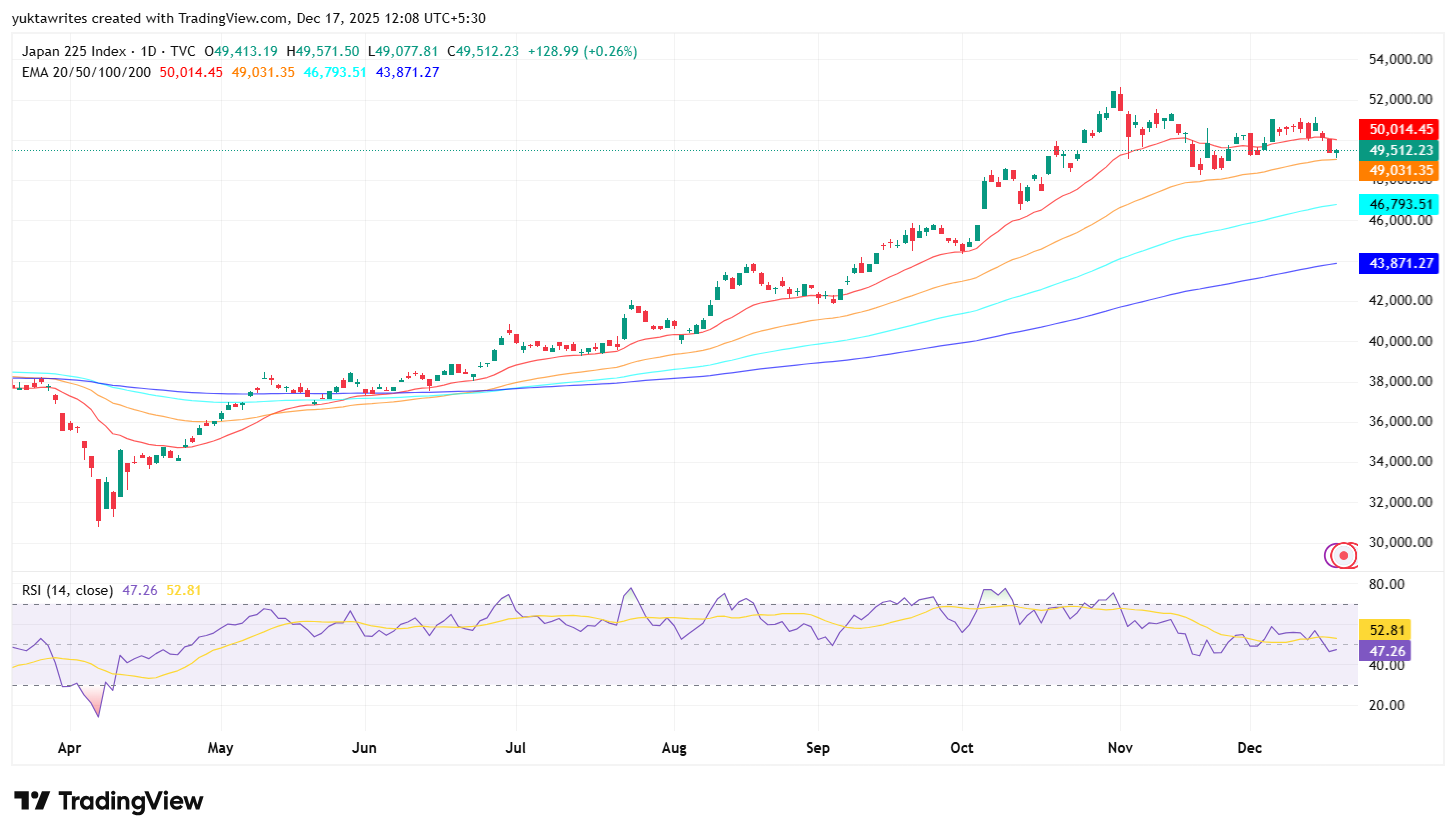
NIKKEI 225 price dynamics (Source: TradingView)
However, price action has stalled below the 50,000 region, which has become a visible ceiling after repeated failed attempts to sustain upside traction. The 20-day and 50-day EMAs have flattened, reflecting a loss of directional conviction. This flattening typically signals a transition from momentum-driven advances into consolidation, particularly following extended rallies.
Momentum indicators reinforce this interpretation. Daily RSI has drifted back toward the mid-40s to low-50s range, a neutral zone that suggests balance between buyers and sellers. There is no evidence of oversold stress or panic-driven liquidation. Instead, momentum behavior points to distribution at elevated levels, where investors are reassessing exposure as policy risk comes into focus.
The inability to reclaim the 50,000 handle despite resilient economic data highlights how forward-looking policy expectations are now outweighing backward-looking growth indicators.
Short-term structure shows sellers defending rallies
Short-term charts illustrate where pressure is concentrated. On the 30-minute timeframe, the Nikkei remains capped beneath its Supertrend and continues to print lower highs. Recovery attempts earlier in the week faded quickly, with price repeatedly rejected near the 49,700 to 49,800 zone. Parabolic SAR placement above price further confirms that near-term control rests with sellers.
At the same time, the index has shown signs of stabilization above the 49,200 area. Dip buyers have stepped in to defend recent lows, preventing deeper downside follow-through. This has created a well-defined trading range rather than a one-directional decline.
From a technical standpoint, a sustained break below 49,000 would expose the index to a deeper pullback toward the 48,500 to 48,700 region. That zone aligns with the rising 50-day moving average and prior breakout structure, making it a natural area for stronger demand to emerge. On the upside, the market would need a decisive close back above 50,000 to restore bullish momentum and reopen the path toward the November highs near 52,000.Until one of these levels gives way, price action is likely to remain choppy and reactive to headlines.
Policy expectations reshape investor positioning
Fundamental factors help explain Nikkei's hesitation. Japan’s economic data remains broadly supportive. Export growth has strengthened, machinery orders have rebounded, and corporate earnings expectations remain firm. Under normal conditions, such data would support further equity upside.
However, that strength has reinforced expectations of imminent policy tightening. The Bank of Japan is widely expected to raise rates this week, marking a further step away from ultra-accommodative policy. Markets are increasingly focused on how forcefully the BOJ signals its path into 2026, particularly around balance sheet policy and future rate normalization.
This shift has prompted a repricing in heavyweight stocks that benefited most from loose financial conditions. Shares of SoftBank, Mitsubishi UFJ, and Mitsubishi Heavy Industries have come under pressure, reflecting sensitivity to higher borrowing costs rather than concerns about economic weakness. The pullback across these names has weighed on the index, even as broader fundamentals remain stable.
Market outlook
Overall, the Nikkei 225 is transitioning from a momentum-driven rally into a more selective, policy-sensitive phase. The broader uptrend remains intact, supported by rising long-term averages and resilient economic conditions. However, upside progress is likely to be slower as investors await clarity from the Bank of Japan.
Previously, we noted that the index’s advance would become increasingly dependent on policy guidance as it pushed deeper into record territory. The current consolidation below 50,000 reflects that shift. Volatility is likely to rise around the BOJ decision, with directional conviction hinging less on economic data and more on how policymakers frame the outlook beyond this week’s expected rate increase. Until that clarity emerges, the Nikkei appears range-bound, favoring patience over aggressive positioning.


Latest Nikkei 225 News







-
 Afghanistan
-
 Albania
-
 Algeria
-
 Angola
-
 Argentina
-
 Armenia
-
 Australia
-
 Austria
-
 Azerbaijan
-
 Bahamas
-
 Bahrain
-
 Bangladesh
-
 Belarus
-
 Belgium
-
 Bolivia
-
 Botswana
-
 Brazil
-
 Brunei
-
 Bulgaria
-
 Cambodia
-
 Cameroon
-
 Canada
-
 Chile
Chile
-
 China
China
-
 Colombia
-
 Congo
Congo
-
 Costa Rica
-
 Cote d'Ivoire
-
 Croatia
-
 Cuba
Cuba
-
 Cyprus
-
 Czechia
-
 DR Congo
-
 Denmark
-
 Dominican Republic
-
 Ecuador
-
 Egypt
Egypt
-
 El Salvador
-
 Estonia
-
 Eswatini
-
 Ethiopia
-
 Finland
-
 France
-
 Georgia
-
 Germany
-
 Ghana
Ghana
-
 Greece
-
 Haiti
Haiti
-
 Hong Kong
-
 Hungary
-
 India
India
-
 Indonesia
-
 Iran, Islamic republic
-
 Iraq
Iraq
-
 Ireland
-
 Israel
-
 Italy
Italy
-
 Jamaica
-
 Japan
Japan
-
 Jordan
-
 Kazakhstan
-
 Kenya
Kenya
-
 Korea
Korea
-
 Kuwait
-
 Kyrgyzstan
-
 Laos
Laos
-
 Latvia
-
 Lebanon
-
 Lesotho
-
 Libya
Libya
-
 Lithuania
-
 Luxembourg
-
 Madagascar
-
 Malaysia
-
 Malta
Malta
-
 Mauritius
-
 Mexico
-
 Moldova
-
 Mongolia
-
 Montenegro
-
 Morocco
-
 Mozambique
-
 Myanmar
-
 Namibia
-
 Nepal
Nepal
-
 Netherlands
-
 New Zealand
-
 Nigeria
-
 North Macedonia
-
 Norway
-
 Oman
Oman
-
 Pakistan
-
 Palestine
-
 Panama
-
 Papua New Guinea
-
 Paraguay
-
 Peru
Peru
-
 Philippines
-
 Poland
-
 Portugal
-
 Puerto Rico
-
 Qatar
Qatar
-
 Reunion
-
 Romania
-
 Rwanda
-
 Saudi Arabia
-
 Serbia
-
 Singapore
-
 Slovakia
-
 Slovenia
-
 Somalia
-
 South Africa
-
 Spain
Spain
-
 Sri Lanka
-
 Sweden
-
 Switzerland
-
 Syria
Syria
-
 Taiwan
-
 Tajikistan
-
 Tanzania
-
 Thailand
-
 Trinidad and Tobago
-
 Tunisia
-
 Turkey
-
 UAE
UAE
-
 Uganda
-
 Ukraine
-
 United Kingdom
-
United States
-
 Uruguay
-
 Uzbekistan
-
 Venezuela
-
 Vietnam
-
 Yemen
Yemen
-
 Zambia
-
 Zimbabwe
- Forex
- Crypto











