
Nikkei 225 falls 1.56% as investors turn defensive after strong run

The Nikkei 225 extended its pullback on Tuesday, closing near 49,383 after another firm rejection from the 50,000 psychological level. The decline reflects a market shifting from momentum-driven buying to caution, as investors reassess positioning ahead of key global and domestic macro events.
Highlights
- The Nikkei closed down 1.56% after failing again near the 50,000 level.
- The index slipped below its 20-day EMA near 50,067, signaling a loss of short-term momentum.
- Technology and AI-linked stocks led losses as investors reduced risk ahead of macro catalysts.
While the broader uptrend remains intact, technical signals now point to a transition into a corrective phase rather than an immediate continuation of recent gains.The latest pullback comes after weeks of elevated optimism that drove Japanese equities to record territory. That enthusiasm has now given way to profit-taking and selective de-risking, particularly in sectors that had led the rally.
Technical structure shows momentum shift, not trend breakdown
From a technical perspective, the daily chart shows the Nikkei slipping back below its 20-day EMAs, a level that had acted as dynamic support through much of November. This break marks a clear change in short-term momentum.
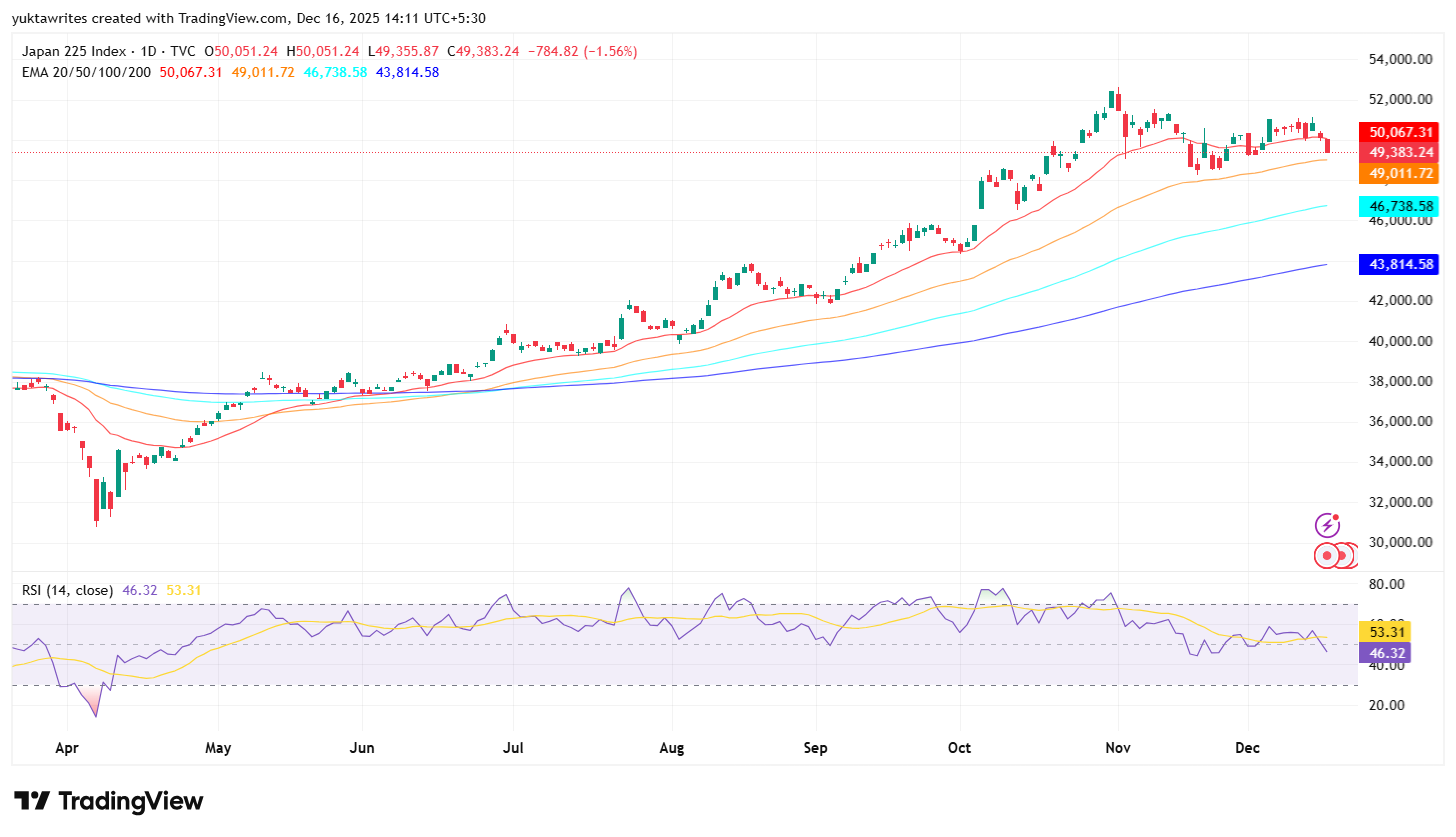
Nikkei 225 index price dynamics (Source: TradingView)
Importantly, the broader structure remains constructive. The index continues to hold above its 50-day EMA near 49,012 and the 100-day EMA around 46,739, both of which are rising. This positioning suggests the pullback is corrective rather than the start of a deeper trend reversal.
Price action over the past two weeks reinforces this view. Repeated attempts to push toward the 52,000 region have failed, forming a short-term lower high. At the same time, the daily RSI has rolled down toward the mid-40s, signaling fading upside momentum without reaching oversold territory. That combination typically reflects controlled distribution rather than panic-driven selling.
Intraday charts point to growing seller control
Shorter timeframes show where pressure has intensified. On the 30-minute chart, Supertrend has flipped firmly bearish, with price trading consistently below resistance near 49,801. Parabolic SAR dots remain positioned above price, confirming that intraday rebounds are being sold into rather than extended.
The index is now oscillating around the 49,300-49,400 zone, which is emerging as an initial demand area. A decisive break below this range would likely expose the late-November consolidation zone near 48,800, followed by stronger structural support closer to 47,500.
As long as selling remains orderly and contained above the 50-day EMA, the pullback is likely to remain part of a broader digestion phase.
Sector rotation and macro caution weigh on sentiment
Sector behavior explains much of the recent weakness. Heavy selling in technology and AI-linked stocks has dragged on index breadth, with names such as SoftBank Group, Kioxia, and Fujikura leading declines. These stocks had been among the strongest contributors to the Nikkei’s advance, making them natural sources of profit-taking as global tech sentiment cooled.
The move mirrors recent AI-led weakness in U.S. equities, underscoring how closely the Nikkei remains tied to global risk appetite. At the same time, losses across financials and industrials limited any offsetting support, leaving the index vulnerable once momentum turned.
Macro positioning has added to caution. Investors are de-risking ahead of the upcoming U.S. jobs report, which could reshape expectations around Federal Reserve policy. Domestically, markets are bracing for a widely anticipated Bank of Japan rate hike, a step toward normalization that introduces uncertainty around funding costs and currency dynamics.
Consolidation favored unless key support breaks
Looking ahead, the critical technical level to watch is the 50-day EMA near 49,000. Holding above this zone would keep the medium-term uptrend intact and allow momentum to reset for another attempt higher later in the quarter.
A decisive daily close below that level, however, would increase the risk of a deeper correction toward the 100-day EMA near 46,700, shifting the narrative from healthy consolidation to emerging trend fatigue.
Previously discussed, Japanese equities have been vulnerable to sharp pullbacks following extended momentum phases, particularly when global tech sentiment softens. That pattern appears to be playing out again, suggesting patience is warranted until clearer signals emerge from macro data and central bank policy.


Latest Nikkei 225 News







-
 Afghanistan
-
 Albania
-
 Algeria
-
 Angola
-
 Argentina
-
 Armenia
-
 Australia
-
 Austria
-
 Azerbaijan
-
 Bahamas
-
 Bahrain
-
 Bangladesh
-
 Belarus
-
 Belgium
-
 Bolivia
-
 Botswana
-
 Brazil
-
 Brunei
-
 Bulgaria
-
 Cambodia
-
 Cameroon
-
 Canada
-
 Chile
Chile
-
 China
China
-
 Colombia
-
 Congo
Congo
-
 Costa Rica
-
 Cote d'Ivoire
-
 Croatia
-
 Cuba
Cuba
-
 Cyprus
-
 Czechia
-
 DR Congo
-
 Denmark
-
 Dominican Republic
-
 Ecuador
-
 Egypt
Egypt
-
 El Salvador
-
 Estonia
-
 Eswatini
-
 Ethiopia
-
 Finland
-
 France
-
 Georgia
-
 Germany
-
 Ghana
Ghana
-
 Greece
-
 Haiti
Haiti
-
 Hong Kong
-
 Hungary
-
 India
India
-
 Indonesia
-
 Iran, Islamic republic
-
 Iraq
Iraq
-
 Ireland
-
 Israel
-
 Italy
Italy
-
 Jamaica
-
 Japan
Japan
-
 Jordan
-
 Kazakhstan
-
 Kenya
Kenya
-
 Korea
Korea
-
 Kuwait
-
 Kyrgyzstan
-
 Laos
Laos
-
 Latvia
-
 Lebanon
-
 Lesotho
-
 Libya
Libya
-
 Lithuania
-
 Luxembourg
-
 Madagascar
-
 Malaysia
-
 Malta
Malta
-
 Mauritius
-
 Mexico
-
 Moldova
-
 Mongolia
-
 Montenegro
-
 Morocco
-
 Mozambique
-
 Myanmar
-
 Namibia
-
 Nepal
Nepal
-
 Netherlands
-
 New Zealand
-
 Nigeria
-
 North Macedonia
-
 Norway
-
 Oman
Oman
-
 Pakistan
-
 Palestine
-
 Panama
-
 Papua New Guinea
-
 Paraguay
-
 Peru
Peru
-
 Philippines
-
 Poland
-
 Portugal
-
 Puerto Rico
-
 Qatar
Qatar
-
 Reunion
-
 Romania
-
 Rwanda
-
 Saudi Arabia
-
 Serbia
-
 Singapore
-
 Slovakia
-
 Slovenia
-
 Somalia
-
 South Africa
-
 Spain
Spain
-
 Sri Lanka
-
 Sweden
-
 Switzerland
-
 Syria
Syria
-
 Taiwan
-
 Tajikistan
-
 Tanzania
-
 Thailand
-
 Trinidad and Tobago
-
 Tunisia
-
 Turkey
-
 UAE
UAE
-
 Uganda
-
 Ukraine
-
 United Kingdom
-
United States
-
 Uruguay
-
 Uzbekistan
-
 Venezuela
-
 Vietnam
-
 Yemen
Yemen
-
 Zambia
-
 Zimbabwe
- Forex
- Crypto











