
Nikkei 225 steadies near 49,500 as BOJ hike triggers consolidation phase

Japan’s Nikkei 225 is stabilizing on Friday after a volatile week, with price action pointing to consolidation rather than structural damage following the Bank of Japan’s long-telegraphed policy shift. The index closed near 49,507 after rebounding from midweek lows, signaling that investors largely absorbed the rate decision without abandoning the broader bullish framework.
Highlights
- Nikkei holds near 49,500 after rebounding from post-BOJ selloff.
- Index remains above key medium and long-term moving averages.
- Overhead resistance near 50,000 caps upside during consolidation phase.
The market’s reaction suggests the policy move was well priced in, leaving price action driven more by positioning and momentum reset than by policy shock. With volatility cooling, attention has shifted back to technical structure and global macro alignment.
Trend structure remains constructive after pullback
On the daily chart, the Nikkei’s broader uptrend remains intact despite the recent cooling phase. The index continues to trade above its rising 50-day EMA near 49,050 and remains comfortably supported by the 100-day and 200-day averages around 46,890 and 43,980. These longer-term levels have consistently underpinned price throughout the rally and continue to signal structural strength.
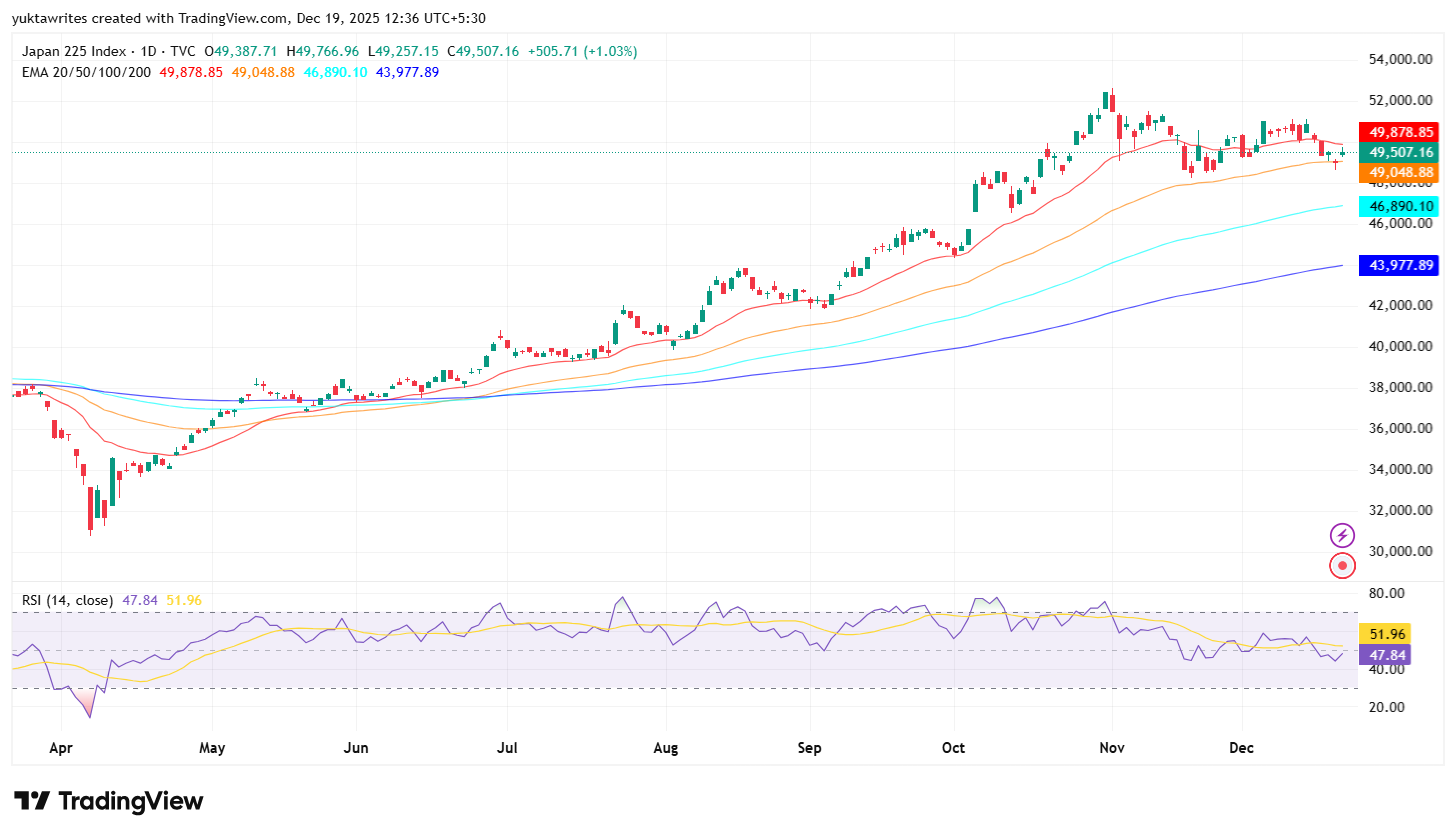
Nikkei 225 price dynamics (TradingView)
While the Nikkei has slipped marginally below the 20-day EMA near 49,880, this move has not been accompanied by downside acceleration. Instead, price action has compressed into a tight range just below recent highs. This behavior is typical of digestion following a strong multi-month advance rather than distribution or trend failure. The lack of follow-through selling reinforces the view that investors are reassessing exposure rather than exiting risk wholesale.
Momentum resets without bearish divergence
Momentum indicators align with this consolidation narrative. Daily RSI has eased toward the high-40s after spending much of October and November in overbought territory. Importantly, the November peak was not accompanied by sharp bearish divergence, suggesting that the pullback reflects reduced momentum rather than aggressive selling pressure.
Historically, similar RSI resets within established uptrends have preceded renewed trend continuation, provided price remains above key moving averages. So far, that condition has been met. The momentum profile supports the idea that the Nikkei is transitioning from expansion into consolidation, not reversing trend.
Intraday recovery meets overhead supply
Shorter timeframes offer additional clarity. On the 30-minute chart, the Nikkei entered a short-term recovery phase after last week’s selloff toward the 48,700 area. Supertrend support has begun to rise toward 49,215, and Parabolic SAR has flipped beneath price, signaling easing downside pressure in the near term.
However, repeated failures near the 49,800 to 50,000 zone highlight persistent overhead supply. Sellers have consistently emerged in that region, preventing a clean upside break. Until price can establish acceptance above 50,000, rallies are likely to remain corrective rather than trend-extending.
BOJ policy and global backdrop shape sentiment
Fundamentals closely mirror the technical balance. The Bank of Japan’s 25 basis point rate hike was historically significant but widely anticipated. Officials framed the move as a continuation of gradual normalization rather than a shift toward restrictive policy, reducing the risk of a sharp repricing in equities.
Inflation has remained above the BOJ’s target for the 44th consecutive month, but modest easing in headline CPI has tempered expectations for more aggressive tightening. At the same time, global conditions have offered support. Cooler U.S. inflation data has strengthened expectations for Federal Reserve rate cuts next year, helping offset domestic policy concerns and supporting risk assets globally.
Sector performance underscores this resilience. Strength in heavyweight names such as SoftBank, Toyota, and major financials suggests institutional participation remains engaged rather than defensive. Still, the weekly decline confirms that the Nikkei is no longer in an uninterrupted expansion phase.
Market outlook
Technically, the 49,000 to 49,100 region now represents key near-term support. Holding above this zone on a closing basis keeps the broader bullish structure intact. A sustained break above 50,000 would reopen the path toward new highs, while a decisive move below the 50-day EMA would signal that a deeper corrective phase is unfolding.
Previously, we highlighted the Nikkei’s vulnerability to a momentum reset as it approached the 52,000 region amid stretched conditions. The latest pullback confirms that view, with price now digesting gains rather than extending immediately higher. For now, the Nikkei is behaving like a market pausing to reassess after a strong rally, not one losing its longer-term footing.


Latest Nikkei 225 News







-
 Afghanistan
-
 Albania
-
 Algeria
-
 Angola
-
 Argentina
-
 Armenia
-
 Australia
-
 Austria
-
 Azerbaijan
-
 Bahamas
-
 Bahrain
-
 Bangladesh
-
 Belarus
-
 Belgium
-
 Bolivia
-
 Botswana
-
 Brazil
-
 Brunei
-
 Bulgaria
-
 Cambodia
-
 Cameroon
-
 Canada
-
 Chile
Chile
-
 China
China
-
 Colombia
-
 Congo
Congo
-
 Costa Rica
-
 Cote d'Ivoire
-
 Croatia
-
 Cuba
Cuba
-
 Cyprus
-
 Czechia
-
 DR Congo
-
 Denmark
-
 Dominican Republic
-
 Ecuador
-
 Egypt
Egypt
-
 El Salvador
-
 Estonia
-
 Eswatini
-
 Ethiopia
-
 Finland
-
 France
-
 Georgia
-
 Germany
-
 Ghana
Ghana
-
 Greece
-
 Haiti
Haiti
-
 Hong Kong
-
 Hungary
-
 India
India
-
 Indonesia
-
 Iran, Islamic republic
-
 Iraq
Iraq
-
 Ireland
-
 Israel
-
 Italy
Italy
-
 Jamaica
-
 Japan
Japan
-
 Jordan
-
 Kazakhstan
-
 Kenya
Kenya
-
 Korea
Korea
-
 Kuwait
-
 Kyrgyzstan
-
 Laos
Laos
-
 Latvia
-
 Lebanon
-
 Lesotho
-
 Libya
Libya
-
 Lithuania
-
 Luxembourg
-
 Madagascar
-
 Malaysia
-
 Malta
Malta
-
 Mauritius
-
 Mexico
-
 Moldova
-
 Mongolia
-
 Montenegro
-
 Morocco
-
 Mozambique
-
 Myanmar
-
 Namibia
-
 Nepal
Nepal
-
 Netherlands
-
 New Zealand
-
 Nigeria
-
 North Macedonia
-
 Norway
-
 Oman
Oman
-
 Pakistan
-
 Palestine
-
 Panama
-
 Papua New Guinea
-
 Paraguay
-
 Peru
Peru
-
 Philippines
-
 Poland
-
 Portugal
-
 Puerto Rico
-
 Qatar
Qatar
-
 Reunion
-
 Romania
-
 Rwanda
-
 Saudi Arabia
-
 Serbia
-
 Singapore
-
 Slovakia
-
 Slovenia
-
 Somalia
-
 South Africa
-
 Spain
Spain
-
 Sri Lanka
-
 Sweden
-
 Switzerland
-
 Syria
Syria
-
 Taiwan
-
 Tajikistan
-
 Tanzania
-
 Thailand
-
 Trinidad and Tobago
-
 Tunisia
-
 Turkey
-
 UAE
UAE
-
 Uganda
-
 Ukraine
-
 United Kingdom
-
United States
-
 Uruguay
-
 Uzbekistan
-
 Venezuela
-
 Vietnam
-
 Yemen
Yemen
-
 Zambia
-
 Zimbabwe
- Forex
- Crypto











