
Nvidia stock climbs 1.2% after CFO says product demand to exceed $500B through 2026
As of January 8, Nvidia stock is trading at $189.36, up 1.2% in the last 24 hours, maintaining its position as a key driver in the AI‑focused equity rally. The stock remains in a well‑defined long‑term uptrend, underpinned by strong institutional demand and robust fundamentals.
Highlights
- Nvidia stock gained 1.2% after CFO Colette Kress revealed product demand will surpass $500 billion through 2026.
- The company’s data center chips, including Hopper and Blackwell, are seeing stronger-than-expected uptake.
- Technical indicators point to continued bullish momentum as Nvidia leads the AI infrastructure market.
From a technical perspective, Nvidia (NVDA) is comfortably holding above both its 50‑day and 200‑day simple moving averages. The 200‑day MA, currently around $181.90, has acted as reliable support in recent months. The 50‑day MA near $182.50 is also converging with price, indicating a possible springboard for further upside if the momentum holds.
Relative strength index (RSI) stands near neutral at 56, suggesting Nvidia is neither overbought nor oversold. The MACD (Moving Average Convergence Divergence) line remains above the signal line, though not strongly, implying modest bullish momentum. Immediate resistance is seen near $193–$195, coinciding with recent swing highs and Fibonacci retracement levels from the last rally leg. A decisive break above $195 could trigger a run toward $210, which was last tested in November. On the downside, initial support lies in the $182–$178 zone, followed by firmer demand around $173 and $164, where volume and moving average clusters exist.
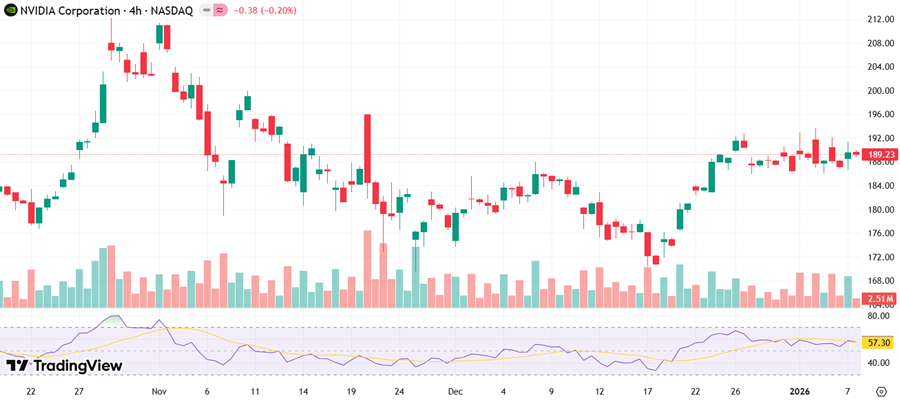
Nvidia stock price dynamics (November 2025 - January 2025). Source: TradingView
Volume over the past five sessions has been relatively stable, suggesting accumulation at current levels. The stock’s ability to sustain higher lows since October further confirms that dips are being bought, consistent with bullish price action. Overall, technicals support a base‑building phase within a larger bullish trend channel.
Nvidia CFO highlights surging demand
At the heart of Nvidia’s latest price move is an upgraded demand outlook issued by CFO Colette Kress. Speaking at a high‑profile investment event, Kress stated that demand for Nvidia’s data center chips—including the current Hopper architecture and next‑generation Blackwell—has exceeded the company’s $500 billion forecast through 2026. She emphasized that "demand has definitely gotten larger" than what Nvidia initially projected, setting off a fresh wave of institutional buying interest.
This demand surge is fueled by the continued expansion of generative AI infrastructure, with hyperscalers, cloud providers, and enterprise clients aggressively scaling their AI capabilities. Nvidia’s Blackwell architecture, launched in 2024, is now widely deployed across data centers and cloud AI platforms. Supply chain reports suggest demand remains strong, with many configurations on long lead times well into 2026. Looking ahead, Nvidia is preparing to launch its next-generation Rubin architecture in the second half of 2026, further reinforcing its roadmap dominance. With a market share exceeding 80% in high-performance AI GPUs, Nvidia continues to benefit from robust pricing power and high margins across its data center segment.
Third‑quarter financials, released in November, showed a 206% YoY increase in data center revenue, and guidance for Q4 remained above consensus. The CFO’s latest comments effectively increase the top‑end of Nvidia’s revenue potential over the next two to three years, reinforcing the long AI supercycle thesis.
Momentum builds with clear breakout levels in sight
Looking ahead, the most likely near‑term scenario is a retest of the $193–$195 resistance zone. If Nvidia can break above that level on strong volume and follow‑through buying, price could quickly advance toward the $205–$210 range, where sellers previously emerged. This bullish scenario is supported by strong institutional flows and renewed AI sentiment from management.
Alternatively, a failure to break $195 could lead to a brief consolidation between $178 and $195. In this case, Nvidia may drift sideways for several weeks before attempting another breakout. Investors should watch for higher lows and rising volume as bullish signals in this consolidation zone.
Investor sentiment on Nvidia remains strong following Piper Sandler’s reaffirmed Overweight rating and $225 price target. Analysts highlighted the company’s dominance in AI accelerators and growing demand for its H100 chips, along with momentum behind its 2026 Vera Rubin platform.








-
 Afghanistan
-
 Albania
-
 Algeria
-
 Angola
-
 Argentina
-
 Armenia
-
 Australia
-
 Austria
-
 Azerbaijan
-
 Bahamas
-
 Bahrain
-
 Bangladesh
-
 Belarus
-
 Belgium
-
 Bolivia
-
 Botswana
-
 Brazil
-
 Brunei
-
 Bulgaria
-
 Cambodia
-
 Cameroon
-
 Canada
-
 Chile
Chile
-
 China
China
-
 Colombia
-
 Congo
Congo
-
 Costa Rica
-
 Cote d'Ivoire
-
 Croatia
-
 Cuba
Cuba
-
 Cyprus
-
 Czechia
-
 DR Congo
-
 Denmark
-
 Dominican Republic
-
 Ecuador
-
 Egypt
Egypt
-
 El Salvador
-
 Estonia
-
 Eswatini
-
 Ethiopia
-
 Finland
-
 France
-
 Georgia
-
 Germany
-
 Ghana
Ghana
-
 Greece
-
 Haiti
Haiti
-
 Hong Kong
-
 Hungary
-
 India
India
-
 Indonesia
-
 Iran, Islamic republic
-
 Iraq
Iraq
-
 Ireland
-
 Israel
-
 Italy
Italy
-
 Jamaica
-
 Japan
Japan
-
 Jordan
-
 Kazakhstan
-
 Kenya
Kenya
-
 Korea
Korea
-
 Kuwait
-
 Kyrgyzstan
-
 Laos
Laos
-
 Latvia
-
 Lebanon
-
 Lesotho
-
 Libya
Libya
-
 Lithuania
-
 Luxembourg
-
 Madagascar
-
 Malaysia
-
 Malta
Malta
-
 Mauritius
-
 Mexico
-
 Moldova
-
 Mongolia
-
 Montenegro
-
 Morocco
-
 Mozambique
-
 Myanmar
-
 Namibia
-
 Nepal
Nepal
-
 Netherlands
-
 New Zealand
-
 Nigeria
-
 North Macedonia
-
 Norway
-
 Oman
Oman
-
 Pakistan
-
 Palestine
-
 Panama
-
 Papua New Guinea
-
 Paraguay
-
 Peru
Peru
-
 Philippines
-
 Poland
-
 Portugal
-
 Puerto Rico
-
 Qatar
Qatar
-
 Reunion
-
 Romania
-
 Rwanda
-
 Saudi Arabia
-
 Serbia
-
 Singapore
-
 Slovakia
-
 Slovenia
-
 Somalia
-
 South Africa
-
 Spain
Spain
-
 Sri Lanka
-
 Sweden
-
 Switzerland
-
 Syria
Syria
-
 Taiwan
-
 Tajikistan
-
 Tanzania
-
 Thailand
-
 Trinidad and Tobago
-
 Tunisia
-
 Turkey
-
 UAE
UAE
-
 Uganda
-
 Ukraine
-
 United Kingdom
-
United States
-
 Uruguay
-
 Uzbekistan
-
 Venezuela
-
 Vietnam
-
 Yemen
Yemen
-
 Zambia
-
 Zimbabwe
- Forex
- Crypto











