
Nvidia stock down 2.2% despite Lenovo deal to scale AI cloud gigafactories

As of January 9, Nvidia stock is trading at $185.02, down 2.2% in the past 24 hours, extending a short-term pullback from its December high of $190.53. This decline places NVDA within a developing consolidation range between $170 and $212.
Highlights
- Nvidia announced a strategic partnership with Lenovo to build AI cloud gigafactories using its new Blackwell Ultra and Rubin platforms.
- Despite the deal, Nvidia stock fell 2.2% as investors remain cautious over ongoing China export restrictions.
- The stock continues to trade within a consolidation range, with $170 as key support and $212 as resistance.
The current price action remains technically neutral, not yet breaking support but stalling below prior resistance. From a moving average perspective, Nvidia remains structurally bullish. The 50-day simple moving average (SMA) is holding above the 200-day SMA, forming a golden cross pattern first seen in mid-2023, typically a long-term bullish signal. However, the RSI (Relative Strength Index) is now hovering around 45–50, suggesting neither oversold nor overbought conditions, further reinforcing the consolidation theme.
Short-term support is found around $175, which corresponds to the November breakout zone and prior demand. A deeper pullback could find firmer support at the $150–160 level, a range that previously acted as resistance in July and August before the stock’s breakout in October. Resistance remains intact near $212, the December high and post-split peak. A confirmed close above this level would likely trigger a retest of $230+ in the weeks that follow.
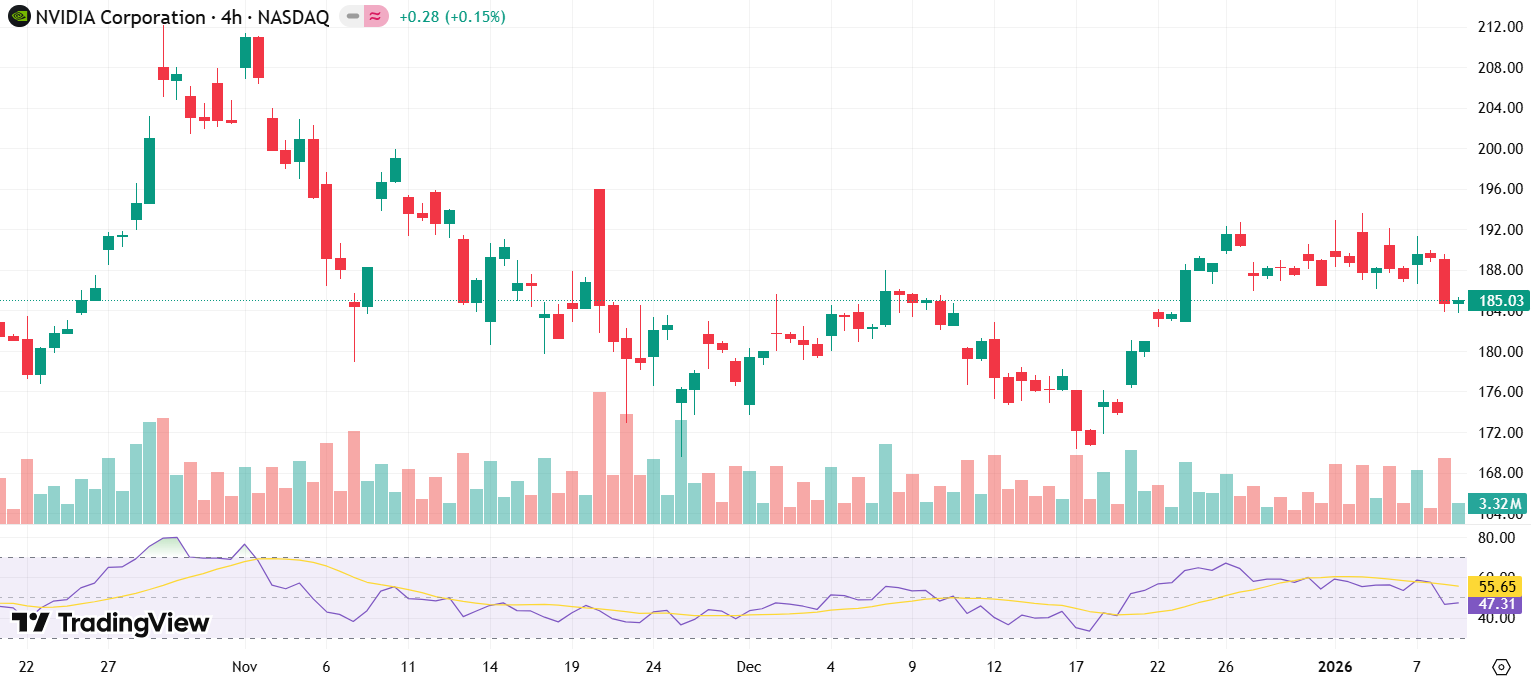
Nvidia stock price dynamics (November 2025 - January 2025). Source: TradingView
Volume remains elevated but not explosive, suggesting that current price action is more rotational than panic-driven. Institutional flows have been net positive in recent weeks, with some rebalancing around CES-driven momentum and sector-wide positioning in large-cap AI stocks.
Lenovo deal boosts AI story
At CES 2026, Nvidia announced a major strategic collaboration with Lenovo to roll out a new class of AI Cloud Gigafactory systems. These will integrate Lenovo’s Neptune liquid-cooling technology with Nvidia’s next-generation Blackwell Ultra GPUs and Vera Rubin architecture, designed to power large-scale generative AI, digital twins, and real-time AI applications. The partnership highlights Nvidia’s shift toward full-stack AI infrastructure, targeting key enterprise sectors such as manufacturing, healthcare, and telecoms across global markets.
The deal strengthens Nvidia’s positioning as a turnkey AI platform provider, not just a chipmaker. The Gigafactory model allows for standardized, scalable AI infrastructure that can be rapidly deployed by cloud operators and enterprises. Through Lenovo, Nvidia is expanding deeper into the Asia-Pacific region and leveraging OEM channels to drive adoption of its latest platforms. Analysts see the partnership as a critical step in Nvidia’s strategy to maintain its lead as hyperscalers and enterprises accelerate AI integration.
However, China-related risks and regulatory uncertainty continue to weigh on investor sentiment. Despite Nvidia’s assertion that China represents a “multi-tens-of-billions” opportunity, U.S. export restrictions have severely limited access to the market for its most advanced chips. Most analysts are excluding China from core revenue forecasts, treating it as upside optionality. Recent stake reductions by major holders like SoftBank underscore cautious positioning, even as Nvidia’s long-term growth story remains intact.
$170 support key in short-term setup
The bullish scenario suggests that if Nvidia reclaims and closes above $200, followed by a breakout past the $212 level, momentum traders could drive the stock quickly toward $230–240, targeting the next Fibonacci extension from the October low. This would likely require further positive headlines—either a strong Q4 earnings beat in February, or regulatory clarity regarding China sales.
The base case scenario sees the most probable outcome in the coming 2–4 weeks as sideways movement within the $170–212 range. The stock appears to be digesting recent gains while awaiting confirmation on both demand drivers (from cloud and enterprise AI) and supply chain stability. This period could offer entry opportunities for long-term investors, especially if Nvidia affirms robust backlog in upcoming guidance.
Nvidia shares surged after CFO Colette Kress revealed that demand for its data center chips has surpassed the company’s $500 billion forecast through 2026. Speaking at an investment event, she noted stronger-than-expected interest in both current Hopper and upcoming Blackwell architectures.









-
 Afghanistan
-
 Albania
-
 Algeria
-
 Angola
-
 Argentina
-
 Armenia
-
 Australia
-
 Austria
-
 Azerbaijan
-
 Bahamas
-
 Bahrain
-
 Bangladesh
-
 Belarus
-
 Belgium
-
 Bolivia
-
 Botswana
-
 Brazil
-
 Brunei
-
 Bulgaria
-
 Cambodia
-
 Cameroon
-
 Canada
-
 Chile
Chile
-
 China
China
-
 Colombia
-
 Congo
Congo
-
 Costa Rica
-
 Cote d'Ivoire
-
 Croatia
-
 Cuba
Cuba
-
 Cyprus
-
 Czechia
-
 DR Congo
-
 Denmark
-
 Dominican Republic
-
 Ecuador
-
 Egypt
Egypt
-
 El Salvador
-
 Estonia
-
 Eswatini
-
 Ethiopia
-
 Finland
-
 France
-
 Georgia
-
 Germany
-
 Ghana
Ghana
-
 Greece
-
 Haiti
Haiti
-
 Hong Kong
-
 Hungary
-
 India
India
-
 Indonesia
-
 Iran, Islamic republic
-
 Iraq
Iraq
-
 Ireland
-
 Israel
-
 Italy
Italy
-
 Jamaica
-
 Japan
Japan
-
 Jordan
-
 Kazakhstan
-
 Kenya
Kenya
-
 Korea
Korea
-
 Kuwait
-
 Kyrgyzstan
-
 Laos
Laos
-
 Latvia
-
 Lebanon
-
 Lesotho
-
 Libya
Libya
-
 Lithuania
-
 Luxembourg
-
 Madagascar
-
 Malaysia
-
 Malta
Malta
-
 Mauritius
-
 Mexico
-
 Moldova
-
 Mongolia
-
 Montenegro
-
 Morocco
-
 Mozambique
-
 Myanmar
-
 Namibia
-
 Nepal
Nepal
-
 Netherlands
-
 New Zealand
-
 Nigeria
-
 North Macedonia
-
 Norway
-
 Oman
Oman
-
 Pakistan
-
 Palestine
-
 Panama
-
 Papua New Guinea
-
 Paraguay
-
 Peru
Peru
-
 Philippines
-
 Poland
-
 Portugal
-
 Puerto Rico
-
 Qatar
Qatar
-
 Reunion
-
 Romania
-
 Rwanda
-
 Saudi Arabia
-
 Serbia
-
 Singapore
-
 Slovakia
-
 Slovenia
-
 Somalia
-
 South Africa
-
 Spain
Spain
-
 Sri Lanka
-
 Sweden
-
 Switzerland
-
 Syria
Syria
-
 Taiwan
-
 Tajikistan
-
 Tanzania
-
 Thailand
-
 Trinidad and Tobago
-
 Tunisia
-
 Turkey
-
 UAE
UAE
-
 Uganda
-
 Ukraine
-
 United Kingdom
-
United States
-
 Uruguay
-
 Uzbekistan
-
 Venezuela
-
 Vietnam
-
 Yemen
Yemen
-
 Zambia
-
 Zimbabwe
- Forex
- Crypto











