
Nvidia stock down 2.5% as Bridgewater boosts stake to $721 million

As of February 17, Nvidia shares are trading at $182.40, down 2.5% over the past 24 hours, reflecting short-term profit taking after a strong AI-driven rally, the pullback leaves the stock just below recent highs and near key technical levels.
Highlights
- Nvidia shares declined 2.5% to $182.40, remaining below the key $185–$190 resistance zone.
- Bridgewater Associates increased its position to $721 million, making Nvidia 2.63% of its U.S. equity portfolio.
- A breakout above $190 could trigger a move toward $200, while failure to clear resistance may keep the stock range-bound between $170 and $190.
Nvidia remains in a medium-term uptrend, but momentum has cooled in recent sessions. The stock is currently trading just under the 200-day moving average, which is positioned near the $185–$188 zone and acting as dynamic resistance. The 50-day moving average sits lower, around the mid-$170s, providing intermediate support and defining the lower boundary of the current consolidation range.
Price action over the past several weeks suggests a tightening range between $170 support and $190 resistance. Each attempt to push decisively above $190 has been met with selling pressure, indicating distribution near highs. At the same time, buyers have consistently defended the $170–$172 zone, preventing a deeper correction.
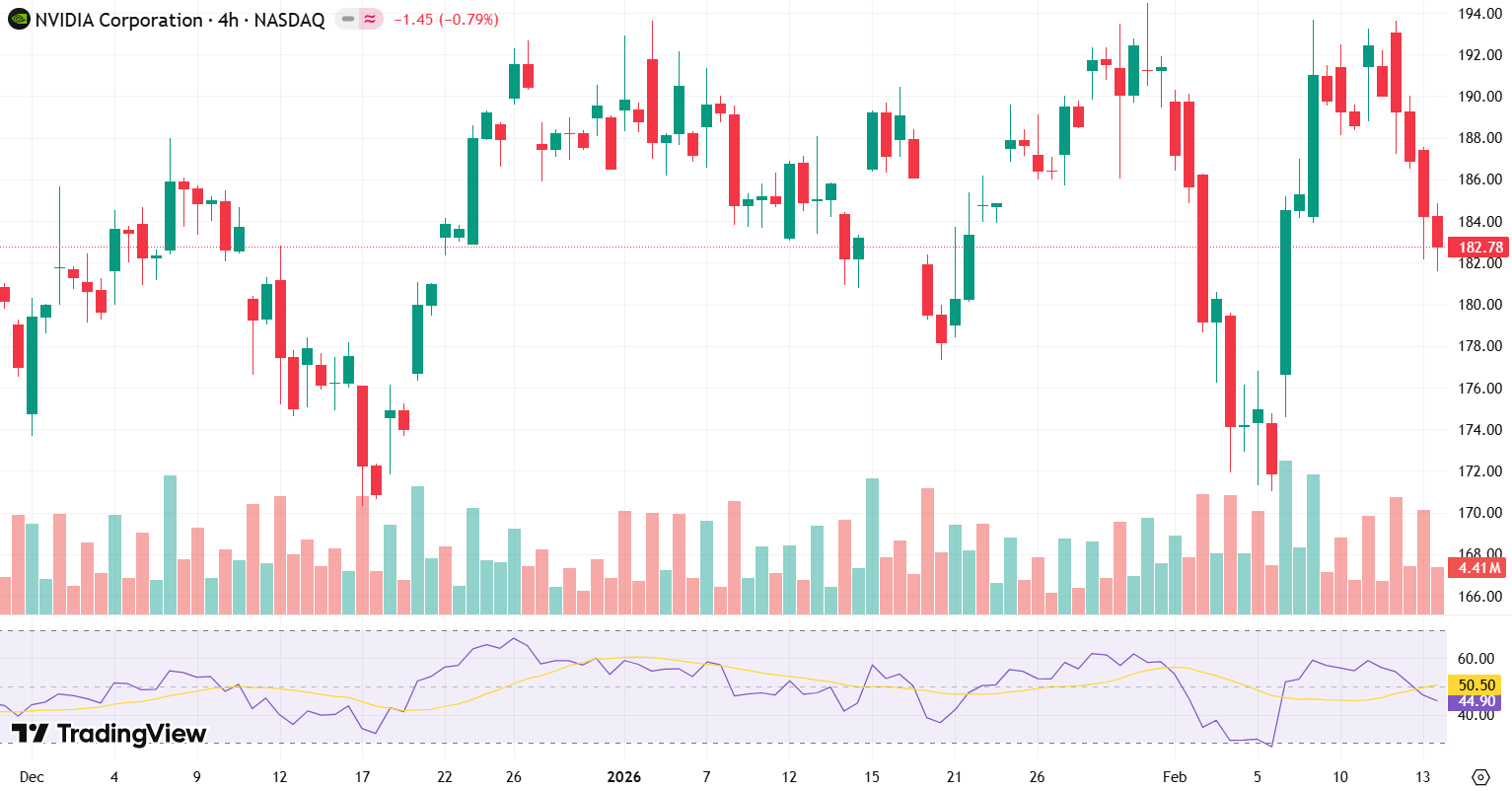
Nvidia stock price dynamics (December 2025 - February 2026). Source: TradingView
Momentum indicators are neutral. The Relative Strength Index is fluctuating around the mid-50 level, signaling neither overbought nor oversold conditions. The MACD has flattened, reflecting a pause in upside momentum rather than a confirmed bearish reversal. Volume has declined during the latest pullback, which reduces the probability of an aggressive downside breakdown in the immediate term.
Bridgewater boosts Nvidia stake to $721M amid stock pressure
Ray Dalio’s Bridgewater Associates has significantly increased its exposure to Nvidia, adding nearly 1.35 million shares according to its latest 13F filing. The move lifted the fund’s total position to approximately $721 million at year-end, making Nvidia one of its more substantial equity holdings. Within Bridgewater’s $27.4 billion U.S. stock portfolio, Nvidia now accounts for roughly 2.63%, underscoring the scale of the allocation.
The timing of this expansion is particularly notable. Nvidia shares have recently faced pressure, experiencing heightened volatility and periodic pullbacks despite their dominant position in the AI semiconductor space. By increasing its stake during a phase of market hesitation, Bridgewater appears to be positioning itself strategically rather than reacting to short-term price weakness.
This adjustment signals conviction in Nvidia’s structural role in the AI arms race. While valuation concerns and competitive pressures remain part of the broader debate, Bridgewater’s allocation suggests confidence that Nvidia’s long-term growth trajectory outweighs near-term fluctuations. The size of the investment implies that the fund views current price levels as an opportunity rather than a warning sign.
Breakout or corrective pullback ahead
In the short term, Nvidia’s direction hinges on reclaiming the $185–$190 resistance zone. A breakout above $190 could quickly open the path toward $200 and potentially $210, while failure to clear this level would likely keep the stock consolidating within the $170–$190 range until the next major catalyst.
The bearish scenario activates only on a daily close below $170. Such a move would signal a breakdown of the consolidation structure and open downside potential toward $160 and possibly $150 in an accelerated correction. That scenario currently carries lower probability given the absence of heavy selling pressure.
Representative Ro Khanna signaled openness to allowing Nvidia to sell older-generation Hopper chips, including the H200, to China once the U.S. secures a clear technological lead. While opposing exports of next-generation Blackwell or Rubin chips, he supports monetizing legacy AI hardware without compromising America’s strategic edge.






-
 Afghanistan
-
 Albania
-
 Algeria
-
 Angola
-
 Argentina
-
 Armenia
-
 Australia
-
 Austria
-
 Azerbaijan
-
 Bahamas
-
 Bahrain
-
 Bangladesh
-
 Belarus
-
 Belgium
-
 Bolivia
-
 Botswana
-
 Brazil
-
 Brunei
-
 Bulgaria
-
 Cambodia
-
 Cameroon
-
 Canada
-
 Chile
Chile
-
 China
China
-
 Colombia
-
 Congo
Congo
-
 Costa Rica
-
 Cote d'Ivoire
-
 Croatia
-
 Cuba
Cuba
-
 Cyprus
-
 Czechia
-
 DR Congo
-
 Denmark
-
 Dominican Republic
-
 Ecuador
-
 Egypt
Egypt
-
 El Salvador
-
 Estonia
-
 Eswatini
-
 Ethiopia
-
 Finland
-
 France
-
 Georgia
-
 Germany
-
 Ghana
Ghana
-
 Greece
-
 Haiti
Haiti
-
 Hong Kong
-
 Hungary
-
 India
India
-
 Indonesia
-
 Iran, Islamic republic
-
 Iraq
Iraq
-
 Ireland
-
 Israel
-
 Italy
Italy
-
 Jamaica
-
 Japan
Japan
-
 Jordan
-
 Kazakhstan
-
 Kenya
Kenya
-
 Korea
Korea
-
 Kuwait
-
 Kyrgyzstan
-
 Laos
Laos
-
 Latvia
-
 Lebanon
-
 Lesotho
-
 Libya
Libya
-
 Lithuania
-
 Luxembourg
-
 Madagascar
-
 Malaysia
-
 Malta
Malta
-
 Mauritius
-
 Mexico
-
 Moldova
-
 Mongolia
-
 Montenegro
-
 Morocco
-
 Mozambique
-
 Myanmar
-
 Namibia
-
 Nepal
Nepal
-
 Netherlands
-
 New Zealand
-
 Nigeria
-
 North Macedonia
-
 Norway
-
 Oman
Oman
-
 Pakistan
-
 Palestine
-
 Panama
-
 Papua New Guinea
-
 Paraguay
-
 Peru
Peru
-
 Philippines
-
 Poland
-
 Portugal
-
 Puerto Rico
-
 Qatar
Qatar
-
 Reunion
-
 Romania
-
 Rwanda
-
 Saudi Arabia
-
 Serbia
-
 Singapore
-
 Slovakia
-
 Slovenia
-
 Somalia
-
 South Africa
-
 Spain
Spain
-
 Sri Lanka
-
 Sweden
-
 Switzerland
-
 Syria
Syria
-
 Taiwan
-
 Tajikistan
-
 Tanzania
-
 Thailand
-
 Trinidad and Tobago
-
 Tunisia
-
 Turkey
-
 UAE
UAE
-
 Uganda
-
 Ukraine
-
 United Kingdom
-
United States
-
 Uruguay
-
 Uzbekistan
-
 Venezuela
-
 Vietnam
-
 Yemen
Yemen
-
 Zambia
-
 Zimbabwe
- Forex
- Crypto











