
WTI crude oil price forecast: Consolidation near $62 tests breakout as diplomacy tempers risk premium

WTI crude oil traded at $62.48 per barrel, up 0.31%, as prices steadied in a tight range following recent losses. The market is balancing tentative diplomatic progress in key geopolitical flashpoints against persistent concerns about oversupply and rising production.
Highlights
- WTI trades near $62.48 as prices consolidate after failing above $66.
- Key support sits at $61–62 amid a dense cluster of moving averages.
- Diplomatic progress with Iran tempers risk premium while supply risks rise.
After rallying sharply from December lows near $55 to early February highs around $67, crude has entered a period of hesitation. Traders are now awaiting fresh inventory data and clearer geopolitical direction before committing to the next move.
Technical structure tests February breakout
From a chart perspective, WTI is hovering just above a critical confluence zone. The 50-day EMA at $62.64, 100-day EMA at $61.25, 200-day EMA at $62.62, and longer 200-day MA at $61.11 are tightly compressed between $61.50 and $62.75. This cluster often precedes a decisive directional move.
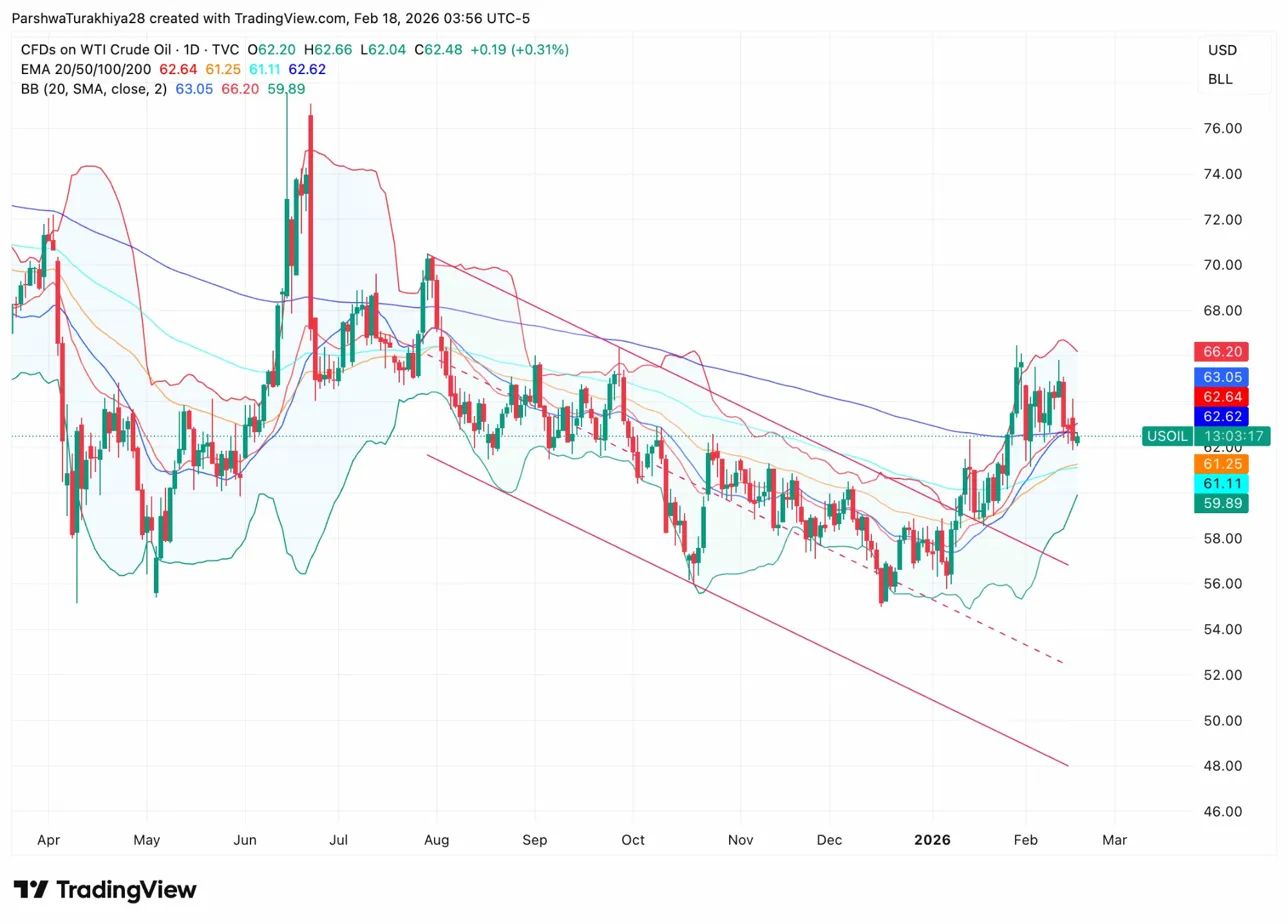
WTI price dynamics (Source: TradingView)
Bollinger Bands show the middle band at $63.05, with the upper band at $66.20 and the lower band at $59.89, placing current prices in the lower-middle of the recent range. The key question is whether February’s break above a long-standing descending trendline was sustainable or a false breakout.
A firm close below $61 would signal a meaningful technical setback and expose $58–60. Conversely, a rebound toward $64–65 would suggest the pullback is a consolidation within a broader recovery trend.
Diplomacy and supply shape fundamentals
On the fundamental side, cautious optimism surrounds reports that Iran and the U.S. have reached a preliminary understanding on guiding principles to address their nuclear dispute. While a final agreement remains distant, even incremental progress reduces the immediate risk of supply disruptions through the Strait of Hormuz, which carries roughly 20% of global oil flows.
At the same time, military signaling persists. Iran temporarily closed sections of the Strait for drills, and the U.S. continues to maintain two carrier groups in the region, underscoring that tensions remain elevated despite diplomatic engagement.
Separately, U.S.-mediated discussions between Ukraine and Russia are proceeding, though expectations for rapid breakthroughs are limited. Any tangible progress in either arena would likely remove additional geopolitical risk premium from oil prices.
Meanwhile, supply-side pressures are intensifying. Kazakhstan’s Tengiz field is ramping output following January’s suspension, adding barrels to a market already grappling with surplus projections. Recent inventory builds have raised fresh concerns about demand strength, making upcoming API and EIA data critical for short-term direction.
Outlook remains range-bound
WTI faces a pivotal moment near $61–62 support, with resistance at $64–65. Diplomatic developments may ease geopolitical tension, but rising output and stockpile concerns continue to limit upside momentum.
As previously discussed, crude’s February breakout shifted the technical narrative, yet failure to hold above $65 has reopened the debate over whether the recovery is durable. Until a decisive catalyst emerges, prices are likely to remain confined between $60 and $65.


Latest WTI News







-
 Afghanistan
-
 Albania
-
 Algeria
-
 Angola
-
 Argentina
-
 Armenia
-
 Australia
-
 Austria
-
 Azerbaijan
-
 Bahamas
-
 Bahrain
-
 Bangladesh
-
 Belarus
-
 Belgium
-
 Bolivia
-
 Botswana
-
 Brazil
-
 Brunei
-
 Bulgaria
-
 Cambodia
-
 Cameroon
-
 Canada
-
 Chile
Chile
-
 China
China
-
 Colombia
-
 Congo
Congo
-
 Costa Rica
-
 Cote d'Ivoire
-
 Croatia
-
 Cuba
Cuba
-
 Cyprus
-
 Czechia
-
 DR Congo
-
 Denmark
-
 Dominican Republic
-
 Ecuador
-
 Egypt
Egypt
-
 El Salvador
-
 Estonia
-
 Eswatini
-
 Ethiopia
-
 Finland
-
 France
-
 Georgia
-
 Germany
-
 Ghana
Ghana
-
 Greece
-
 Haiti
Haiti
-
 Hong Kong
-
 Hungary
-
 India
India
-
 Indonesia
-
 Iran, Islamic republic
-
 Iraq
Iraq
-
 Ireland
-
 Israel
-
 Italy
Italy
-
 Jamaica
-
 Japan
Japan
-
 Jordan
-
 Kazakhstan
-
 Kenya
Kenya
-
 Korea
Korea
-
 Kuwait
-
 Kyrgyzstan
-
 Laos
Laos
-
 Latvia
-
 Lebanon
-
 Lesotho
-
 Libya
Libya
-
 Lithuania
-
 Luxembourg
-
 Madagascar
-
 Malaysia
-
 Malta
Malta
-
 Mauritius
-
 Mexico
-
 Moldova
-
 Mongolia
-
 Montenegro
-
 Morocco
-
 Mozambique
-
 Myanmar
-
 Namibia
-
 Nepal
Nepal
-
 Netherlands
-
 New Zealand
-
 Nigeria
-
 North Macedonia
-
 Norway
-
 Oman
Oman
-
 Pakistan
-
 Palestine
-
 Panama
-
 Papua New Guinea
-
 Paraguay
-
 Peru
Peru
-
 Philippines
-
 Poland
-
 Portugal
-
 Puerto Rico
-
 Qatar
Qatar
-
 Reunion
-
 Romania
-
 Rwanda
-
 Saudi Arabia
-
 Serbia
-
 Singapore
-
 Slovakia
-
 Slovenia
-
 Somalia
-
 South Africa
-
 Spain
Spain
-
 Sri Lanka
-
 Sweden
-
 Switzerland
-
 Syria
Syria
-
 Taiwan
-
 Tajikistan
-
 Tanzania
-
 Thailand
-
 Trinidad and Tobago
-
 Tunisia
-
 Turkey
-
 UAE
UAE
-
 Uganda
-
 Ukraine
-
 United Kingdom
-
United States
-
 Uruguay
-
 Uzbekistan
-
 Venezuela
-
 Vietnam
-
 Yemen
Yemen
-
 Zambia
-
 Zimbabwe
- Forex
- Crypto











