
Nvidia stock rises 2% amid energy partnerships for AI expansion
Investor sentiment in the stock market tends to shift. As of March 24, Nvidia stock is trading at $176.32, up 2% over the past 24 hours. This indicates the signs of stabilization following a nearly 9% decline over the past month.
Highlights
- Nvidia is stabilizing near $176 after a recent pullback, and technical indicators indicate the likely consolidation and a possible breakout above $182.
- The company’s partnership with energy firms enables the integration of AI infrastructure with power systems.
- Short-term price action remains range-bound, but it tends to improve sentiment and ease selling pressure, supporting a mild upside move toward $190.
The stock is now consolidating within a defined range, with resistance at $178–$182. The 20-day moving average is trending downward and serves as a dynamic ceiling. On the downside, $170 remains the key near-term support. It has been tested multiple times over the past week.
A secondary and more significant support zone lies at $160–$165. In this area, longer-term buyers are likely to re-enter, supported by the 200-day moving average. Momentum indicators suggest neutrality. In particular, the RSI sits around the mid-40s, confirming neither overbought nor oversold conditions. Declining volume may lead to fading selling pressure rather than strong accumulation.
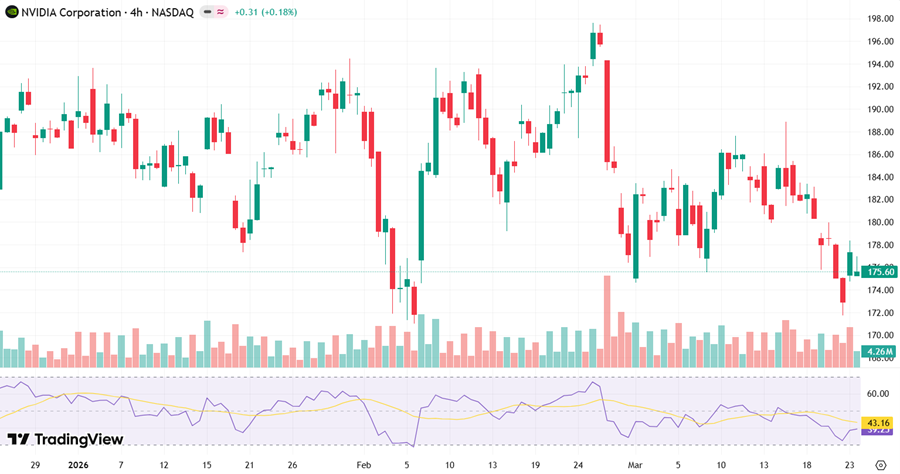
Nvidia shares price performance (January 2026 – March 2026). Source: TradingView
However, the broader trend remains stable. Nvidia continues to trade well above its 200-day average, and its long-term bullish structure remains the same. However, the short-term pattern reflects a descending channel. It shows consolidation rather than immediate continuation. A confirmed breakout above $182 may invalidate this pattern and cause renewed upside momentum.
Grid-integrated AI factories reshape Nvidia’s infrastructure play
Nvidia has expanded its AI strategy through a partnership with Emerald AI and six major U.S. energy companies. They include AES, Constellation, Invenergy, NextEra Energy, Nscale, and Vistra. This collaboration aims at accelerating the deployment of power-connected AI data centers. The initiative centers on Nvidia’s Vera Rubin DSX AI Factory design, which integrates compute, networking, and energy systems. A key innovation is the DSX Flex software layer, enabling these facilities to connect to power grids faster. They can also actively participate in grid services rather than functioning as passive consumers.
The strategic shift lies in turning AI data centers into flexible energy assets. These facilities will initially rely on co-located generation and battery storage to secure early-stage power supply. This may reduce delays tied to grid constraints. Over time, they are designed to feed electricity back into the grid. So they effectively serve as distributed energy resources. Emerald AI’s Conductor platform will enable this balance, adjusting compute workloads in line with grid conditions. The new system will maintain performance standards for AI operations. This positions Nvidia at the center of a new category where compute infrastructure and energy systems are co-optimized.
The broader implication is a potential unlocking of up to 100 gigawatts of additional capacity across the U.S. power system. This may address one of the most critical bottlenecks in AI scaling. With Nvidia reporting 65% revenue growth over the past year and continued upward earnings revisions, this move reinforces its transition from a chipmaker to a full-stack AI infrastructure provider. The ability to align compute demand with energy availability both enhances scalability but strengthens Nvidia’s long-term competitive situation.
Short-term scenarios point to range breakout decision
In the short term, Nvidia is approaching a technical breakout. The base case scenario implies continued consolidation within the $170–$185 range over the next weeks. At the moment, the market tends to absorb recent gains and awaits new catalysts.
A bullish breakout above $182 may cause momentum buying, with an initial target at $190 and potential extension toward $200. This scenario depends on improved sentiment in the tech sector and continued positive news flow and AI infrastructure expansion.
Nvidia has resumed H200 chip production for China after securing U.S. export licenses and receiving confirmed local orders, signaling a partial recovery of its China business. However, the company is supplying older-generation chips, indicating limited re-entry despite strong demand and regulatory approval from Beijing.








-
 Afghanistan
-
 Albania
-
 Algeria
-
 Angola
-
 Argentina
-
 Armenia
-
 Australia
-
 Austria
-
 Azerbaijan
-
 Bahamas
-
 Bahrain
-
 Bangladesh
-
 Belarus
-
 Belgium
-
 Bolivia
-
 Botswana
-
 Brazil
-
 Brunei
-
 Bulgaria
-
 Cambodia
-
 Cameroon
-
 Canada
-
 Chile
Chile
-
 China
China
-
 Colombia
-
 Congo
Congo
-
 Costa Rica
-
 Cote d'Ivoire
-
 Croatia
-
 Cuba
Cuba
-
 Cyprus
-
 Czechia
-
 DR Congo
-
 Denmark
-
 Dominican Republic
-
 Ecuador
-
 Egypt
Egypt
-
 El Salvador
-
 Estonia
-
 Eswatini
-
 Ethiopia
-
 Finland
-
 France
-
 Georgia
-
 Germany
-
 Ghana
Ghana
-
 Greece
-
 Haiti
Haiti
-
 Hong Kong
-
 Hungary
-
 India
India
-
 Indonesia
-
 Iran, Islamic republic
-
 Iraq
Iraq
-
 Ireland
-
 Israel
-
 Italy
Italy
-
 Jamaica
-
 Japan
Japan
-
 Jordan
-
 Kazakhstan
-
 Kenya
Kenya
-
 Korea
Korea
-
 Kuwait
-
 Kyrgyzstan
-
 Laos
Laos
-
 Latvia
-
 Lebanon
-
 Lesotho
-
 Libya
Libya
-
 Lithuania
-
 Luxembourg
-
 Madagascar
-
 Malaysia
-
 Malta
Malta
-
 Mauritius
-
 Mexico
-
 Moldova
-
 Mongolia
-
 Montenegro
-
 Morocco
-
 Mozambique
-
 Myanmar
-
 Namibia
-
 Nepal
Nepal
-
 Netherlands
-
 New Zealand
-
 Nigeria
-
 North Macedonia
-
 Norway
-
 Oman
Oman
-
 Pakistan
-
 Palestine
-
 Panama
-
 Papua New Guinea
-
 Paraguay
-
 Peru
Peru
-
 Philippines
-
 Poland
-
 Portugal
-
 Puerto Rico
-
 Qatar
Qatar
-
 Reunion
-
 Romania
-
 Rwanda
-
 Saudi Arabia
-
 Serbia
-
 Singapore
-
 Slovakia
-
 Slovenia
-
 Somalia
-
 South Africa
-
 Spain
Spain
-
 Sri Lanka
-
 Sweden
-
 Switzerland
-
 Syria
Syria
-
 Taiwan
-
 Tajikistan
-
 Tanzania
-
 Thailand
-
 Trinidad and Tobago
-
 Tunisia
-
 Turkey
-
 UAE
UAE
-
 Uganda
-
 Ukraine
-
 United Kingdom
-
United States
-
 Uruguay
-
 Uzbekistan
-
 Venezuela
-
 Vietnam
-
 Yemen
Yemen
-
 Zambia
-
 Zimbabwe
- Forex
- Crypto











