
LVMH stock falls below €520 amid Fendi leadership change

As of September 30, LVMH stock is trading at €519.7, down 0.7% in the last 24 hours. Year-to-date, the stock has declined by approximately 17%, underperforming the broader Euro Stoxx 50 index.
Highlights
- LVMH stock is trading at €519.7, down 0.7%, as investors react to leadership changes at Fendi and restructuring in its wine and spirits division.
- The company plans to cut 1,200 jobs at Moët Hennessy amid falling demand and margin pressure.
- Technical indicators remain weak, with the stock trading below key moving averages and facing resistance around €550.
The headline development this week is that Silvia Venturini Fendi will step down from her role as creative director at Fendi. She will remain as honorary president, but LVMH has yet to name a successor. The departure follows other major creative exits in 2025, including Dior’s Maria Grazia Chiuri earlier this year. These shifts suggest a generational and stylistic change within LVMH’s fashion and leather goods division, which contributes over 50% of group EBIT.
While such transitions are not unusual in luxury fashion, they come at a time when consumer sentiment is fragile and demand for high-end goods is cooling in both North America and China. Investors are especially sensitive to leadership changes at flagship maisons, as creative vision plays a direct role in brand momentum and pricing power. Fendi, while smaller than Louis Vuitton or Dior, plays a vital role in LVMH’s fashion portfolio and appeals to a younger demographic. Any disruption in design or collection rollouts could delay revenue recoveries in key quarters.
The challenges extend beyond fashion. Moët Hennessy, LVMH’s wine and spirits arm, is undergoing a painful restructuring. The division will cut 1,200 jobs—roughly 10% of its workforce—amid falling demand for cognac and champagne. Previously a cash engine, Moët Hennessy has recently come under pressure as consumer preferences shift toward lower-alcohol and premium non-alcoholic alternatives in key markets. Rising production costs, logistical bottlenecks, and weaker export volumes have all contributed to eroding margins.
Bearish trend persists as key averages signal technical weakness
From a technical standpoint, the chart reveals that LVMH remains stuck below its 200-day moving average, a bearish signal that reinforces broader concerns about momentum and investor conviction. The short-term 50-day moving average has also begun to curl lower, adding to downward pressure. Key support levels are clustered around €480–500, an area where the stock previously found buying interest. On the upside, resistance remains firm in the €530–550 band, a zone that has repelled multiple recovery attempts over the past three months.
Volume has remained stable, with no significant spikes suggesting panic selling, but relative strength index (RSI) indicators remain near neutral levels (45–50 range), indicating lackluster demand rather than oversold panic. Bollinger Bands are narrowing, which could precede a breakout—but the prevailing bias remains slightly bearish unless macro or internal catalysts change.
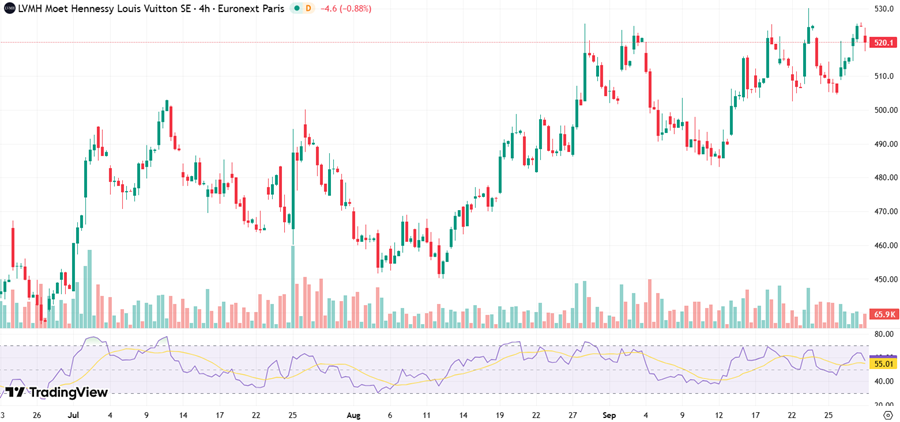
LVMH stock price dynamics (July 2025 - September 2025). Source: TradingView.
LVMH’s forward price-to-earnings ratio has dropped to roughly 20x, down from mid-20s at the start of the year, reflecting the market’s tempered growth expectations. Though still commanding a premium versus peers like Kering or Richemont, that premium is beginning to compress as the group battles headwinds in key business units, particularly Moët Hennessy.
Cautious outlook with limited upside and risk of renewed downside
The short-term outlook for LVMH remains cautious. In the base case, assuming the Fendi transition proceeds smoothly and further losses at Moët Hennessy are contained, the stock could stabilize and recover modestly toward the €530–540 range over the next six months. This would require evidence of resilience in Q4 earnings and early signs of recovery in U.S. and Chinese luxury demand. Investor sentiment would also need to improve, particularly among institutional holders currently underweight on the luxury sector.
In a downside scenario, where Moët Hennessy drags further on profitability or brand transitions result in weaker sell-through at Fendi or Dior, the stock could fall back to €480–490, testing major technical support. The threat of trade-related tariffs or unexpected macro deterioration could accelerate that move. A break below the €480 level could trigger algorithmic selling and push the stock toward the lower end of its 12-month range.
Goldman Sachs upgraded LVMH, raising its 12-month price target to €580 on stronger-than-expected brand resilience in fashion and leather goods. The move has boosted sentiment but increased pressure on LVMH to deliver strong Q3 results and clear guidance to support its premium valuation.








-
 Afghanistan
-
 Albania
-
 Algeria
-
 Angola
-
 Argentina
-
 Armenia
-
 Australia
-
 Austria
-
 Azerbaijan
-
 Bahamas
-
 Bahrain
-
 Bangladesh
-
 Belarus
-
 Belgium
-
 Bolivia
-
 Botswana
-
 Brazil
-
 Brunei
-
 Bulgaria
-
 Cambodia
-
 Cameroon
-
 Canada
-
 Chile
Chile
-
 China
China
-
 Colombia
-
 Congo
Congo
-
 Costa Rica
-
 Cote d'Ivoire
-
 Croatia
-
 Cuba
Cuba
-
 Cyprus
-
 Czechia
-
 DR Congo
-
 Denmark
-
 Dominican Republic
-
 Ecuador
-
 Egypt
Egypt
-
 El Salvador
-
 Estonia
-
 Eswatini
-
 Ethiopia
-
 Finland
-
 France
-
 Georgia
-
 Germany
-
 Ghana
Ghana
-
 Greece
-
 Haiti
Haiti
-
 Hong Kong
-
 Hungary
-
 India
India
-
 Indonesia
-
 Iran, Islamic republic
-
 Iraq
Iraq
-
 Ireland
-
 Israel
-
 Italy
Italy
-
 Jamaica
-
 Japan
Japan
-
 Jordan
-
 Kazakhstan
-
 Kenya
Kenya
-
 Korea
Korea
-
 Kuwait
-
 Kyrgyzstan
-
 Laos
Laos
-
 Latvia
-
 Lebanon
-
 Lesotho
-
 Libya
Libya
-
 Lithuania
-
 Luxembourg
-
 Madagascar
-
 Malaysia
-
 Malta
Malta
-
 Mauritius
-
 Mexico
-
 Moldova
-
 Mongolia
-
 Montenegro
-
 Morocco
-
 Mozambique
-
 Myanmar
-
 Namibia
-
 Nepal
Nepal
-
 Netherlands
-
 New Zealand
-
 Nigeria
-
 North Macedonia
-
 Norway
-
 Oman
Oman
-
 Pakistan
-
 Palestine
-
 Panama
-
 Papua New Guinea
-
 Paraguay
-
 Peru
Peru
-
 Philippines
-
 Poland
-
 Portugal
-
 Puerto Rico
-
 Qatar
Qatar
-
 Reunion
-
 Romania
-
 Rwanda
-
 Saudi Arabia
-
 Serbia
-
 Singapore
-
 Slovakia
-
 Slovenia
-
 Somalia
-
 South Africa
-
 Spain
Spain
-
 Sri Lanka
-
 Sweden
-
 Switzerland
-
 Syria
Syria
-
 Taiwan
-
 Tajikistan
-
 Tanzania
-
 Thailand
-
 Trinidad and Tobago
-
 Tunisia
-
 Turkey
-
 UAE
UAE
-
 Uganda
-
 Ukraine
-
 United Kingdom
-
United States
-
 Uruguay
-
 Uzbekistan
-
 Venezuela
-
 Vietnam
-
 Yemen
Yemen
-
 Zambia
-
 Zimbabwe
- Forex
- Crypto











