
Microsoft slips to $514 as investors weigh legal risks and AI growth outlook

Microsoft Corp. (NASDAQ: MSFT) fell 0.60% on Monday to close at $514.05, easing after a brief retest of key resistance levels near $515. The move reflects continued caution as investors balance optimism over the company’s AI-driven expansion with emerging legal challenges tied to its deep integration with OpenAI.
Highlights
- Microsoft closed at $514.05, down 0.60%, as the stock retested its 20-day EMA resistance.
- An antitrust lawsuit raises scrutiny over Microsoft’s $13 billion OpenAI investment.
- Support lies near $510, while resistance remains between $525 and $530.
The daily chart highlights Microsoft’s effort to stabilize above the 50-day exponential moving average (EMA) at $509.95, a key level that traders are watching closely. The stock has rebounded nearly 5% from its September low of $492.10, but resistance remains firm between $525 and $530, coinciding with the 0.5 and 0.618 Fibonacci retracement levels.
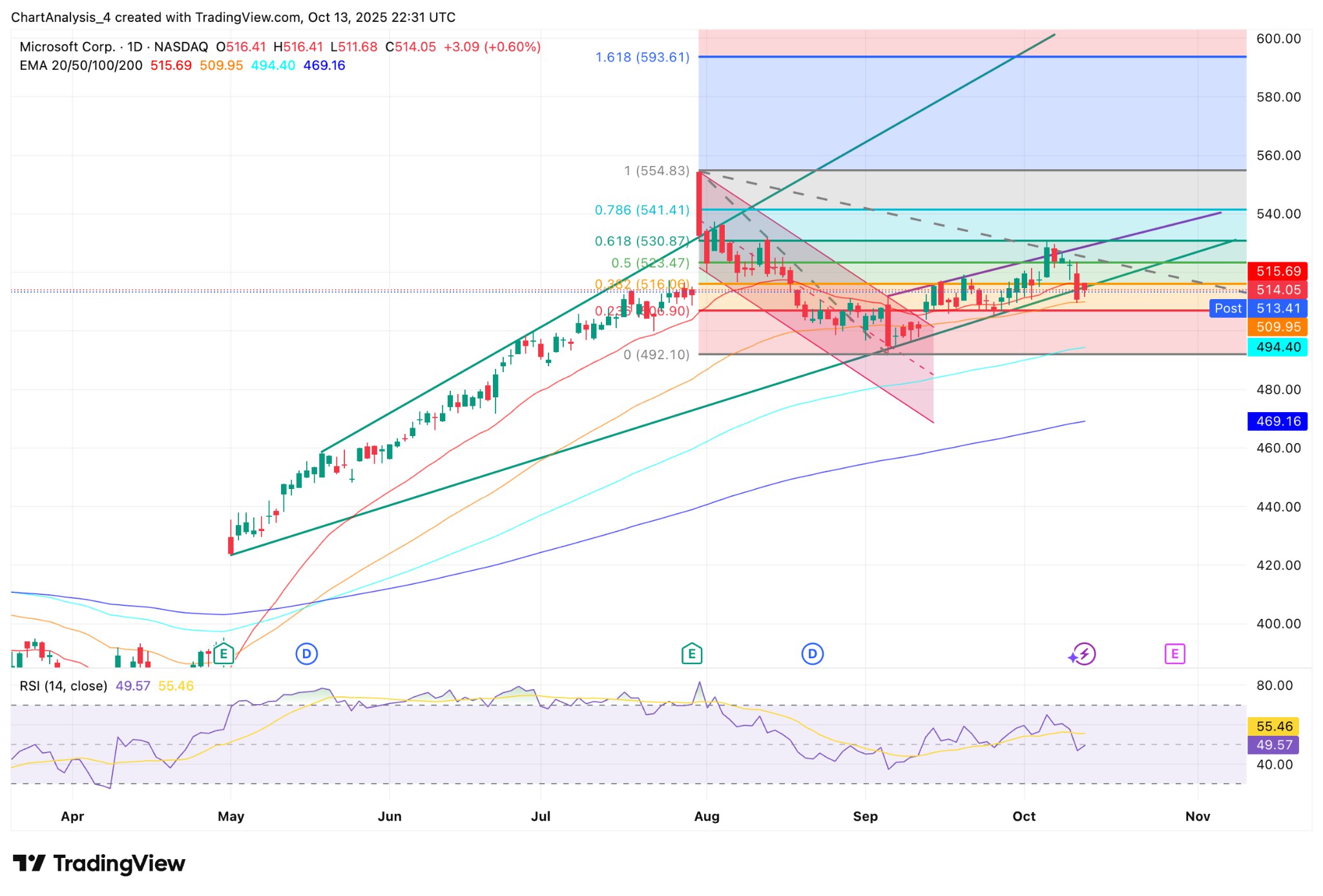
Microsoft stock analysis (Source: TradingView)
A successful breakout above that zone would open the path to $541 and possibly the July high of $554.83. Conversely, failure to hold $510 could bring a deeper pullback toward $494, with the 200-day EMA at $469 providing longer-term support. The relative strength index at 49.57 reinforces a neutral tone, suggesting the stock is consolidating rather than trending. Traders view $516–$520 as the threshold that would confirm renewed bullish control, while a close below $494 would signal broader weakness.
Legal scrutiny clouds otherwise strong fundamentals
Beyond the charts, Microsoft faces fresh regulatory pressure. A newly filed antitrust class action accuses the company of leveraging its exclusive partnership with OpenAI to limit competition and inflate the cost of generative AI services. The suit renews debate around Microsoft’s $13 billion investment in OpenAI, which has cemented its dominant role in the artificial intelligence ecosystem through its Azure cloud platform and integration of OpenAI models into products such as Copilot.
While the lawsuit introduces uncertainty, analysts suggest it is unlikely to disrupt operations in the near term. Instead, the focus remains on Microsoft’s expanding AI portfolio, which has become a key driver of investor confidence. Copilot adoption across enterprise software, alongside growing demand for Azure-based AI infrastructure, continues to underpin the company’s long-term growth narrative.
However, the balance between growth and regulation is becoming more complex. Regulators in both the U.S. and Europe have increased scrutiny of AI partnerships and data practices, raising the prospect of stricter oversight. Market observers say that while Microsoft’s scale provides an edge, legal developments could inject volatility into an otherwise steady uptrend.
Outlook
In the short term, attention centers on the $510–$525 trading range. Sustained trade above this zone could reignite upside momentum toward $541 and $555, while a breakdown below $510 risks a return to the $494–$469 region.
Previously, we discussed Microsoft’s critical positioning as the cornerstone of AI infrastructure, supported by robust enterprise demand and multi-year investment in generative tools. That thesis remains intact, but the growing legal spotlight adds a layer of caution. As investors weigh short-term turbulence against long-term opportunity, Microsoft’s ability to navigate regulation without slowing innovation will likely define its trajectory heading into 2026.


Latest Microsoft News







-
 Afghanistan
-
 Albania
-
 Algeria
-
 Angola
-
 Argentina
-
 Armenia
-
 Australia
-
 Austria
-
 Azerbaijan
-
 Bahamas
-
 Bahrain
-
 Bangladesh
-
 Belarus
-
 Belgium
-
 Bolivia
-
 Botswana
-
 Brazil
-
 Brunei
-
 Bulgaria
-
 Cambodia
-
 Cameroon
-
 Canada
-
 Chile
Chile
-
 China
China
-
 Colombia
-
 Congo
Congo
-
 Costa Rica
-
 Cote d'Ivoire
-
 Croatia
-
 Cuba
Cuba
-
 Cyprus
-
 Czechia
-
 DR Congo
-
 Denmark
-
 Dominican Republic
-
 Ecuador
-
 Egypt
Egypt
-
 El Salvador
-
 Estonia
-
 Eswatini
-
 Ethiopia
-
 Finland
-
 France
-
 Georgia
-
 Germany
-
 Ghana
Ghana
-
 Greece
-
 Haiti
Haiti
-
 Hong Kong
-
 Hungary
-
 India
India
-
 Indonesia
-
 Iran, Islamic republic
-
 Iraq
Iraq
-
 Ireland
-
 Israel
-
 Italy
Italy
-
 Jamaica
-
 Japan
Japan
-
 Jordan
-
 Kazakhstan
-
 Kenya
Kenya
-
 Korea
Korea
-
 Kuwait
-
 Kyrgyzstan
-
 Laos
Laos
-
 Latvia
-
 Lebanon
-
 Lesotho
-
 Libya
Libya
-
 Lithuania
-
 Luxembourg
-
 Madagascar
-
 Malaysia
-
 Malta
Malta
-
 Mauritius
-
 Mexico
-
 Moldova
-
 Mongolia
-
 Montenegro
-
 Morocco
-
 Mozambique
-
 Myanmar
-
 Namibia
-
 Nepal
Nepal
-
 Netherlands
-
 New Zealand
-
 Nigeria
-
 North Macedonia
-
 Norway
-
 Oman
Oman
-
 Pakistan
-
 Palestine
-
 Panama
-
 Papua New Guinea
-
 Paraguay
-
 Peru
Peru
-
 Philippines
-
 Poland
-
 Portugal
-
 Puerto Rico
-
 Qatar
Qatar
-
 Reunion
-
 Romania
-
 Rwanda
-
 Saudi Arabia
-
 Serbia
-
 Singapore
-
 Slovakia
-
 Slovenia
-
 Somalia
-
 South Africa
-
 Spain
Spain
-
 Sri Lanka
-
 Sweden
-
 Switzerland
-
 Syria
Syria
-
 Taiwan
-
 Tajikistan
-
 Tanzania
-
 Thailand
-
 Trinidad and Tobago
-
 Tunisia
-
 Turkey
-
 UAE
UAE
-
 Uganda
-
 Ukraine
-
 United Kingdom
-
United States
-
 Uruguay
-
 Uzbekistan
-
 Venezuela
-
 Vietnam
-
 Yemen
Yemen
-
 Zambia
-
 Zimbabwe
- Forex
- Crypto











