

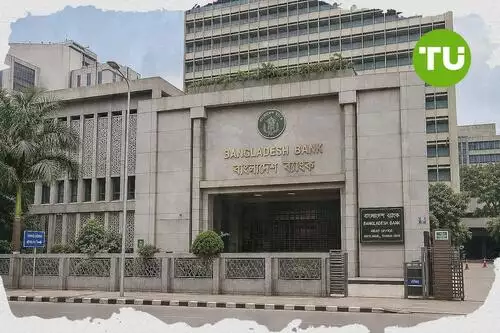
Bangladesh banks' capital shortfall deepens as weak balance sheets curb private credit

Bangladesh's banking sector is facing mounting pressure as capital shortfalls widen across 22 lenders and private sector credit growth stays at historically low levels. The strain is limiting banks' capacity to finance new investment while businesses remain cautious because of high borrowing costs, weak law and order, and energy concerns.
Highlights
- Bangladesh's banking sector capital shortfall widened to Tk3,08,803 crore across 22 banks by June, up from Tk2.94 lakh crore over 21 banks in March.
- The sector's combined CRAR fell to negative 3.80% in June, far below the Bangladesh Bank's required 12.5%, with Islamic banks accounting for over Tk1,87,238 crore of deficits.
- Private sector credit growth slipped to 4.17% in September as rising non-performing loans force higher provisioning, reducing profits and lending capacity amid loan irregularities and weak investor demand.
Capital deficit widens across banking system
As reported by The Business Standard, the combined capital shortfall of 22 banks rises to Tk3,08,803 crore at the end of June, from around Tk2.94 lakh crore across 21 banks at the end of March, according to Bangladesh Bank data. The remaining banks in the country have no capital shortfall, the central bank data shows.The banking sector's overall capital adequacy ratio, or CRAR, falls further to negative 3.80% at the end of June, compared with negative 3.17% at the end of March. Under Bangladesh Bank regulations, banks are required to maintain a minimum capital adequacy ratio of 12.5%.
Islamic banks account for the largest share of the deficit, with seven lenders posting a combined capital shortfall of Tk1,87,238 crore at the end of June. First Security Islami Bank alone accounts for Tk66,126 crore and is now operating as part of Sammilito Islami Bank following its merger.
The four state-owned banks post a combined capital shortfall of Tk38,411 crore, led by Janata Bank at Tk19,707 crore, followed by Agrani Bank at Tk8,782 crore, Rupali Bank at Tk5,231 crore and BASIC Bank at Tk4,690 crore. Eight private banks report a combined shortfall of Tk49,731 crore, including National Bank at Tk17,474 crore, AB Bank at Tk8,912 crore, IFIC Bank at Tk7,199 crore, Padma Bank at Tk6,618 crore and Premier Bank at Tk6,078 crore.
Among specialised banks, Bangladesh Krishi Bank records a capital shortfall of Tk30,461 crore, while Rajshahi Krishi Unnayan Bank posts a deficit of Tk2,957 crore. Foreign lender National Bank of Pakistan reports a shortfall of Tk4 crore.
Bad loans and weak demand weigh on lending
Private sector credit growth remains below 5% for the seventh consecutive month and falls to 4.17% in September, reflecting both weakened lending capacity and subdued demand for fresh investment. Bankers say a large share of loans disbursed through irregularities and political influence during the Awami League government's tenure has turned non-performing.Higher provisioning against bad loans is cutting profits and pushing some banks into losses, further eroding capital and weakening their ability to run normal operations and extend new loans. A recent report by The Economist says parts of Bangladesh's banking sector are at risk of insolvency because of corruption and lending irregularities, and adds that nearly one-third of total sector loans has become non-performing.
Bankers, economists and businesspeople say financing is now under pressure from both sides. Financially weak banks have less capacity to lend, while businesses are reluctant to invest or expand because of high lending rates, VAT and tax complexities, deteriorating law and order, rising energy prices and renewed fears of energy shortages.
Syed Mahbubur Rahman, managing director of Mutual Trust Bank, says rising non-performing loans are forcing banks to maintain higher provisions, reducing profits and eroding capital when provisioning leads to losses. Ejazul Islam, director general of the Bangladesh Institute of Bank Management, says the sector's capital adequacy position has deteriorated further, although stronger private banks still maintain ratios of between 10% and 12%, and he calls for better governance, capital restructuring, fresh fund injections and stricter enforcement of banking rules.
Previously, we outlined the main factors behind Moody’s negative outlook for US banks amid recession and interest-rate risks.






Latest Bangladesh News




-
 Afghanistan
-
 Albania
-
 Algeria
-
 Angola
-
 Argentina
-
 Armenia
-
 Australia
-
 Austria
-
 Azerbaijan
-
 Bahamas
-
 Bahrain
-
 Bangladesh
-
 Belarus
-
 Belgium
-
 Bolivia
-
 Botswana
-
 Brazil
-
 Brunei
-
 Bulgaria
-
 Cambodia
-
 Cameroon
-
 Canada
-
 Chile
-
 China
-
 Colombia
-
 Congo
-
 Costa Rica
-
 Cote d'Ivoire
-
 Croatia
-
 Cuba
-
 Cyprus
-
 Czechia
-
 DR Congo
-
 Denmark
-
 Dominican Republic
-
 Ecuador
-
 Egypt
-
 El Salvador
-
 Estonia
-
 Eswatini
-
 Ethiopia
-
 Finland
-
 France
-
 Georgia
-
 Germany
-
 Ghana
-
 Greece
-
 Haiti
-
 Hong Kong
-
 Hungary
-
 India
-
 Indonesia
-
 Iran, Islamic republic
-
 Iraq
-
 Ireland
-
 Israel
-
 Italy
-
 Jamaica
-
 Japan
-
 Jordan
-
 Kazakhstan
-
 Kenya
-
 Korea
-
 Kuwait
-
 Kyrgyzstan
-
 Laos
-
 Latvia
-
 Lebanon
-
 Lesotho
-
 Libya
-
 Lithuania
-
 Luxembourg
-
 Madagascar
-
 Malaysia
-
 Malta
-
 Mauritius
-
 Mexico
-
 Moldova
-
 Mongolia
-
 Montenegro
-
 Morocco
-
 Mozambique
-
 Myanmar
-
 Namibia
-
 Nepal
-
 Netherlands
-
 New Zealand
-
 Nigeria
-
 North Macedonia
-
 Norway
-
 Oman
-
 Pakistan
-
 Palestine
-
 Panama
-
 Papua New Guinea
-
 Paraguay
-
 Peru
-
 Philippines
-
 Poland
-
 Portugal
-
 Puerto Rico
-
 Qatar
-
 Reunion
-
 Romania
-
 Rwanda
-
 Saudi Arabia
-
 Serbia
-
 Singapore
-
 Slovakia
-
 Slovenia
-
 Somalia
-
 South Africa
-
 Spain
-
 Sri Lanka
-
 Sweden
-
 Switzerland
-
 Syria
-
 Taiwan
-
 Tajikistan
-
 Tanzania
-
 Thailand
-
 Trinidad and Tobago
-
 Tunisia
-
 Turkey
-
 UAE
-
 Uganda
-
 Ukraine
-
 United Kingdom
-
United States
-
 Uruguay
-
 Uzbekistan
-
 Venezuela
-
 Vietnam
-
 Yemen
-
 Zambia
-
 Zimbabwe
- Forex
- Crypto












