

Boeing stock pullback extends as oversold conditions limit further selling

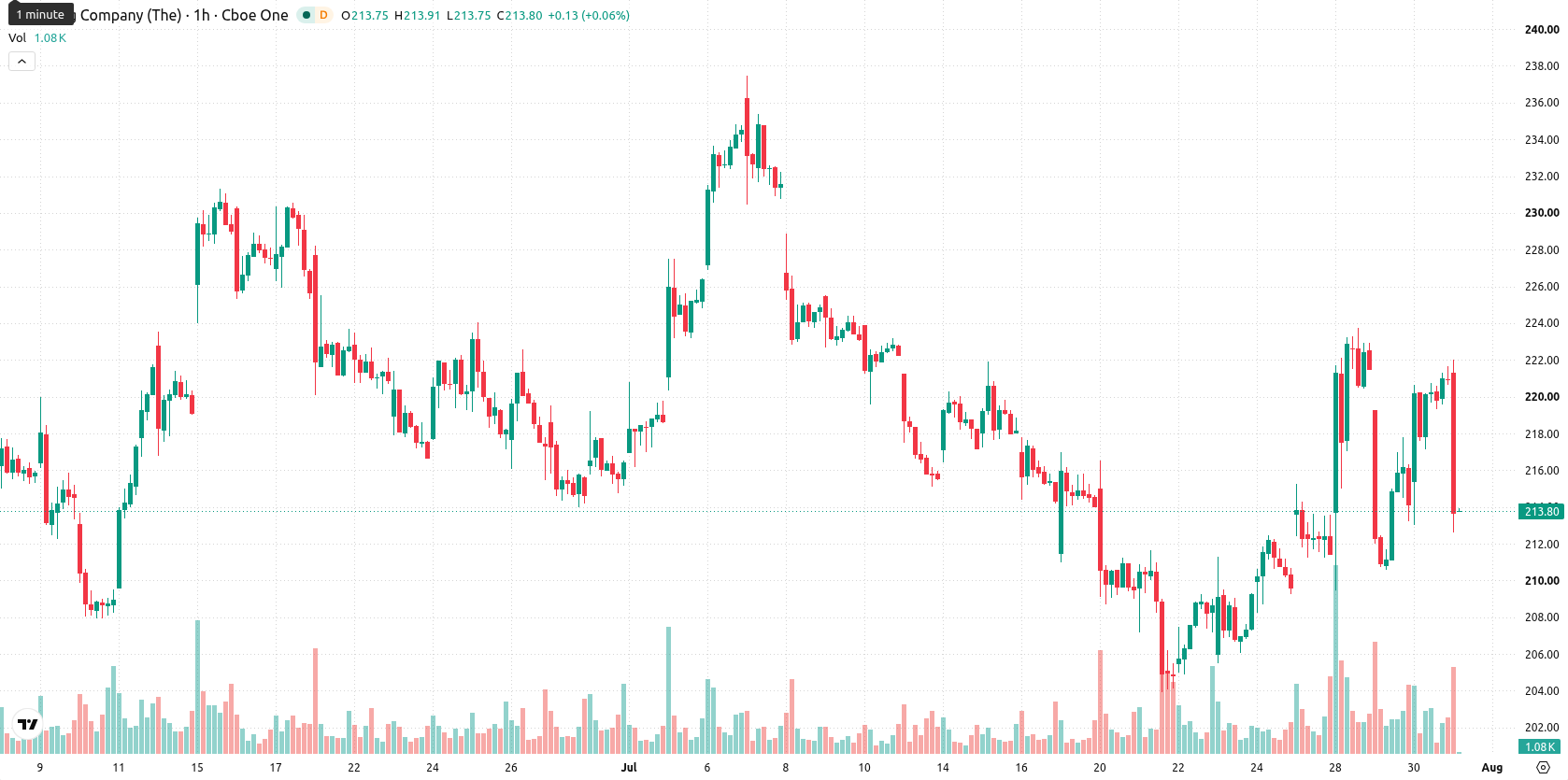
Boeing (BA) stock is trading at $214.07 after a drop of 3.25% for the day, sitting below its key short- and long-term moving averages while remaining above the medium-term average.
 174.45
178.35
Highlights
- Boeing's final contract proposal to about 17,000 SPEEA engineers aims to resolve labor talks, potentially stabilizing operations.
- Completion of 737 MAX 7, MAX 10, and 777X test flights advances key product certifications, easing regulatory uncertainty before launches.
- BA/USD is trading under broad selling pressure with a 54% probability of downside, targeting a $207.62–$220.52 range for the next 2–3 days.
Final labor contract and certification progress offset by persistent pressure
Boeing presented its final contract offer to around 17,000 engineers represented by the Society of Professional Engineering Employees in Aerospace (SPEEA), according to Marketscreener. This seeks to resolve labor negotiations, which could bring greater operational stability if the offer is accepted. Separately, Boeing completed the final planned certification flight test for the 737-10 model and finished certification flight testing for both the 737 MAX 7 and MAX 10, mitigating regulatory hurdles ahead of expected product rollouts. The seventh 777-9 test aircraft entering the ETOPS phase also advances the 777X program toward final certification, though price action has remained under broader selling pressure.
Bullish momentum clashes with resistance and low volatility signals
The 20-period and 200-period moving averages are positioned above the current price, while the 50-period moving average sits below. The Ichimoku Kijun on the daily chart stands at $216.56, acting as immediate resistance. Technical indicators reveal a divergence: MACD, ADX, and Awesome Oscillator give bullish momentum signals, but Stoch RSI and Bull/Bear Power both highlight overbought conditions and buyer dominance. The RSI and CCI confirm strong buying strength, yet the presence of a $5.25 downside gap and low volatility contrasts sharply with these momentum signals.
Short-term downside risk rises amid break-triggered volatility bands
Over the next 2 to 3 trading days, BA is expected to fluctuate within a typical volatility band between $207.62 and $220.52. There is a 54% probability of a downside move and a 46% likelihood of an upward break, tilting short-term risks toward further weakness. A confirmed breakout above $216.56 could open the door for additional gains, while a move below $207.62 would likely accelerate downside momentum.
Previously it was reported that Boeing's technical and fundamental outlook had shifted toward a more bullish sentiment amid narrowing losses and progress on regulatory milestones. The current decline below key moving averages and heightened downside risk suggest that a sustained move above $216.56 or below $207.62 will likely set the tone for BA's next decisive trend.






Latest Boeing News




-
 Afghanistan
-
 Albania
-
 Algeria
-
 Angola
-
 Argentina
-
 Armenia
-
 Australia
-
 Austria
-
 Azerbaijan
-
 Bahamas
-
 Bahrain
-
 Bangladesh
-
 Belarus
-
 Belgium
-
 Bolivia
-
 Botswana
-
 Brazil
-
 Brunei
-
 Bulgaria
-
 Cambodia
-
 Cameroon
-
 Canada
-
 Chile
-
 China
-
 Colombia
-
 Congo
-
 Costa Rica
-
 Cote d'Ivoire
-
 Croatia
-
 Cuba
-
 Cyprus
-
 Czechia
-
 DR Congo
-
 Denmark
-
 Dominican Republic
-
 Ecuador
-
 Egypt
-
 El Salvador
-
 Estonia
-
 Eswatini
-
 Ethiopia
-
 Finland
-
 France
-
 Georgia
-
 Germany
-
 Ghana
-
 Greece
-
 Haiti
-
 Hong Kong
-
 Hungary
-
 India
-
 Indonesia
-
 Iran, Islamic republic
-
 Iraq
-
 Ireland
-
 Israel
-
 Italy
-
 Jamaica
-
 Japan
-
 Jordan
-
 Kazakhstan
-
 Kenya
-
 Korea
-
 Kuwait
-
 Kyrgyzstan
-
 Laos
-
 Latvia
-
 Lebanon
-
 Lesotho
-
 Libya
-
 Lithuania
-
 Luxembourg
-
 Madagascar
-
 Malaysia
-
 Malta
-
 Mauritius
-
 Mexico
-
 Moldova
-
 Mongolia
-
 Montenegro
-
 Morocco
-
 Mozambique
-
 Myanmar
-
 Namibia
-
 Nepal
-
 Netherlands
-
 New Zealand
-
 Nigeria
-
 North Macedonia
-
 Norway
-
 Oman
-
 Pakistan
-
 Palestine
-
 Panama
-
 Papua New Guinea
-
 Paraguay
-
 Peru
-
 Philippines
-
 Poland
-
 Portugal
-
 Puerto Rico
-
 Qatar
-
 Reunion
-
 Romania
-
 Rwanda
-
 Saudi Arabia
-
 Serbia
-
 Singapore
-
 Slovakia
-
 Slovenia
-
 Somalia
-
 South Africa
-
 Spain
-
 Sri Lanka
-
 Sweden
-
 Switzerland
-
 Syria
-
 Taiwan
-
 Tajikistan
-
 Tanzania
-
 Thailand
-
 Trinidad and Tobago
-
 Tunisia
-
 Turkey
-
 UAE
-
 Uganda
-
 Ukraine
-
 United Kingdom
-
United States
-
 Uruguay
-
 Uzbekistan
-
 Venezuela
-
 Vietnam
-
 Yemen
-
 Zambia
-
 Zimbabwe
- Forex
- Crypto












