


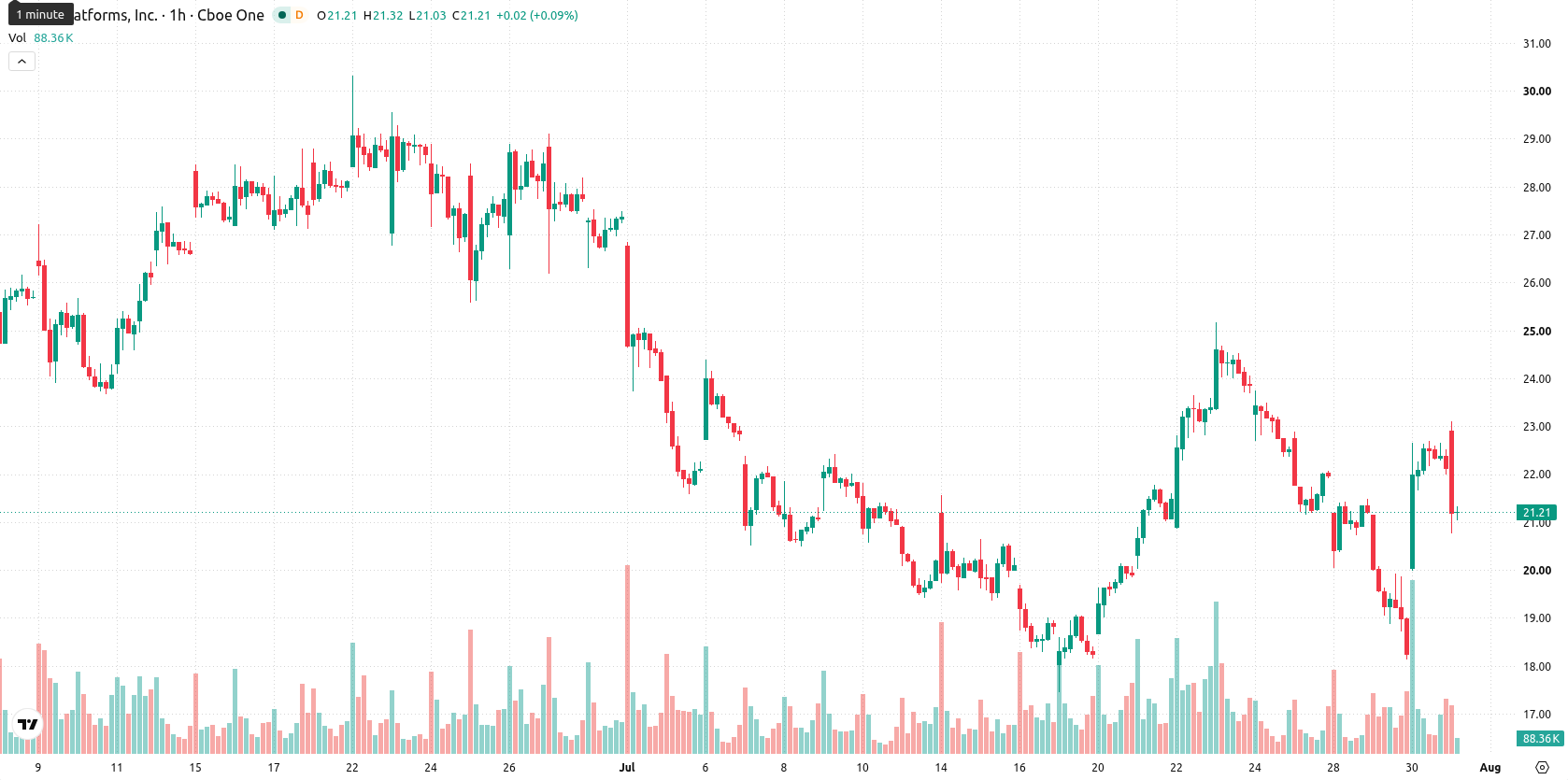
Riot Platforms (RIOT) stock is trading at $21.19, marking a 4.2% daily decline. The price sits above its key short-term averages but remains below several intermediate-term moving averages.
 17.12
17.12
Highlights
- Price maintains a short-term bullish stance but faces medium-term resistance with strong long-term support in place.
- Momentum signals are mixed as intraday buyer dominance meets overbought indicators and weak closing tone amid high volatility.
- Expected price range is $19.05 to $23.33 over the next sessions, with immediate support at $20.57 and a slight bullish bias.
Bullish momentum and overbought signals amid mixed indicators
On the hourly chart, price action is above the MA-20 at $20.91 while continuing to face resistance below the MA-50 at $22.08. On the daily timeframe, RIOT is holding well above the MA-200 at $18.54, with the Ichimoku Kijun situated at $20.57 acting as immediate support. Momentum signals are mixed: RSI at 57.27 and CCI both indicate buying, supported by evidence from ADX and Awesome Oscillator pointing to intraday bullish momentum. However, Stochastic RSI and Bull/Bear Power register overbought conditions, highlighting strong buyer dominance, while MACD remains neutral and points to divergent momentum. Notably, the price closed near the day’s low with a 0.87 gap amid high volatility.
Marginal buyer advantage as volatility defines consolidation range
In the short term, RIOT is forecast to fluctuate within a wide range between $19.05 and $23.33. The baseline scenario anticipates consolidation within this volatility band. With the up probability at 52% and the downside at 48%, buyers have a marginal edge. A sustained move above resistance could drive retests of upper price levels, while a break under $20.57 support would expose the lower end of the projected range.
Earlier, analysts noted that Riot Platforms was grappling with mixed technical signals and medium-term resistance limiting upward momentum. The current setup reinforces this view, highlighting that sustained consolidation within the broad volatility band remains likely and making directional confirmation dependent on a decisive break beyond the established support or resistance levels.









-
 Afghanistan
-
 Albania
-
 Algeria
-
 Angola
-
 Argentina
-
 Armenia
-
 Australia
-
 Austria
-
 Azerbaijan
-
 Bahamas
-
 Bahrain
-
 Bangladesh
-
 Belarus
-
 Belgium
-
 Bolivia
-
 Botswana
-
 Brazil
-
 Brunei
-
 Bulgaria
-
 Cambodia
-
 Cameroon
-
 Canada
-
 Chile
-
 China
-
 Colombia
-
 Congo
-
 Costa Rica
-
 Cote d'Ivoire
-
 Croatia
-
 Cuba
-
 Cyprus
-
 Czechia
-
 DR Congo
-
 Denmark
-
 Dominican Republic
-
 Ecuador
-
 Egypt
-
 El Salvador
-
 Estonia
-
 Eswatini
-
 Ethiopia
-
 Finland
-
 France
-
 Georgia
-
 Germany
-
 Ghana
-
 Greece
-
 Haiti
-
 Hong Kong
-
 Hungary
-
 India
-
 Indonesia
-
 Iran, Islamic republic
-
 Iraq
-
 Ireland
-
 Israel
-
 Italy
-
 Jamaica
-
 Japan
-
 Jordan
-
 Kazakhstan
-
 Kenya
-
 Korea
-
 Kuwait
-
 Kyrgyzstan
-
 Laos
-
 Latvia
-
 Lebanon
-
 Lesotho
-
 Libya
-
 Lithuania
-
 Luxembourg
-
 Madagascar
-
 Malaysia
-
 Malta
-
 Mauritius
-
 Mexico
-
 Moldova
-
 Mongolia
-
 Montenegro
-
 Morocco
-
 Mozambique
-
 Myanmar
-
 Namibia
-
 Nepal
-
 Netherlands
-
 New Zealand
-
 Nigeria
-
 North Macedonia
-
 Norway
-
 Oman
-
 Pakistan
-
 Palestine
-
 Panama
-
 Papua New Guinea
-
 Paraguay
-
 Peru
-
 Philippines
-
 Poland
-
 Portugal
-
 Puerto Rico
-
 Qatar
-
 Reunion
-
 Romania
-
 Rwanda
-
 Saudi Arabia
-
 Serbia
-
 Singapore
-
 Slovakia
-
 Slovenia
-
 Somalia
-
 South Africa
-
 Spain
-
 Sri Lanka
-
 Sweden
-
 Switzerland
-
 Syria
-
 Taiwan
-
 Tajikistan
-
 Tanzania
-
 Thailand
-
 Trinidad and Tobago
-
 Tunisia
-
 Turkey
-
 UAE
-
 Uganda
-
 Ukraine
-
 United Kingdom
-
United States
-
 Uruguay
-
 Uzbekistan
-
 Venezuela
-
 Vietnam
-
 Yemen
-
 Zambia
-
 Zimbabwe
- Forex
- Crypto












