


GE Aerospace (GE) dropped 3.47% after announcing its largest post-split acquisition, with selling pressure intensifying on the day of the news. The down move is supported by the stock trading below its 20- and 50-day moving averages, signaling bearish momentum and weak technical structure.
 333.65
322.94
Highlights
- GE Aerospace agreed to acquire Consolidated Precision Products for $11.75 billion in a deal targeted to close in the second half of 2027.
- The acquisition, funded with $7 billion in cash and new debt, aims to increase in-house manufacturing and address supply chain challenges.
- Shares of GE Aerospace fell 3.47%, trading near session lows with downside technical signals and an expected five-day range of $316.29 to $329.54.
Acquisition bid and funding plan stoke investor caution amid deal goals
GE Aerospace announced an agreement to acquire Consolidated Precision Products for $11.75 billion from Warburg Pincus and Berkshire Partners. The transaction will be funded with $7 billion in cash and new debt, and is expected to close in the second half of 2027, pending regulatory approvals. The deal is aimed at expanding in-house manufacturing and addressing supply chain bottlenecks, though price action has remained under broader selling pressure.
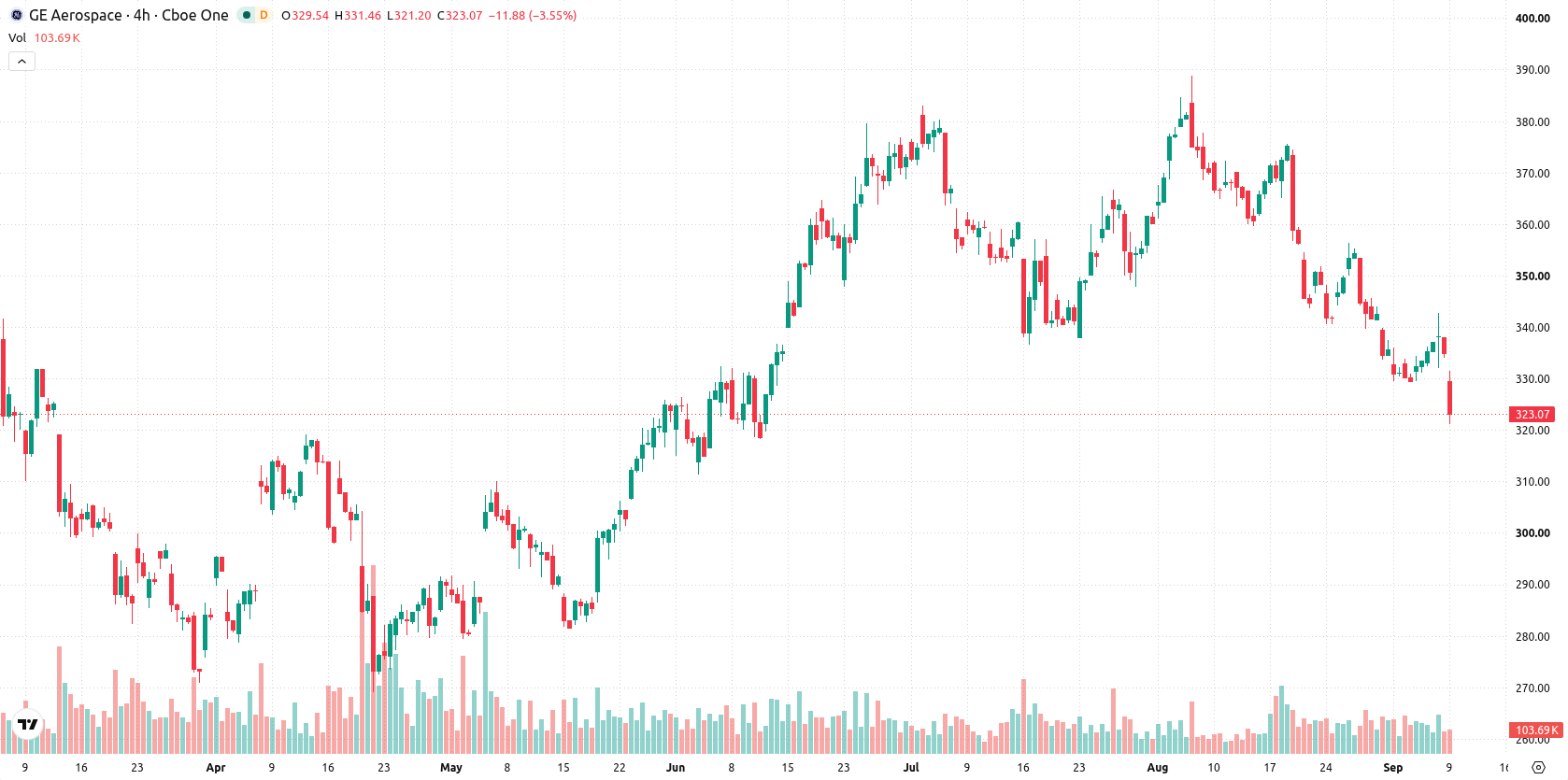
Short-term bearish momentum as key averages breached, volatility elevated
GE is trading below its 20-day and 50-day moving averages ($349.43 and $356.52), but remains just above the 200-day moving average at $321.52. This setup suggests short- and medium-term bearish pressure, with long-term support still intact. Immediate support aligns near $321.52, while resistance is found near $329.48. Momentum signals are weak: MACD trend is negative, ADX is soft, and oscillators such as RSI (40.23) and CCI (-71.99) are skewed to the sell side, indicating the stock is nearing but not at extreme oversold territory. Intraday, buyers are still slightly dominant per Bull/Bear Power (0.96), but the risk of overbought conditions is also present. Volatility is elevated at 2.98%, and the stock is trading close to its session low, reflecting sustained selling pressure. The bearish structure is confirmed by both weak oscillators and recent price action.
Earlier, analysts noted that GE Aerospace faced heightened technical uncertainty amid selling pressure, despite efforts to bolster its supply chain through acquisitions. The latest move confirms ongoing downside risk, making sustained price action above the 200-day moving average a critical level to monitor for any signs of reversal.






Latest General Electric News




-
 Afghanistan
-
 Albania
-
 Algeria
-
 Angola
-
 Argentina
-
 Armenia
-
 Australia
-
 Austria
-
 Azerbaijan
-
 Bahamas
-
 Bahrain
-
 Bangladesh
-
 Belarus
-
 Belgium
-
 Bolivia
-
 Botswana
-
 Brazil
-
 Brunei
-
 Bulgaria
-
 Cambodia
-
 Cameroon
-
 Canada
-
 Chile
-
 China
-
 Colombia
-
 Congo
-
 Costa Rica
-
 Cote d'Ivoire
-
 Croatia
-
 Cuba
-
 Cyprus
-
 Czechia
-
 DR Congo
-
 Denmark
-
 Dominican Republic
-
 Ecuador
-
 Egypt
-
 El Salvador
-
 Estonia
-
 Eswatini
-
 Ethiopia
-
 Finland
-
 France
-
 Georgia
-
 Germany
-
 Ghana
-
 Greece
-
 Haiti
-
 Hong Kong
-
 Hungary
-
 India
-
 Indonesia
-
 Iran, Islamic republic
-
 Iraq
-
 Ireland
-
 Israel
-
 Italy
-
 Jamaica
-
 Japan
-
 Jordan
-
 Kazakhstan
-
 Kenya
-
 Korea
-
 Kuwait
-
 Kyrgyzstan
-
 Laos
-
 Latvia
-
 Lebanon
-
 Lesotho
-
 Libya
-
 Lithuania
-
 Luxembourg
-
 Madagascar
-
 Malaysia
-
 Malta
-
 Mauritius
-
 Mexico
-
 Moldova
-
 Mongolia
-
 Montenegro
-
 Morocco
-
 Mozambique
-
 Myanmar
-
 Namibia
-
 Nepal
-
 Netherlands
-
 New Zealand
-
 Nigeria
-
 North Macedonia
-
 Norway
-
 Oman
-
 Pakistan
-
 Palestine
-
 Panama
-
 Papua New Guinea
-
 Paraguay
-
 Peru
-
 Philippines
-
 Poland
-
 Portugal
-
 Puerto Rico
-
 Qatar
-
 Reunion
-
 Romania
-
 Rwanda
-
 Saudi Arabia
-
 Serbia
-
 Singapore
-
 Slovakia
-
 Slovenia
-
 Somalia
-
 South Africa
-
 Spain
-
 Sri Lanka
-
 Sweden
-
 Switzerland
-
 Syria
-
 Taiwan
-
 Tajikistan
-
 Tanzania
-
 Thailand
-
 Trinidad and Tobago
-
 Tunisia
-
 Turkey
-
 UAE
-
 Uganda
-
 Ukraine
-
 United Kingdom
-
United States
-
 Uruguay
-
 Uzbekistan
-
 Venezuela
-
 Vietnam
-
 Yemen
-
 Zambia
-
 Zimbabwe
- Forex
- Crypto












