

What's behind Charter Communications's latest 4.8% stock surge?

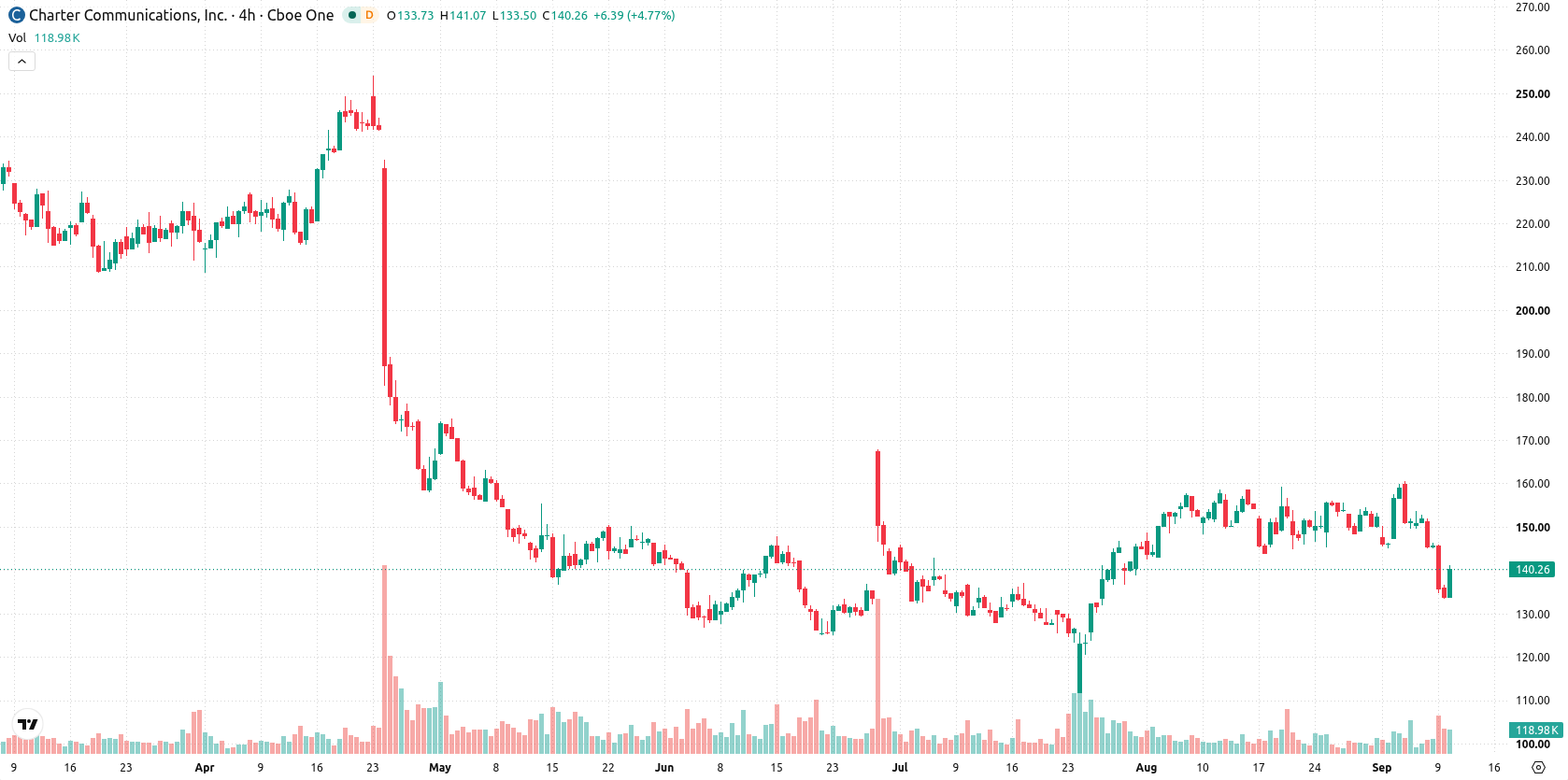
Charter Communications, Inc. (CHTR) jumped 4.8% after quarterly earnings and revenue modestly beat analyst expectations, fueling renewed buying interest. The rebound looks limited, with the stock’s price still capped below the 20-, 50-, and 200-day moving averages.
 109.82
110.66
Highlights
- Charter Communications reported quarterly earnings per share of $10.66, exceeding the consensus estimate of $9.98.
- Revenue reached $13.53 billion, modestly above forecasts, and Parkside Financial Bank & Trust increased its holdings in the company.
- Shares of Charter Communications trade below key moving averages with the next resistance at $141.04 and support at $133.67; the expected range is $130.3 to $150.32.
Analyst expectations beat and stakeholder buying drive sentiment shift
Charter Communications recently reported quarterly earnings per share of $10.66, surpassing the consensus estimate of $9.98. Revenue was $13.53 billion, modestly above analysts’ forecasts. Parkside Financial Bank & Trust also significantly increased its holdings in the company during the second quarter.
Bearish structure persists as oversold signals meet resistance
CHTR is trading under pressure below the 20-day ($150.29), 50-day ($143.27), and 200-day ($181.59) moving averages, confirming persistent selling trends in the short, medium, and long term. Resistance is currently at $141.04 and support at $133.67, indicating a bearish technical setup over the longer timeframe. Momentum indicators show mixed signals: the MACD is neutral, and the ADX suggests an absence of a clear trend. However, most oscillators (RSI, CCI, Stochastic RSI, BBP) mark the stock as oversold, with BBP reflecting intraday seller dominance. Despite the stock moving up $6.42 and trading near the day’s highs, most technical signals highlight ongoing seller control and oversold conditions.
Earlier, analysts noted that Charter Communications was facing persistent bearish pressure as technical signals indicated heightened downside risk. The latest earnings-driven rebound adds a new dimension, but with sustained resistance from all major moving averages, traders should be alert to further volatility and ensure risk controls are in place as the prevailing scenario favors a continued sideways-to-lower trend.






Latest Charter Communications News


-
 Afghanistan
-
 Albania
-
 Algeria
-
 Angola
-
 Argentina
-
 Armenia
-
 Australia
-
 Austria
-
 Azerbaijan
-
 Bahamas
-
 Bahrain
-
 Bangladesh
-
 Belarus
-
 Belgium
-
 Bolivia
-
 Botswana
-
 Brazil
-
 Brunei
-
 Bulgaria
-
 Cambodia
-
 Cameroon
-
 Canada
-
 Chile
-
 China
-
 Colombia
-
 Congo
-
 Costa Rica
-
 Cote d'Ivoire
-
 Croatia
-
 Cuba
-
 Cyprus
-
 Czechia
-
 DR Congo
-
 Denmark
-
 Dominican Republic
-
 Ecuador
-
 Egypt
-
 El Salvador
-
 Estonia
-
 Eswatini
-
 Ethiopia
-
 Finland
-
 France
-
 Georgia
-
 Germany
-
 Ghana
-
 Greece
-
 Haiti
-
 Hong Kong
-
 Hungary
-
 India
-
 Indonesia
-
 Iran, Islamic republic
-
 Iraq
-
 Ireland
-
 Israel
-
 Italy
-
 Jamaica
-
 Japan
-
 Jordan
-
 Kazakhstan
-
 Kenya
-
 Korea
-
 Kuwait
-
 Kyrgyzstan
-
 Laos
-
 Latvia
-
 Lebanon
-
 Lesotho
-
 Libya
-
 Lithuania
-
 Luxembourg
-
 Madagascar
-
 Malaysia
-
 Malta
-
 Mauritius
-
 Mexico
-
 Moldova
-
 Mongolia
-
 Montenegro
-
 Morocco
-
 Mozambique
-
 Myanmar
-
 Namibia
-
 Nepal
-
 Netherlands
-
 New Zealand
-
 Nigeria
-
 North Macedonia
-
 Norway
-
 Oman
-
 Pakistan
-
 Palestine
-
 Panama
-
 Papua New Guinea
-
 Paraguay
-
 Peru
-
 Philippines
-
 Poland
-
 Portugal
-
 Puerto Rico
-
 Qatar
-
 Reunion
-
 Romania
-
 Rwanda
-
 Saudi Arabia
-
 Serbia
-
 Singapore
-
 Slovakia
-
 Slovenia
-
 Somalia
-
 South Africa
-
 Spain
-
 Sri Lanka
-
 Sweden
-
 Switzerland
-
 Syria
-
 Taiwan
-
 Tajikistan
-
 Tanzania
-
 Thailand
-
 Trinidad and Tobago
-
 Tunisia
-
 Turkey
-
 UAE
-
 Uganda
-
 Ukraine
-
 United Kingdom
-
United States
-
 Uruguay
-
 Uzbekistan
-
 Venezuela
-
 Vietnam
-
 Yemen
-
 Zambia
-
 Zimbabwe
- Forex
- Crypto












