

DIS slides over 2% as technical signals suggest continued downside risk

The Walt Disney Company (DIS) fell 2.2% amid ongoing selling pressure, even as leadership changes in its streaming division and recent gains in operating income set a constructive corporate backdrop. The move is supported by Disney trading below its 20-day and 200-day moving averages, with a bearish 50-day versus 200-day structure reinforcing near-term downside risk.
 117.75
119.95
Highlights
- Disney named Adam Smith as Chairman of Direct-to-Consumer to manage global Disney+ and Hulu operations.
- Fiscal Q3 2026 revenue rose 7% to $25.2 billion, with segment operating income up 21% to $5.6 billion on streaming and parks expansion.
- Shares of Disney trade below key moving averages with mixed momentum, projected to range from $100.99 to $105.07 over five days.
Leadership shakeup and profit gains as shares remain under selling pressure
Disney appointed Adam Smith as Chairman of Direct-to-Consumer to oversee the global operations of Disney+ and Hulu. Joe Earley was named President, Disney Entertainment Television Franchise and Content Strategy, responsible for the company's television franchises. For the fiscal third quarter of 2026, Disney reported a 7% year-over-year increase in revenue to $25.2 billion and a 21% rise in total segment operating income to $5.6 billion, including growth in streaming and continued investment in parks, cruises, and share buybacks, though price action has remained under broader selling pressure.
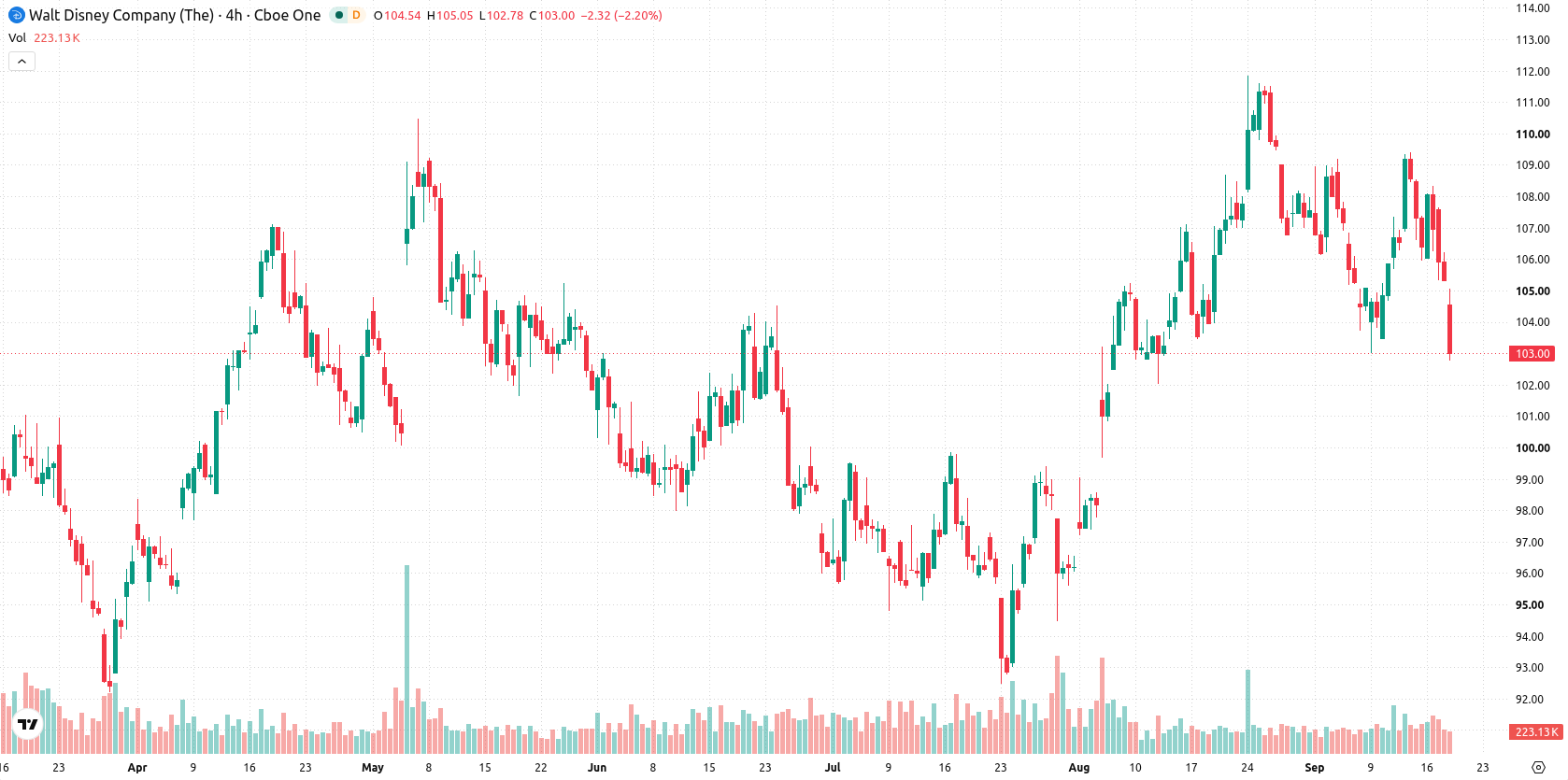
Mixed momentum signals as Disney hovers between technical support and resistance
Disney is trading below the 20-day ($107.22) and 200-day ($104.05) moving averages, but remains above the 50-day ($102.57) average, positioning the stock between near-term support and resistance. This short- and long-term moving average structure reflects lingering selling pressure with underlying medium-term support, reinforced by the bearish alignment of the 50-day moving average versus the 200-day. Momentum signals are mixed: the MACD issues a strong buy but the Average Directional Index (ADX) is neutral, indicating lackluster conviction. Relative Strength Index (RSI) and Commodity Channel Index (CCI) both signal a sell, suggesting sellers dominate, while the Stochastic RSI indicates the stock is oversold. Bull/Bear Power (BBP) is positive at 0.67, so buyers are still showing dominance intraday, though BBP itself is forecasting overbought. The Awesome Oscillator holds neutral. Disney has fallen to $103.03, down $2.32 or 2.2% after opening with a $2.24 upside gap (about 2.13%), with price now near the session low. Intraday volatility stands at 2.27%, with clear pressure from sellers after the open. Daily momentum readings and price action both lean toward further weakness, even as BBP suggests that buyers have not fully relinquished control, highlighting a significant divergence among momentum signals.
Earlier, analysts noted that Disney’s strong operating performance and share buyback plans underpinned a broadly bullish technical outlook. The current analysis signals a shift toward heightened downside risk, with traders watching the $102.57 support as the next pivotal level for potential breakdown or stabilization.











-
 Afghanistan
-
 Albania
-
 Algeria
-
 Angola
-
 Argentina
-
 Armenia
-
 Australia
-
 Austria
-
 Azerbaijan
-
 Bahamas
-
 Bahrain
-
 Bangladesh
-
 Belarus
-
 Belgium
-
 Bolivia
-
 Botswana
-
 Brazil
-
 Brunei
-
 Bulgaria
-
 Cambodia
-
 Cameroon
-
 Canada
-
 Chile
-
 China
-
 Colombia
-
 Congo
-
 Costa Rica
-
 Cote d'Ivoire
-
 Croatia
-
 Cuba
-
 Cyprus
-
 Czechia
-
 DR Congo
-
 Denmark
-
 Dominican Republic
-
 Ecuador
-
 Egypt
-
 El Salvador
-
 Estonia
-
 Eswatini
-
 Ethiopia
-
 Finland
-
 France
-
 Georgia
-
 Germany
-
 Ghana
-
 Greece
-
 Haiti
-
 Hong Kong
-
 Hungary
-
 India
-
 Indonesia
-
 Iran, Islamic republic
-
 Iraq
-
 Ireland
-
 Israel
-
 Italy
-
 Jamaica
-
 Japan
-
 Jordan
-
 Kazakhstan
-
 Kenya
-
 Korea
-
 Kuwait
-
 Kyrgyzstan
-
 Laos
-
 Latvia
-
 Lebanon
-
 Lesotho
-
 Libya
-
 Lithuania
-
 Luxembourg
-
 Madagascar
-
 Malaysia
-
 Malta
-
 Mauritius
-
 Mexico
-
 Moldova
-
 Mongolia
-
 Montenegro
-
 Morocco
-
 Mozambique
-
 Myanmar
-
 Namibia
-
 Nepal
-
 Netherlands
-
 New Zealand
-
 Nigeria
-
 North Macedonia
-
 Norway
-
 Oman
-
 Pakistan
-
 Palestine
-
 Panama
-
 Papua New Guinea
-
 Paraguay
-
 Peru
-
 Philippines
-
 Poland
-
 Portugal
-
 Puerto Rico
-
 Qatar
-
 Reunion
-
 Romania
-
 Rwanda
-
 Saudi Arabia
-
 Serbia
-
 Singapore
-
 Slovakia
-
 Slovenia
-
 Somalia
-
 South Africa
-
 Spain
-
 Sri Lanka
-
 Sweden
-
 Switzerland
-
 Syria
-
 Taiwan
-
 Tajikistan
-
 Tanzania
-
 Thailand
-
 Trinidad and Tobago
-
 Tunisia
-
 Turkey
-
 UAE
-
 Uganda
-
 Ukraine
-
 United Kingdom
-
United States
-
 Uruguay
-
 Uzbekistan
-
 Venezuela
-
 Vietnam
-
 Yemen
-
 Zambia
-
 Zimbabwe
- Forex
- Crypto












