

Why is Denison Mines stock down today? Seller pressure and support levels to watch

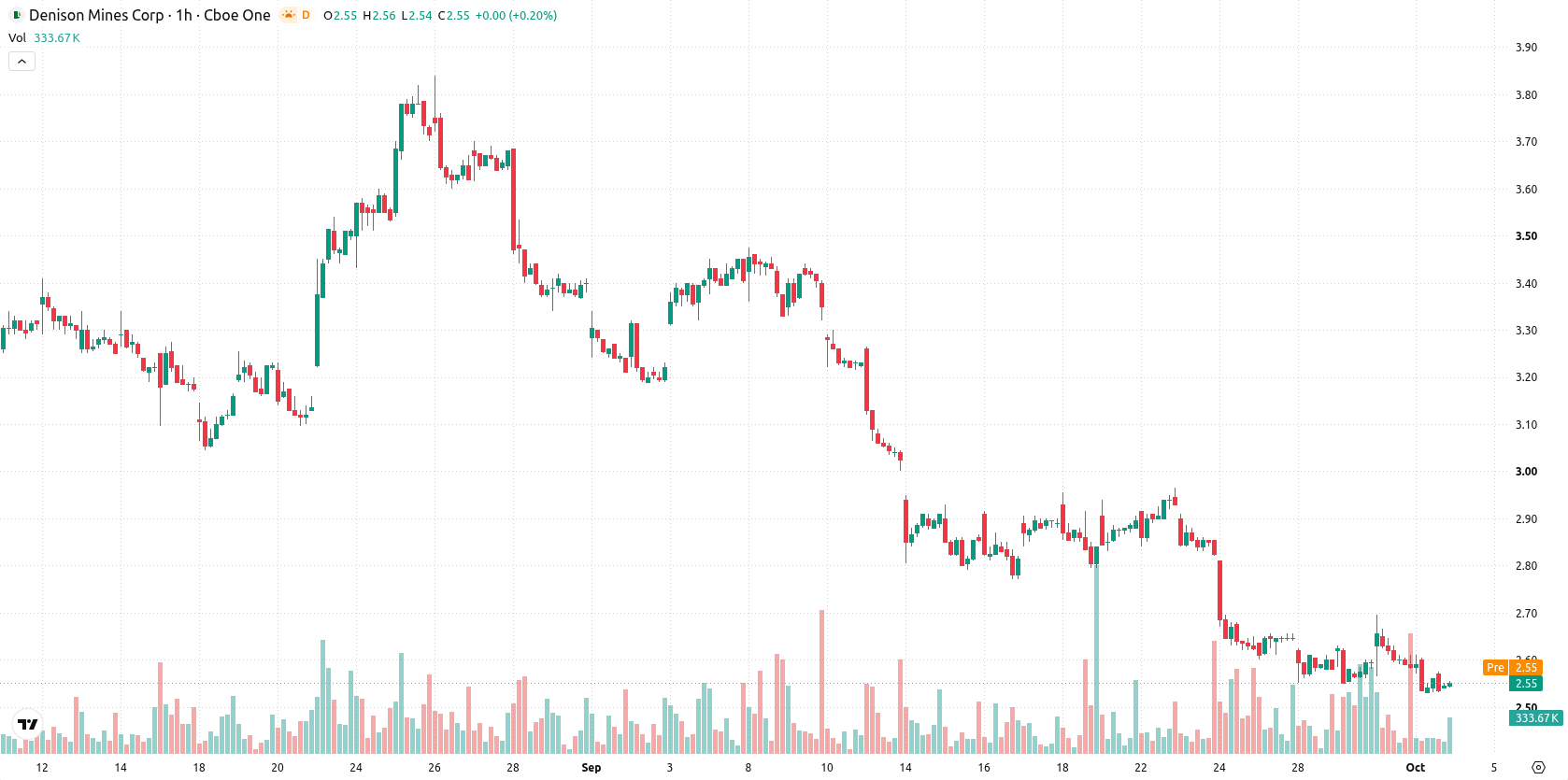
Denison Mines (DNN) stock is trading at $2.54, down 1.74% on the day. The price sits below its key moving averages, reflecting ongoing downside pressure in the near term.
 2.12
2.38
Highlights
- DNN/USD trades below key moving averages and remains under persistent selling pressure across all time frames.
- Momentum indicators such as MACD, ADX, and oscillators show heavy bearish control with oversold conditions and strong volatility.
- The projected trading range for the next 2 to 3 days is $2.46 to $2.62, with a high probability of additional downside risk.
Oversold signals intensify as technical barriers cap rebound
On the hourly chart, DNN is trading below its MA-20 at $2.58 and MA-50 at $2.65, with the long-term MA-200 level at $3.39 remaining well above the current price. The Ichimoku Kijun at $2.62 represents immediate resistance. Both MACD and ADX indicate that sellers maintain firm control, while RSI, Stoch RSI, and CCI are all in oversold conditions, highlighting strong downward momentum and possible exhaustion. Bull/Bear Power points to persistent seller dominance throughout the session, and the Awesome Oscillator is aligned with the negative trend.
Further downside risk rises as consolidation shapes near-term outlook
The expected trading range over the coming 2–3 days is between $2.46 and $2.62, capturing a realistic volatility band relative to current levels. There is a very high probability of further downside, while the chance of an upside reversal remains very low. The baseline short-term scenario sees consolidation within this corridor. A bullish case would require a break above the immediate $2.62 resistance, while a bearish scenario would open further downside risk if the price falls below $2.46.
Earlier, analysts noted that Denison Mines was exhibiting sustained bearish momentum, with technical indicators pointing to continued downside pressure. The current analysis strengthens this bearish outlook as oversold conditions persist, making a break below $2.46 an important trigger to monitor for further downside risk.






Latest Denison Mines News




-
 Afghanistan
-
 Albania
-
 Algeria
-
 Angola
-
 Argentina
-
 Armenia
-
 Australia
-
 Austria
-
 Azerbaijan
-
 Bahamas
-
 Bahrain
-
 Bangladesh
-
 Belarus
-
 Belgium
-
 Bolivia
-
 Botswana
-
 Brazil
-
 Brunei
-
 Bulgaria
-
 Cambodia
-
 Cameroon
-
 Canada
-
 Chile
-
 China
-
 Colombia
-
 Congo
-
 Costa Rica
-
 Cote d'Ivoire
-
 Croatia
-
 Cuba
-
 Cyprus
-
 Czechia
-
 DR Congo
-
 Denmark
-
 Dominican Republic
-
 Ecuador
-
 Egypt
-
 El Salvador
-
 Estonia
-
 Eswatini
-
 Ethiopia
-
 Finland
-
 France
-
 Georgia
-
 Germany
-
 Ghana
-
 Greece
-
 Haiti
-
 Hong Kong
-
 Hungary
-
 India
-
 Indonesia
-
 Iran, Islamic republic
-
 Iraq
-
 Ireland
-
 Israel
-
 Italy
-
 Jamaica
-
 Japan
-
 Jordan
-
 Kazakhstan
-
 Kenya
-
 Korea
-
 Kuwait
-
 Kyrgyzstan
-
 Laos
-
 Latvia
-
 Lebanon
-
 Lesotho
-
 Libya
-
 Lithuania
-
 Luxembourg
-
 Madagascar
-
 Malaysia
-
 Malta
-
 Mauritius
-
 Mexico
-
 Moldova
-
 Mongolia
-
 Montenegro
-
 Morocco
-
 Mozambique
-
 Myanmar
-
 Namibia
-
 Nepal
-
 Netherlands
-
 New Zealand
-
 Nigeria
-
 North Macedonia
-
 Norway
-
 Oman
-
 Pakistan
-
 Palestine
-
 Panama
-
 Papua New Guinea
-
 Paraguay
-
 Peru
-
 Philippines
-
 Poland
-
 Portugal
-
 Puerto Rico
-
 Qatar
-
 Reunion
-
 Romania
-
 Rwanda
-
 Saudi Arabia
-
 Serbia
-
 Singapore
-
 Slovakia
-
 Slovenia
-
 Somalia
-
 South Africa
-
 Spain
-
 Sri Lanka
-
 Sweden
-
 Switzerland
-
 Syria
-
 Taiwan
-
 Tajikistan
-
 Tanzania
-
 Thailand
-
 Trinidad and Tobago
-
 Tunisia
-
 Turkey
-
 UAE
-
 Uganda
-
 Ukraine
-
 United Kingdom
-
United States
-
 Uruguay
-
 Uzbekistan
-
 Venezuela
-
 Vietnam
-
 Yemen
-
 Zambia
-
 Zimbabwe
- Forex
- Crypto












