

Oracle shares technical analysis: Oversold conditions and weak momentum cap further upside

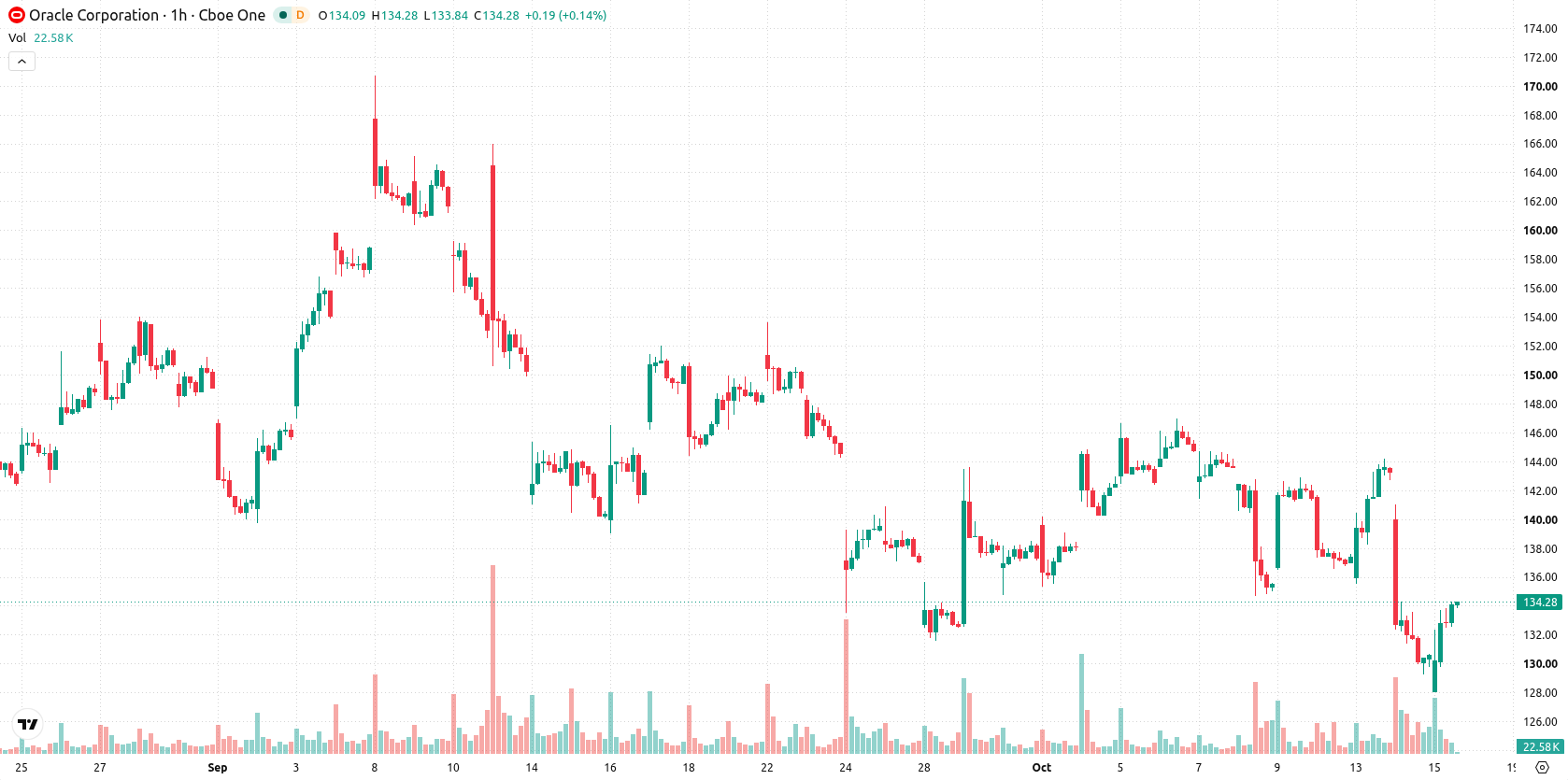
Oracle (ORCL) stock is trading at $134.52 after climbing 3.03% on the day. The price remains below its key moving averages, indicating that recent gains have not yet reversed the broader technical setup.
 133.80
144.17
133.80
144.17
Highlights
- Higher-than-expected U.S. inflation on October 14, 2026 triggered renewed expectations for additional Federal Reserve rate hikes and increased Treasury yields, impacting Oracle stock valuation.
- Federal Trade Commission subpoenas to Anthropic and OpenAI over consumer protection concerns pushed Oracle credit default swap spreads to 288 basis points, raising attention to regulatory and credit risks related to AI.
- Shares of Oracle trade below major moving averages, with strong bearish momentum and a 65% probability of moving within the $127.85 to $141.19 range in coming days.
Federal policy and regulatory probes fuel risk repricing in Oracle
Hotter-than-expected U.S. inflation data on October 14, 2026 revived market expectations for further Federal Reserve rate hikes, pushing Treasury yields higher and weighing on Oracle's equity valuation, according to Yahoo Finance. In a parallel development, the Federal Trade Commission's issuance of subpoenas to AI firms Anthropic and OpenAI over consumer protection concerns triggered a sharp increase in Oracle's credit default swap spreads to 288 basis points, as reported by Gurufocus. These events intensified investor anxiety over the company’s debt profile and increased the focus on AI-related regulatory and credit risks within Oracle’s broader risk assessment. The convergence of macroeconomic pressure and regulatory scrutiny has contributed to a reactive trading environment for Oracle shares.
Persistent bearish momentum as oversold signals clash with recovery
On the h1 timeframe, ORCL is positioned below the MA-20 at $136.74 and MA-50 at $139.55, while the daily chart shows it well beneath the MA-200 at $160.82. The Ichimoku Kijun on the daily chart marks immediate resistance at $136.7. Momentum indicators underscore ongoing negative pressure: MACD and ADX both indicate a bearish bias, and the RSI sits at 29.09, signalling deep oversold conditions. Stoch RSI and CCI also flag oversold readings, pointing to potential near-term selling exhaustion. Bull/Bear Power confirms intraday seller dominance, and the Awesome Oscillator adds further evidence of sustained downward momentum. Despite the latest close near the session high, these technicals highlight a divergence between precarious momentum and any surface-level recovery.
Consolidation risk rises as resistance and support levels converge
Over the short term, ORCL is expected to trade within a $127.85 to $141.19 range, reflecting a typical volatility band relative to current levels. There is a 65% likelihood of a downward move, with a base case scenario involving continued consolidation within this range. Any upward breakout would require a decisive move above resistance at $136.7, while a sustained breach below the $127.85 support would validate further bearish extension.
Earlier, analysts noted that Oracle faced persistent downside pressure despite positive strategic developments, with consolidation expected to govern the near-term outlook. The latest technicals and fresh regulatory risks add a new dimension to this view, underscoring $136.70 as a critical resistance level for any potential reversal.








-
 Afghanistan
-
 Albania
-
 Algeria
-
 Angola
-
 Argentina
-
 Armenia
-
 Australia
-
 Austria
-
 Azerbaijan
-
 Bahamas
-
 Bahrain
-
 Bangladesh
-
 Belarus
-
 Belgium
-
 Bolivia
-
 Botswana
-
 Brazil
-
 Brunei
-
 Bulgaria
-
 Cambodia
-
 Cameroon
-
 Canada
-
 Chile
Chile
-
 China
China
-
 Colombia
-
 Congo
Congo
-
 Costa Rica
-
 Cote d'Ivoire
-
 Croatia
-
 Cuba
Cuba
-
 Cyprus
-
 Czechia
-
 DR Congo
-
 Denmark
-
 Dominican Republic
-
 Ecuador
-
 Egypt
Egypt
-
 El Salvador
-
 Estonia
-
 Eswatini
-
 Ethiopia
-
 Finland
-
 France
-
 Georgia
-
 Germany
-
 Ghana
Ghana
-
 Greece
-
 Haiti
Haiti
-
 Hong Kong
-
 Hungary
-
 India
India
-
 Indonesia
-
 Iran, Islamic republic
-
 Iraq
Iraq
-
 Ireland
-
 Israel
-
 Italy
Italy
-
 Jamaica
-
 Japan
Japan
-
 Jordan
-
 Kazakhstan
-
 Kenya
Kenya
-
 Korea
Korea
-
 Kuwait
-
 Kyrgyzstan
-
 Laos
Laos
-
 Latvia
-
 Lebanon
-
 Lesotho
-
 Libya
Libya
-
 Lithuania
-
 Luxembourg
-
 Madagascar
-
 Malaysia
-
 Malta
Malta
-
 Mauritius
-
 Mexico
-
 Moldova
-
 Mongolia
-
 Montenegro
-
 Morocco
-
 Mozambique
-
 Myanmar
-
 Namibia
-
 Nepal
Nepal
-
 Netherlands
-
 New Zealand
-
 Nigeria
-
 North Macedonia
-
 Norway
-
 Oman
Oman
-
 Pakistan
-
 Palestine
-
 Panama
-
 Papua New Guinea
-
 Paraguay
-
 Peru
Peru
-
 Philippines
-
 Poland
-
 Portugal
-
 Puerto Rico
-
 Qatar
Qatar
-
 Reunion
-
 Romania
-
 Rwanda
-
 Saudi Arabia
-
 Serbia
-
 Singapore
-
 Slovakia
-
 Slovenia
-
 Somalia
-
 South Africa
-
 Spain
Spain
-
 Sri Lanka
-
 Sweden
-
 Switzerland
-
 Syria
Syria
-
 Taiwan
-
 Tajikistan
-
 Tanzania
-
 Thailand
-
 Trinidad and Tobago
-
 Tunisia
-
 Turkey
-
 UAE
UAE
-
 Uganda
-
 Ukraine
-
 United Kingdom
-
United States
-
 Uruguay
-
 Uzbekistan
-
 Venezuela
-
 Vietnam
-
 Yemen
Yemen
-
 Zambia
-
 Zimbabwe
- Forex
- Crypto












