

Will CleanSpark stock hold $7.08 support amid continued seller pressure?

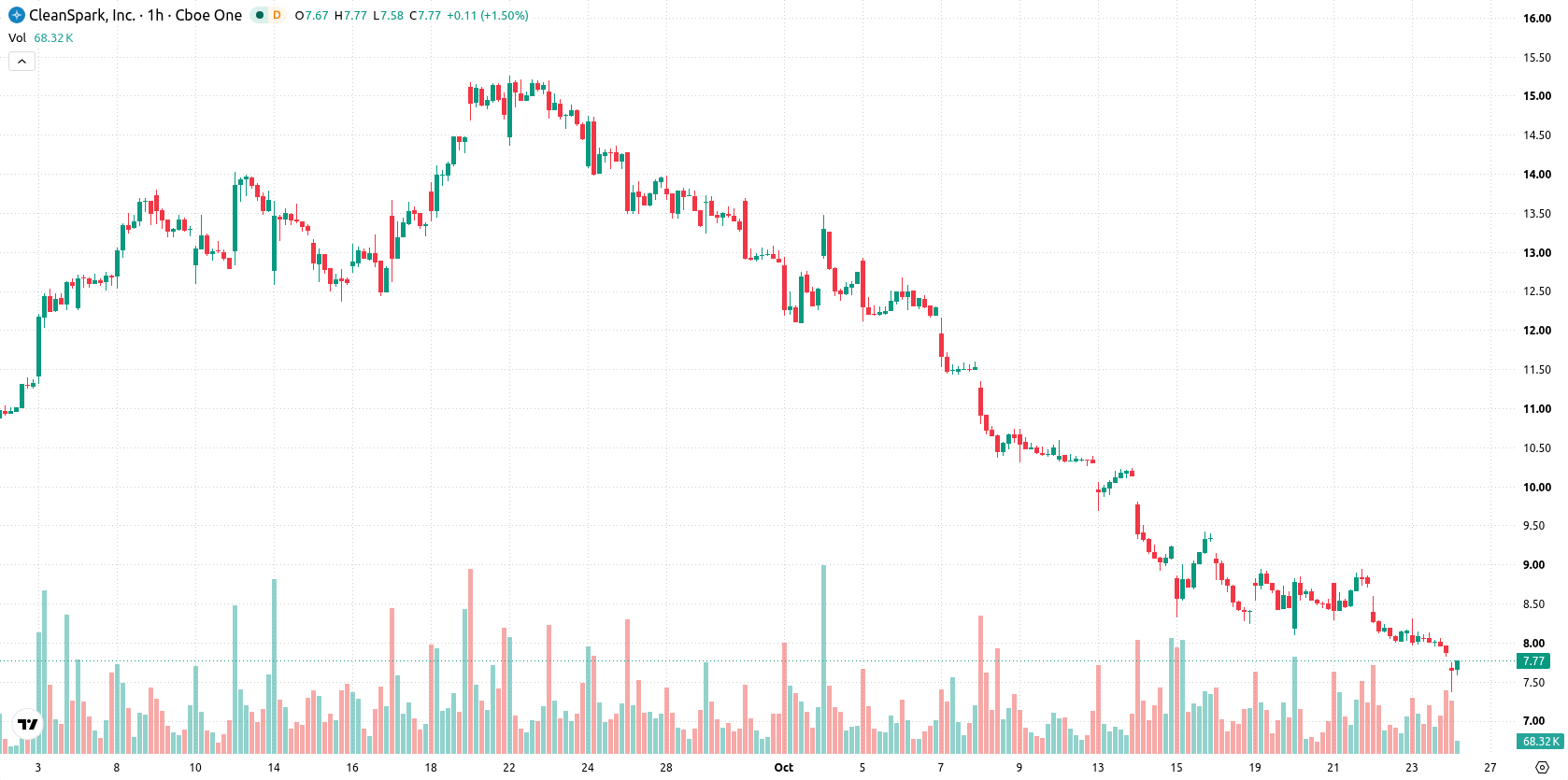
CleanSpark (CLSK) stock is trading at $7.58 after a daily decline of 3.93%. The price remains below its key moving averages, reflecting continued weakness relative to short-, medium-, and long-term trends.
 6.20
8.17
Highlights
- CLSK/USD trades under major moving averages, indicating sustained bearish momentum across short- and long-term timeframes.
- Technical indicators show strong selling pressure and oversold readings, with no signs of imminent reversal in price action.
- Expected trading range is $7.08 to $8.08, with further declines likely if support at $7.08 gives way.
Bearish momentum confirmed as oscillators and resistance cap recovery
On the technical front, CLSK/USD has stayed below its MA-20 at $8.26, MA-50 at $8.54 on the hourly chart, and daily MA-200 at $12.45, with the Ichimoku Kijun line positioned at $8.38 acting as immediate resistance. Momentum readings remain decisively bearish: MACD and ADX indicate strong selling conditions, RSI is at 32.78 in sell territory, CCI also signals sell, and the Stoch RSI is oversold without hinting at reversal. Bull/Bear Power favors sellers in intraday action, and the Awesome Oscillator reinforces the prevailing downward trend.
Limited rebound risk as price volatility and downside threats persist
Looking ahead, the expected trading range for the next several days is $7.08 to $8.08, with volatility expected to remain elevated. The potential for a meaningful rebound is very low, while downside risk remains significant. Only a clear move above $8.38 resistance would hint at a bullish scenario, whereas a breakdown below $7.08 would expose further losses. If price action stabilizes, CLSK could oscillate inside this range for the near term.
Earlier, analysts noted that CleanSpark was experiencing sustained technical weakness and persistent downside risk. The current article reinforces this bearish view, highlighting that traders should closely monitor the $7.08 support as the next key level amid elevated volatility and ongoing selling pressure.






Latest CleanSpark News



-
 Afghanistan
-
 Albania
-
 Algeria
-
 Angola
-
 Argentina
-
 Armenia
-
 Australia
-
 Austria
-
 Azerbaijan
-
 Bahamas
-
 Bahrain
-
 Bangladesh
-
 Belarus
-
 Belgium
-
 Bolivia
-
 Botswana
-
 Brazil
-
 Brunei
-
 Bulgaria
-
 Cambodia
-
 Cameroon
-
 Canada
-
 Chile
-
 China
-
 Colombia
-
 Congo
-
 Costa Rica
-
 Cote d'Ivoire
-
 Croatia
-
 Cuba
-
 Cyprus
-
 Czechia
-
 DR Congo
-
 Denmark
-
 Dominican Republic
-
 Ecuador
-
 Egypt
-
 El Salvador
-
 Estonia
-
 Eswatini
-
 Ethiopia
-
 Finland
-
 France
-
 Georgia
-
 Germany
-
 Ghana
-
 Greece
-
 Haiti
-
 Hong Kong
-
 Hungary
-
 India
-
 Indonesia
-
 Iran, Islamic republic
-
 Iraq
-
 Ireland
-
 Israel
-
 Italy
-
 Jamaica
-
 Japan
-
 Jordan
-
 Kazakhstan
-
 Kenya
-
 Korea
-
 Kuwait
-
 Kyrgyzstan
-
 Laos
-
 Latvia
-
 Lebanon
-
 Lesotho
-
 Libya
-
 Lithuania
-
 Luxembourg
-
 Madagascar
-
 Malaysia
-
 Malta
-
 Mauritius
-
 Mexico
-
 Moldova
-
 Mongolia
-
 Montenegro
-
 Morocco
-
 Mozambique
-
 Myanmar
-
 Namibia
-
 Nepal
-
 Netherlands
-
 New Zealand
-
 Nigeria
-
 North Macedonia
-
 Norway
-
 Oman
-
 Pakistan
-
 Palestine
-
 Panama
-
 Papua New Guinea
-
 Paraguay
-
 Peru
-
 Philippines
-
 Poland
-
 Portugal
-
 Puerto Rico
-
 Qatar
-
 Reunion
-
 Romania
-
 Rwanda
-
 Saudi Arabia
-
 Serbia
-
 Singapore
-
 Slovakia
-
 Slovenia
-
 Somalia
-
 South Africa
-
 Spain
-
 Sri Lanka
-
 Sweden
-
 Switzerland
-
 Syria
-
 Taiwan
-
 Tajikistan
-
 Tanzania
-
 Thailand
-
 Trinidad and Tobago
-
 Tunisia
-
 Turkey
-
 UAE
-
 Uganda
-
 Ukraine
-
 United Kingdom
-
United States
-
 Uruguay
-
 Uzbekistan
-
 Venezuela
-
 Vietnam
-
 Yemen
-
 Zambia
-
 Zimbabwe
- Forex
- Crypto












