

LAES falls over 7% as technical signals reinforce downside bias

SEALSQ Corp (LAES) fell 7.26% as persistent selling pressure and bearish technical momentum dominated trading. The move is supported by the stock trading below its 20-, 50-, and 200-day moving averages, with multiple indicators confirming a broad downside bias.
 1.42
1.65
Highlights
- SEALSQ stock is under persistent pressure, trading below all its key moving averages with a recent close at $1.46.
- Momentum indicators confirm a strong bearish bias, with oversold conditions and 21 sell signals against only 1 buy.
- The expected trading range over the next five sessions is $1.39 to $1.6, with a high probability of further downside.
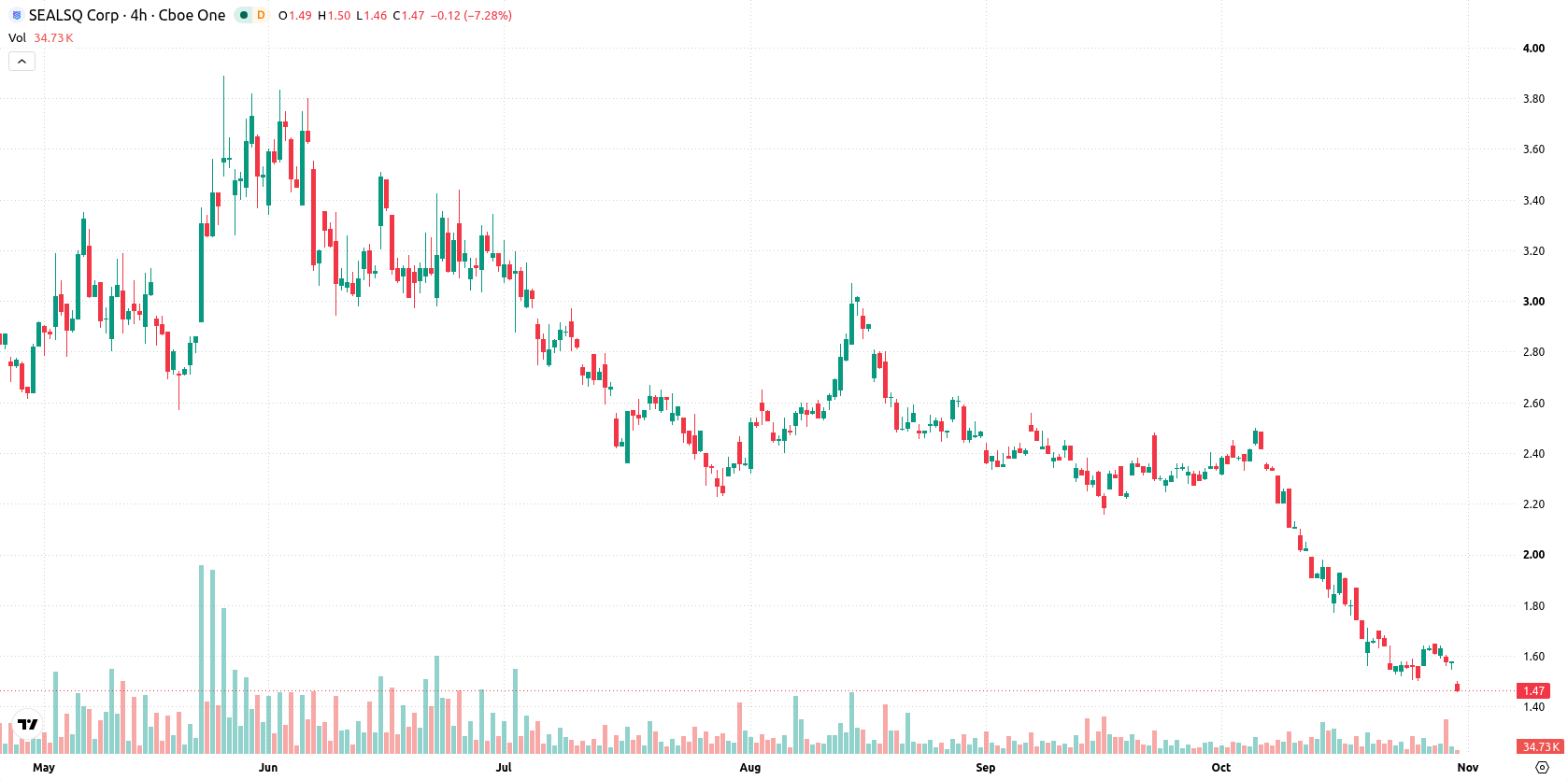
Bearish trend confirmed as averages and momentum indicators align lower
SEALSQ trades below all its key averages, with the price at $1.46 sitting under the 20-day ($1.89), 50-day ($2.19), and 200-day ($2.96) moving averages, indicating persistent pressure from sellers across short-, medium-, and long-term trends. The nearest support is at $1.39, with resistance seen at the recent week low of $1.5; broader trend confirmation remains bearish based on the 50-day vs 200-day alignment and the Ichimoku Kijun at $2 acting as a distant resistance. Momentum indicators highlight a strong downside bias: both the Moving Average Convergence Divergence (MACD) and Average Directional Index (ADX) are on sell, underlining growing bearish momentum. The Relative Strength Index (RSI) is at 28.01, signaling the stock is oversold, which is echoed by the Commodity Channel Index (CCI) and reinforced by neutral signals from the Stochastic RSI. Bull/Bear Power (BBP) reads negative, confirming sellers dominate intraday momentum. The stock slipped 7.26% to $1.46, with an upside gap of about 1.27% at the open. Price is near its intraday low, and intraday volatility stands at 4.55%. The tone remains under pressure after the open, and the Awesome Oscillator is neutral, providing no counter-signal to the active bearish trend.
Earlier, analysts noted that SEALSQ faced persistent downside risk as bearish momentum and pressure below key moving averages dominated its technical outlook. The latest trading action reinforces this negative trend, with downside risk remaining elevated as a close below $1.39 could open up further losses in the coming sessions.






Latest SEALSQ News




-
 Afghanistan
-
 Albania
-
 Algeria
-
 Angola
-
 Argentina
-
 Armenia
-
 Australia
-
 Austria
-
 Azerbaijan
-
 Bahamas
-
 Bahrain
-
 Bangladesh
-
 Belarus
-
 Belgium
-
 Bolivia
-
 Botswana
-
 Brazil
-
 Brunei
-
 Bulgaria
-
 Cambodia
-
 Cameroon
-
 Canada
-
 Chile
-
 China
-
 Colombia
-
 Congo
-
 Costa Rica
-
 Cote d'Ivoire
-
 Croatia
-
 Cuba
-
 Cyprus
-
 Czechia
-
 DR Congo
-
 Denmark
-
 Dominican Republic
-
 Ecuador
-
 Egypt
-
 El Salvador
-
 Estonia
-
 Eswatini
-
 Ethiopia
-
 Finland
-
 France
-
 Georgia
-
 Germany
-
 Ghana
-
 Greece
-
 Haiti
-
 Hong Kong
-
 Hungary
-
 India
-
 Indonesia
-
 Iran, Islamic republic
-
 Iraq
-
 Ireland
-
 Israel
-
 Italy
-
 Jamaica
-
 Japan
-
 Jordan
-
 Kazakhstan
-
 Kenya
-
 Korea
-
 Kuwait
-
 Kyrgyzstan
-
 Laos
-
 Latvia
-
 Lebanon
-
 Lesotho
-
 Libya
-
 Lithuania
-
 Luxembourg
-
 Madagascar
-
 Malaysia
-
 Malta
-
 Mauritius
-
 Mexico
-
 Moldova
-
 Mongolia
-
 Montenegro
-
 Morocco
-
 Mozambique
-
 Myanmar
-
 Namibia
-
 Nepal
-
 Netherlands
-
 New Zealand
-
 Nigeria
-
 North Macedonia
-
 Norway
-
 Oman
-
 Pakistan
-
 Palestine
-
 Panama
-
 Papua New Guinea
-
 Paraguay
-
 Peru
-
 Philippines
-
 Poland
-
 Portugal
-
 Puerto Rico
-
 Qatar
-
 Reunion
-
 Romania
-
 Rwanda
-
 Saudi Arabia
-
 Serbia
-
 Singapore
-
 Slovakia
-
 Slovenia
-
 Somalia
-
 South Africa
-
 Spain
-
 Sri Lanka
-
 Sweden
-
 Switzerland
-
 Syria
-
 Taiwan
-
 Tajikistan
-
 Tanzania
-
 Thailand
-
 Trinidad and Tobago
-
 Tunisia
-
 Turkey
-
 UAE
-
 Uganda
-
 Ukraine
-
 United Kingdom
-
United States
-
 Uruguay
-
 Uzbekistan
-
 Venezuela
-
 Vietnam
-
 Yemen
-
 Zambia
-
 Zimbabwe
- Forex
- Crypto












