

Oracle stock extends downward price move as seller pressure dominates trading

Oracle (ORCL) stock is trading at $122.09, down 6.62% on the day. The stock is currently positioned below its key moving averages, indicating continued selling pressure.
 124.89
148.40
Highlights
- Oracle completed a $20 billion capital raise, equally split between common stock and senior notes, to support AI expansion.
- The funding directly increases cash reserves but results in both share dilution and higher leverage, changing Oracle stock's near-term risk profile.
- Shares of Oracle closed down 6.62% at $122.09, with bearish technical signals and a projected trading range of $113.52 to $130.66.
Share dilution and leverage increase as capital raise targets AI growth
Oracle has announced a $20 billion capital raise, split evenly between new common stock and senior notes, to fund its artificial intelligence expansion, according to CNBC. This action directly increases the company's cash reserves but also results in share dilution and heightened leverage, both of which alter Oracle's near-term risk and value profile. While the proceeds are intended for investment in growth, debt repayment, acquisitions, dividends, and potential buybacks, the market has responded to concerns over the immediate impact of dilution and debt on shareholder value.
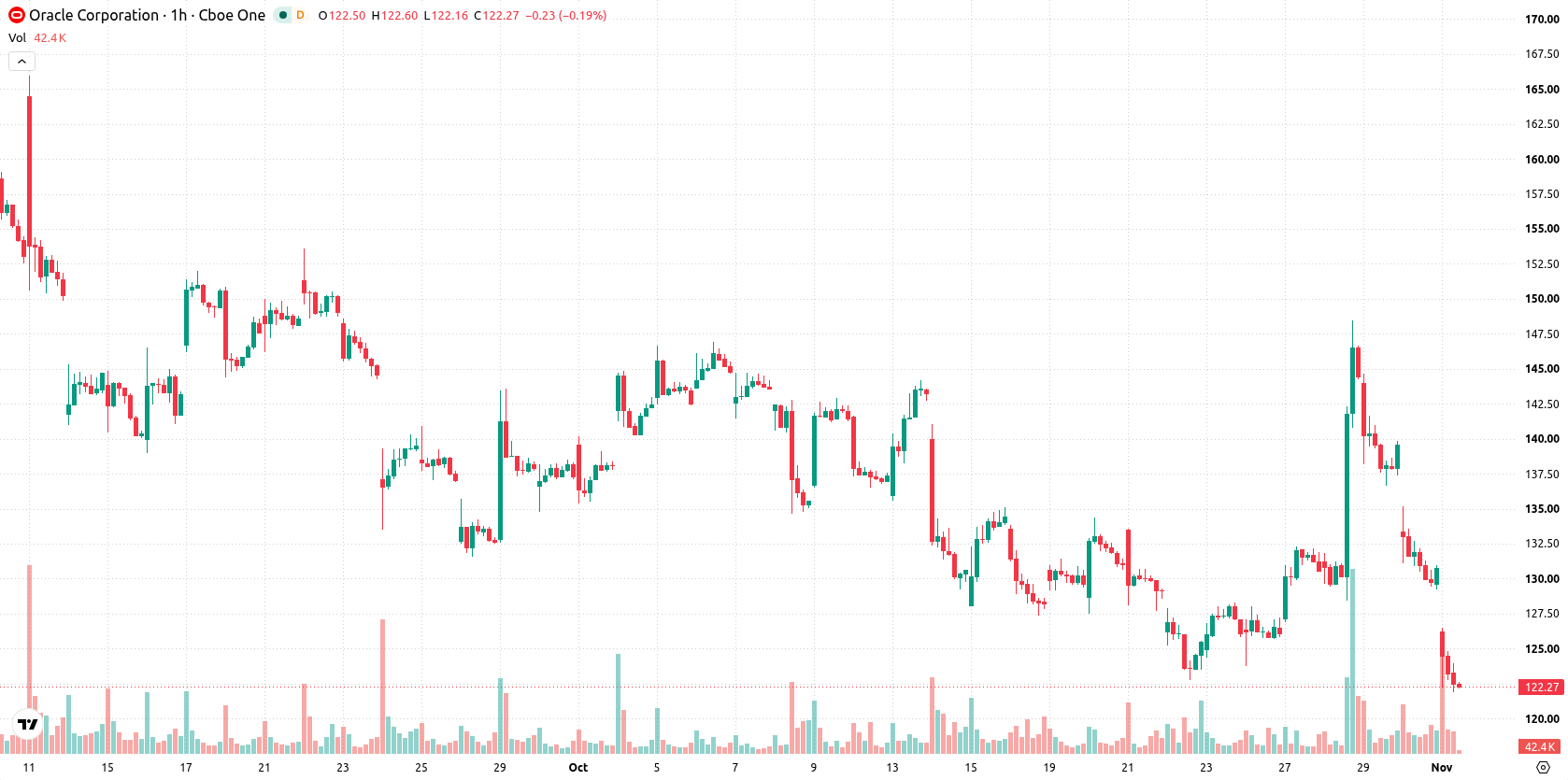
Sustained bearish momentum as price nears session low support
ORCL is trading below the MA-20, MA-50, and MA-200 on the working timeframe, with the Ichimoku Kijun level at $136.1 acting as the closest resistance. Momentum indicators confirm significant downside: RSI is at 32.25 (Sell), and ADX indicates a Sell, while MACD remains neutral. Oscillators such as Stochastic RSI, CCI, and Bull/Bear Power are in oversold territory, reflecting strong seller dominance intraday. The bearish setup is further confirmed by the Awesome Oscillator, with price closing near the session low amid heightened volatility.
Downside risk prevails as breakout above resistance remains unlikely
In the next several trading days, ORCL is expected to trade within the $113.52 to $130.66 range, representing a typical volatility band relative to current levels. The probability of an upward move is low at 23%, while a decline remains more likely at 77%. A bullish scenario would require a breakout above the immediate resistance at $136.1, which could trigger fresh upside momentum. Conversely, a breakdown below support near $113.52 would likely accelerate further losses.
Previously it was reported that Oracle’s growing leverage and capital raising activity had introduced heightened risk to its near-term outlook despite ongoing strategic investments. The current technical structure, marked by persistent downside momentum and key moving averages turning lower, underscores a prevailing downside risk with $113.52 emerging as the critical support level to monitor for further weakness.









-
 Afghanistan
-
 Albania
-
 Algeria
-
 Angola
-
 Argentina
-
 Armenia
-
 Australia
-
 Austria
-
 Azerbaijan
-
 Bahamas
-
 Bahrain
-
 Bangladesh
-
 Belarus
-
 Belgium
-
 Bolivia
-
 Botswana
-
 Brazil
-
 Brunei
-
 Bulgaria
-
 Cambodia
-
 Cameroon
-
 Canada
-
 Chile
-
 China
-
 Colombia
-
 Congo
-
 Costa Rica
-
 Cote d'Ivoire
-
 Croatia
-
 Cuba
-
 Cyprus
-
 Czechia
-
 DR Congo
-
 Denmark
-
 Dominican Republic
-
 Ecuador
-
 Egypt
-
 El Salvador
-
 Estonia
-
 Eswatini
-
 Ethiopia
-
 Finland
-
 France
-
 Georgia
-
 Germany
-
 Ghana
-
 Greece
-
 Haiti
-
 Hong Kong
-
 Hungary
-
 India
-
 Indonesia
-
 Iran, Islamic republic
-
 Iraq
-
 Ireland
-
 Israel
-
 Italy
-
 Jamaica
-
 Japan
-
 Jordan
-
 Kazakhstan
-
 Kenya
-
 Korea
-
 Kuwait
-
 Kyrgyzstan
-
 Laos
-
 Latvia
-
 Lebanon
-
 Lesotho
-
 Libya
-
 Lithuania
-
 Luxembourg
-
 Madagascar
-
 Malaysia
-
 Malta
-
 Mauritius
-
 Mexico
-
 Moldova
-
 Mongolia
-
 Montenegro
-
 Morocco
-
 Mozambique
-
 Myanmar
-
 Namibia
-
 Nepal
-
 Netherlands
-
 New Zealand
-
 Nigeria
-
 North Macedonia
-
 Norway
-
 Oman
-
 Pakistan
-
 Palestine
-
 Panama
-
 Papua New Guinea
-
 Paraguay
-
 Peru
-
 Philippines
-
 Poland
-
 Portugal
-
 Puerto Rico
-
 Qatar
-
 Reunion
-
 Romania
-
 Rwanda
-
 Saudi Arabia
-
 Serbia
-
 Singapore
-
 Slovakia
-
 Slovenia
-
 Somalia
-
 South Africa
-
 Spain
-
 Sri Lanka
-
 Sweden
-
 Switzerland
-
 Syria
-
 Taiwan
-
 Tajikistan
-
 Tanzania
-
 Thailand
-
 Trinidad and Tobago
-
 Tunisia
-
 Turkey
-
 UAE
-
 Uganda
-
 Ukraine
-
 United Kingdom
-
United States
-
 Uruguay
-
 Uzbekistan
-
 Venezuela
-
 Vietnam
-
 Yemen
-
 Zambia
-
 Zimbabwe
- Forex
- Crypto












