

Can Microsoft maintain cloud and AI momentum with looming policy risks on Chinese-made hardware imports?

Microsoft (MSFT) stock is trading slightly higher, with market participants watching geopolitical policy risks that could affect its data center supply chain. The potential U.S. ban on Chinese-made optical transceivers raises concerns about MSFT's ability to expand its AI and cloud infrastructure, and traders are monitoring U.S. trade policy developments closely.
 526.30
548.27
Highlights
- Microsoft warns a proposed U.S. ban on Chinese optical transceivers could disrupt the company’s AI data center expansion.
- Supply chain dependence on Chinese hardware creates geopolitical risk for Microsoft’s operational capacity and U.S. market competitiveness.
- Microsoft stock retains a long-term bullish structure but faces mixed technical signals with key resistance at $532 and support near $519.
Geopolitical trade risk: U.S. optical transceiver ban warning
According to Investing.com, on November 10, 2026, Microsoft warned that a proposed U.S. government ban on Chinese-made optical transceivers could severely disrupt the build-out of AI infrastructure in the United States, highlighting critical supply chain dependencies related to data center hardware.
If implemented, this proposed policy would threaten the timely availability of essential components for MSFT's data centers, potentially slowing the company's expansion of AI and cloud services. The warning signals a geopolitical risk channel, where regulatory action on Chinese technology imports could impede MSFT's operational capacity and competitiveness within the U.S. market.
While no final U.S. policy decision has been made, this issue remains highly relevant for MSFT's forward planning given the ongoing trade tensions. Investors should note that the situation could materially affect data center project timelines if the ban moves forward and supply alternatives are not promptly secured.
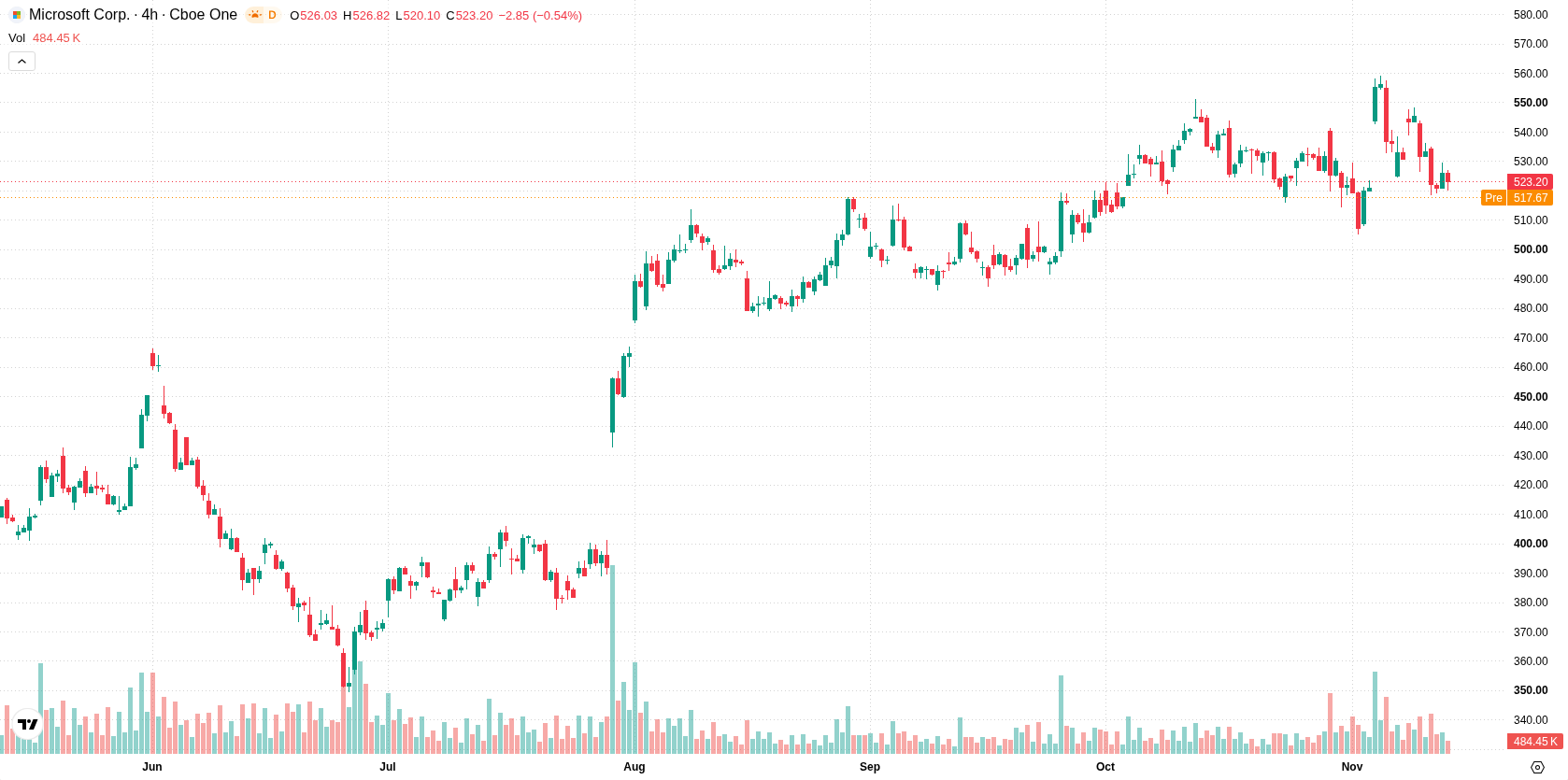
Macro supply risk meets mixed 4H trend signals
On the technical side, MSFT remains positioned above both the 50-day ($518.77) and 200-day ($440.93) simple moving averages on the daily timeframe, reflecting sustained longer-term bullish structure. However, the current price is trading below the 4H 20-period SMA ($530.19), indicating some near-term loss of momentum.
The MACD reading is neutral, while the ADX signal suggests weak trend strength and a potential tilt toward selling pressure. With the 4H Kijun resistance at $532.05 capping further upside in the short term, technical signals are mixed and do not confirm a clear directional bias.
Trade policy remains the pivot for the next MSFT move
The main risk for MSFT remains the potential implementation of U.S. trade bans affecting crucial Chinese tech imports. A sustained break above resistance around $532 would help re-establish upward momentum, while a drop toward the support zone near $519 could invite further downside flows. Monitoring regulatory headlines and progress in sourcing alternative suppliers is key for assessing the balance of risk and opportunity.
Previously it was reported that Microsoft faced a major global outage impacting its enterprise cloud and AI services, highlighting concerns over infrastructure reliability. The current focus shifts to geopolitical risks affecting supply chains, with upcoming U.S. policy decisions on Chinese technology imports now central to Microsoft’s operational outlook and expansion in AI and cloud.






Latest Microsoft News




-
 Afghanistan
-
 Albania
-
 Algeria
-
 Angola
-
 Argentina
-
 Armenia
-
 Australia
-
 Austria
-
 Azerbaijan
-
 Bahamas
-
 Bahrain
-
 Bangladesh
-
 Belarus
-
 Belgium
-
 Bolivia
-
 Botswana
-
 Brazil
-
 Brunei
-
 Bulgaria
-
 Cambodia
-
 Cameroon
-
 Canada
-
 Chile
-
 China
-
 Colombia
-
 Congo
-
 Costa Rica
-
 Cote d'Ivoire
-
 Croatia
-
 Cuba
-
 Cyprus
-
 Czechia
-
 DR Congo
-
 Denmark
-
 Dominican Republic
-
 Ecuador
-
 Egypt
-
 El Salvador
-
 Estonia
-
 Eswatini
-
 Ethiopia
-
 Finland
-
 France
-
 Georgia
-
 Germany
-
 Ghana
-
 Greece
-
 Haiti
-
 Hong Kong
-
 Hungary
-
 India
-
 Indonesia
-
 Iran, Islamic republic
-
 Iraq
-
 Ireland
-
 Israel
-
 Italy
-
 Jamaica
-
 Japan
-
 Jordan
-
 Kazakhstan
-
 Kenya
-
 Korea
-
 Kuwait
-
 Kyrgyzstan
-
 Laos
-
 Latvia
-
 Lebanon
-
 Lesotho
-
 Libya
-
 Lithuania
-
 Luxembourg
-
 Madagascar
-
 Malaysia
-
 Malta
-
 Mauritius
-
 Mexico
-
 Moldova
-
 Mongolia
-
 Montenegro
-
 Morocco
-
 Mozambique
-
 Myanmar
-
 Namibia
-
 Nepal
-
 Netherlands
-
 New Zealand
-
 Nigeria
-
 North Macedonia
-
 Norway
-
 Oman
-
 Pakistan
-
 Palestine
-
 Panama
-
 Papua New Guinea
-
 Paraguay
-
 Peru
-
 Philippines
-
 Poland
-
 Portugal
-
 Puerto Rico
-
 Qatar
-
 Reunion
-
 Romania
-
 Rwanda
-
 Saudi Arabia
-
 Serbia
-
 Singapore
-
 Slovakia
-
 Slovenia
-
 Somalia
-
 South Africa
-
 Spain
-
 Sri Lanka
-
 Sweden
-
 Switzerland
-
 Syria
-
 Taiwan
-
 Tajikistan
-
 Tanzania
-
 Thailand
-
 Trinidad and Tobago
-
 Tunisia
-
 Turkey
-
 UAE
-
 Uganda
-
 Ukraine
-
 United Kingdom
-
United States
-
 Uruguay
-
 Uzbekistan
-
 Venezuela
-
 Vietnam
-
 Yemen
-
 Zambia
-
 Zimbabwe
- Forex
- Crypto












