

What's behind SanDisk's latest 6.7% stock pullback?

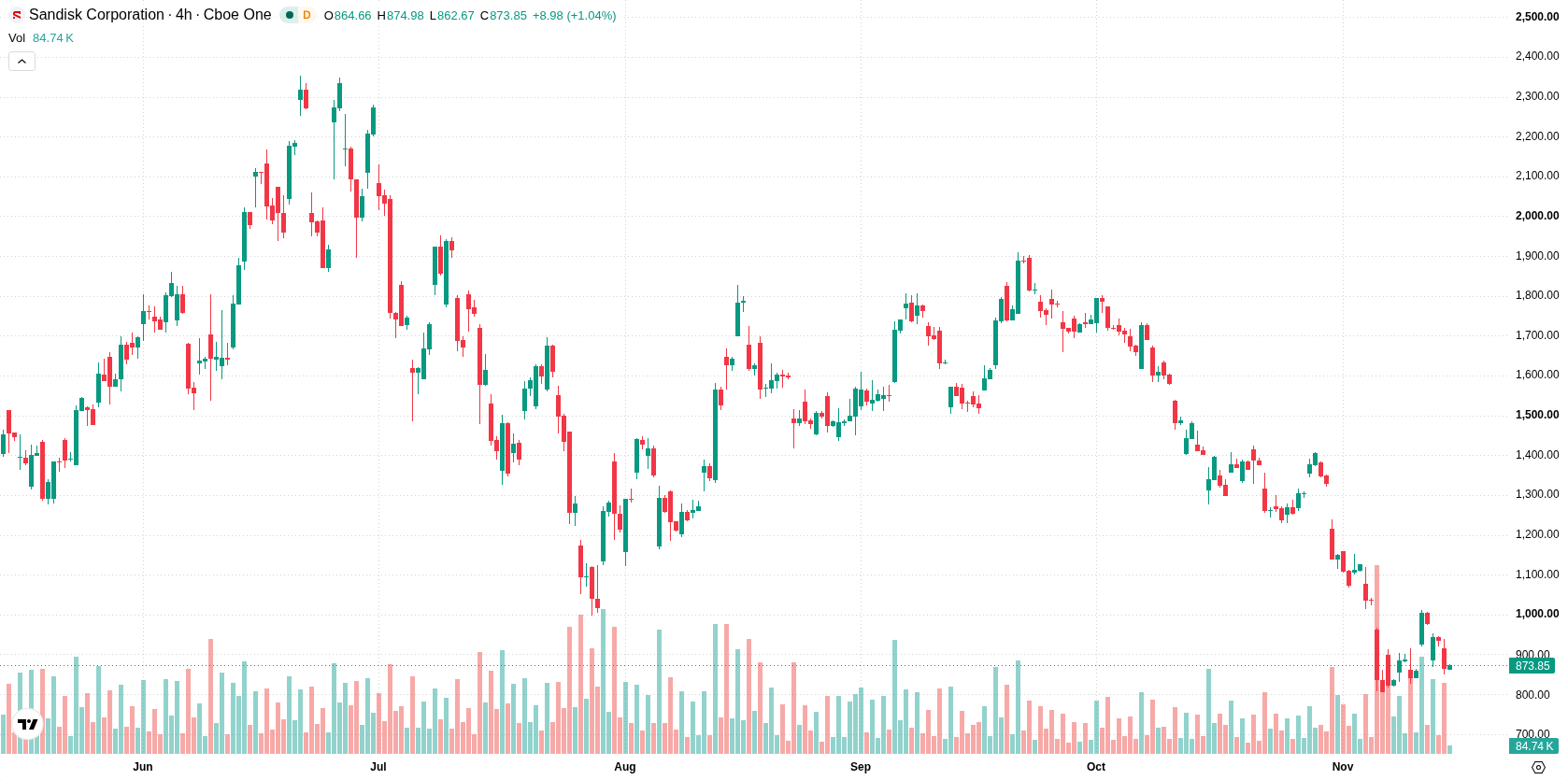
SanDisk Corporation (SNDK) dropped 6.72% after heavy losses swept across the technology sector, driven by a combination of industry turmoil and leadership changes. The decline is reinforced by the stock trading below all major moving averages, which underscores persistent selling pressure across all timeframes.
 939.53
1009.19
Highlights
- SanDisk stock was affected by broad technology sector selling and leadership changes at Nvidia, increasing margin uncertainty.
- The company delivered a 61% sequential increase in data center revenue to $4.8 billion and maintained long-term customer contracts.
- Shares of SanDisk traded at $873.55, down 6.72% for the session, with bearish signals and expected range of $783.33 to $963.77 for the next five days.
Investor uncertainty grows with industry competition and margin risks
SanDisk was affected by a broader technology sector selloff and recent leadership changes at Nvidia. Rising competition in the NAND flash memory market and warnings from Kioxia about possible price surges contributed to investor uncertainty over margins. SanDisk reported a 61% sequential rise in data center revenue to $4.8 billion and maintained long-term customer contracts, though price action has remained under broader selling pressure.
Bearish momentum confirmed by multi-horizon averages and weak indicators
SanDisk is trading below its 20-day, 50-day, and 200-day moving averages ($1,145, $1,454, and $1,280 respectively), confirming broad-based selling pressure on short-, medium-, and long-term horizons. Nearest support is at $849.86 (today’s low) and resistance at $932.91 (today’s high). MACD and ADX indicators point to ongoing bearish momentum and downside risk. RSI, Stochastic RSI, and CCI remain neutral, showing no signs of overbought or oversold conditions. Bull/Bear Power (BBP) is negative, indicating sellers still dominate the session.
Earlier, analysts highlighted persistent bearish momentum in SanDisk amid technical weakness and broad selling pressure. The latest developments reinforce this downtrend and introduce heightened downside risk, with traders advised to monitor the $783.33 level as a potential pivot for further volatility.






Latest SanDisk Corporation News





-
 Afghanistan
-
 Albania
-
 Algeria
-
 Angola
-
 Argentina
-
 Armenia
-
 Australia
-
 Austria
-
 Azerbaijan
-
 Bahamas
-
 Bahrain
-
 Bangladesh
-
 Belarus
-
 Belgium
-
 Bolivia
-
 Botswana
-
 Brazil
-
 Brunei
-
 Bulgaria
-
 Cambodia
-
 Cameroon
-
 Canada
-
 Chile
-
 China
-
 Colombia
-
 Congo
-
 Costa Rica
-
 Cote d'Ivoire
-
 Croatia
-
 Cuba
-
 Cyprus
-
 Czechia
-
 DR Congo
-
 Denmark
-
 Dominican Republic
-
 Ecuador
-
 Egypt
-
 El Salvador
-
 Estonia
-
 Eswatini
-
 Ethiopia
-
 Finland
-
 France
-
 Georgia
-
 Germany
-
 Ghana
-
 Greece
-
 Haiti
-
 Hong Kong
-
 Hungary
-
 India
-
 Indonesia
-
 Iran, Islamic republic
-
 Iraq
-
 Ireland
-
 Israel
-
 Italy
-
 Jamaica
-
 Japan
-
 Jordan
-
 Kazakhstan
-
 Kenya
-
 Korea
-
 Kuwait
-
 Kyrgyzstan
-
 Laos
-
 Latvia
-
 Lebanon
-
 Lesotho
-
 Libya
-
 Lithuania
-
 Luxembourg
-
 Madagascar
-
 Malaysia
-
 Malta
-
 Mauritius
-
 Mexico
-
 Moldova
-
 Mongolia
-
 Montenegro
-
 Morocco
-
 Mozambique
-
 Myanmar
-
 Namibia
-
 Nepal
-
 Netherlands
-
 New Zealand
-
 Nigeria
-
 North Macedonia
-
 Norway
-
 Oman
-
 Pakistan
-
 Palestine
-
 Panama
-
 Papua New Guinea
-
 Paraguay
-
 Peru
-
 Philippines
-
 Poland
-
 Portugal
-
 Puerto Rico
-
 Qatar
-
 Reunion
-
 Romania
-
 Rwanda
-
 Saudi Arabia
-
 Serbia
-
 Singapore
-
 Slovakia
-
 Slovenia
-
 Somalia
-
 South Africa
-
 Spain
-
 Sri Lanka
-
 Sweden
-
 Switzerland
-
 Syria
-
 Taiwan
-
 Tajikistan
-
 Tanzania
-
 Thailand
-
 Trinidad and Tobago
-
 Tunisia
-
 Turkey
-
 UAE
-
 Uganda
-
 Ukraine
-
 United Kingdom
-
United States
-
 Uruguay
-
 Uzbekistan
-
 Venezuela
-
 Vietnam
-
 Yemen
-
 Zambia
-
 Zimbabwe
- Forex
- Crypto












