

SEALSQ stock forecast: Downside risks increase with sellers dominating short-term trend

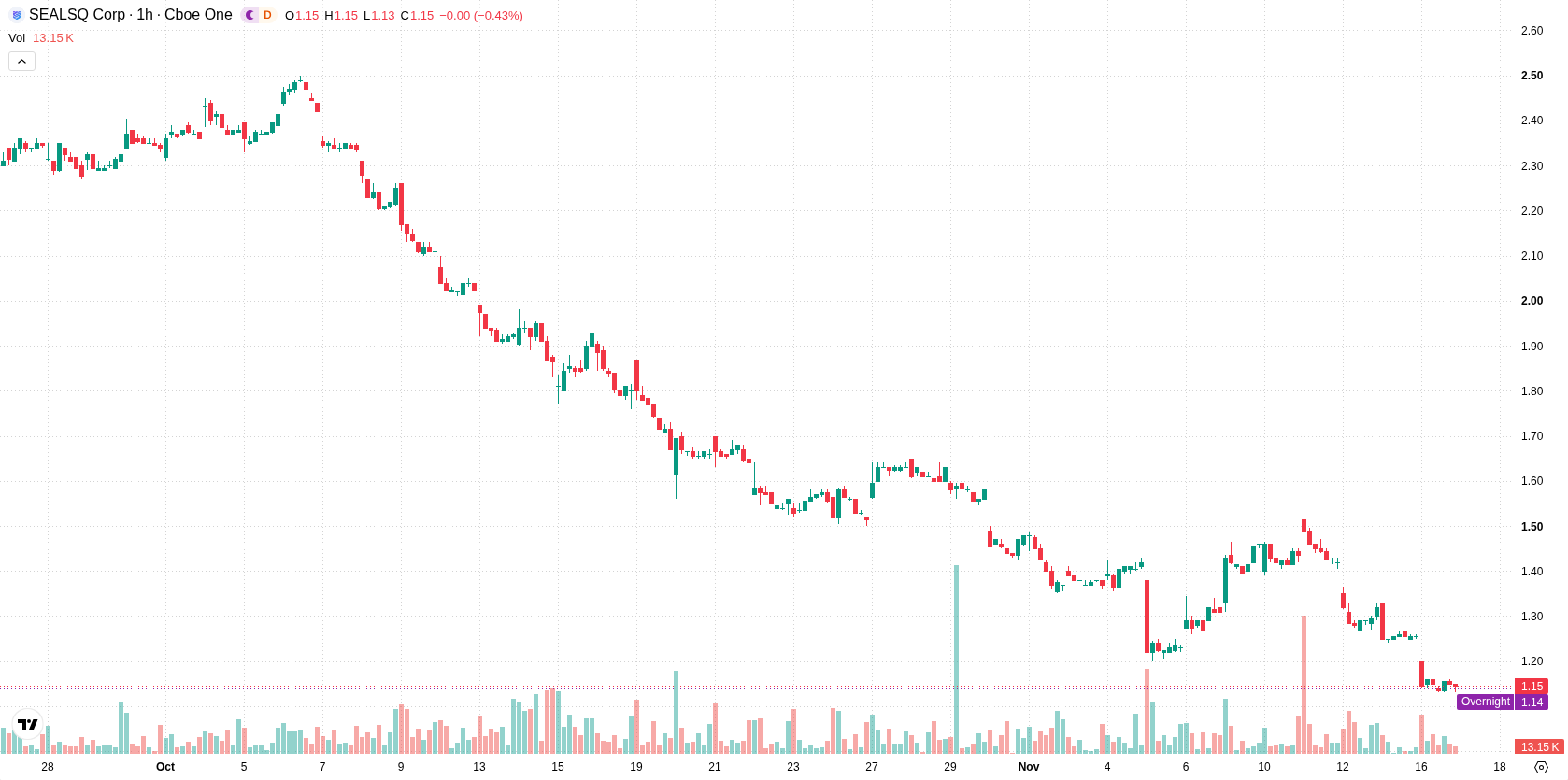
SEALSQ (LAES) stock is trading at $1.15, recording a sharp daily drop of 8.76%. The price currently sits below its key moving averages, pointing to ongoing weakness relative to recent trends.
 1.21
1.53
Highlights
- LAES/USD stock remains under sustained selling pressure across short-, medium-, and long-term technical indicators.
- Intraday losses deepen with an 8.76% drop to $1.15 and elevated volatility, as sellers hold control.
- The trading range is projected between $0.97 and $1.33 for the next 2 to 3 days, with low probability of an upward move and high risk of further decline if support at $0.97 fails.
Multi-timeframe downside confirmed by bearish momentum indicators
On the hourly chart, LAES remains below the H1 SMA-20 at $1.23 and H1 SMA-50 at $1.33, as well as the D1 SMA-200 at $2.76, highlighting multi-timeframe weakness. The Ichimoku Kijun on the H1 timeframe stands at $1.3 and serves as immediate resistance. Momentum indicators reinforce a negative bias: MACD and ADX point to bearish momentum, while RSI and CCI are in deeply oversold territory. Stochastic RSI and the Awesome Oscillator remain neutral, suggesting mixed short-term signals. Bull/Bear Power confirms that sellers are still dominant throughout intraday trading.
Downside bias favored as recovery faces strong resistance
Over the next two to three sessions, LAES is projected to trade in a wide volatility band between $0.97 and $1.33. The chance of a meaningful recovery above the $1.3 resistance level remains quite low, and additional downside is much more likely if $0.97 fails to hold. The most probable scenario favors a consolidation at lower levels; upside reversal prospects are limited unless resistance is convincingly reclaimed.
Earlier, analysts noted that SEALSQ was exhibiting persistent technical weakness and maintained a broadly bearish outlook. The latest price action and momentum readings confirm this negative trend, with heightened volatility suggesting that traders should monitor the $0.97 level as a pivotal point for further downside risk.






Latest SEALSQ News




-
 Afghanistan
-
 Albania
-
 Algeria
-
 Angola
-
 Argentina
-
 Armenia
-
 Australia
-
 Austria
-
 Azerbaijan
-
 Bahamas
-
 Bahrain
-
 Bangladesh
-
 Belarus
-
 Belgium
-
 Bolivia
-
 Botswana
-
 Brazil
-
 Brunei
-
 Bulgaria
-
 Cambodia
-
 Cameroon
-
 Canada
-
 Chile
-
 China
-
 Colombia
-
 Congo
-
 Costa Rica
-
 Cote d'Ivoire
-
 Croatia
-
 Cuba
-
 Cyprus
-
 Czechia
-
 DR Congo
-
 Denmark
-
 Dominican Republic
-
 Ecuador
-
 Egypt
-
 El Salvador
-
 Estonia
-
 Eswatini
-
 Ethiopia
-
 Finland
-
 France
-
 Georgia
-
 Germany
-
 Ghana
-
 Greece
-
 Haiti
-
 Hong Kong
-
 Hungary
-
 India
-
 Indonesia
-
 Iran, Islamic republic
-
 Iraq
-
 Ireland
-
 Israel
-
 Italy
-
 Jamaica
-
 Japan
-
 Jordan
-
 Kazakhstan
-
 Kenya
-
 Korea
-
 Kuwait
-
 Kyrgyzstan
-
 Laos
-
 Latvia
-
 Lebanon
-
 Lesotho
-
 Libya
-
 Lithuania
-
 Luxembourg
-
 Madagascar
-
 Malaysia
-
 Malta
-
 Mauritius
-
 Mexico
-
 Moldova
-
 Mongolia
-
 Montenegro
-
 Morocco
-
 Mozambique
-
 Myanmar
-
 Namibia
-
 Nepal
-
 Netherlands
-
 New Zealand
-
 Nigeria
-
 North Macedonia
-
 Norway
-
 Oman
-
 Pakistan
-
 Palestine
-
 Panama
-
 Papua New Guinea
-
 Paraguay
-
 Peru
-
 Philippines
-
 Poland
-
 Portugal
-
 Puerto Rico
-
 Qatar
-
 Reunion
-
 Romania
-
 Rwanda
-
 Saudi Arabia
-
 Serbia
-
 Singapore
-
 Slovakia
-
 Slovenia
-
 Somalia
-
 South Africa
-
 Spain
-
 Sri Lanka
-
 Sweden
-
 Switzerland
-
 Syria
-
 Taiwan
-
 Tajikistan
-
 Tanzania
-
 Thailand
-
 Trinidad and Tobago
-
 Tunisia
-
 Turkey
-
 UAE
-
 Uganda
-
 Ukraine
-
 United Kingdom
-
United States
-
 Uruguay
-
 Uzbekistan
-
 Venezuela
-
 Vietnam
-
 Yemen
-
 Zambia
-
 Zimbabwe
- Forex
- Crypto












