

Can MSFT maintain growth if US moves forward with import rules affecting Chinese-made components?

Microsoft (MSFT) stock is trading higher, with participants closely watching risk channels tied to U.S. regulatory decisions that could impact technology supply chains. The main concern centers on potential hardware disruptions affecting the buildout of domestic AI infrastructure.
 508.05
529.53
Highlights
- Microsoft warns that a potential U.S. ban on Chinese optical transceivers could disrupt AI data center expansion and hardware supply.
- AI infrastructure projects central to Microsoft stock's long-term growth may face delays or higher costs if supply is restricted.
- Shares of Microsoft trade below key moving averages with bearish technical signals and immediate resistance near $520 and support around $442.
Potential supply chain disruption from US-China policy risk
According to Investing.com, on November 10, 2026, Microsoft warned that a proposed U.S. ban on Chinese-made optical transceivers could severely disrupt the expansion of domestic artificial intelligence infrastructure, citing concerns about reliable supply of critical hardware as AI data center capital investment grows.
This warning underscores a tangible risk that AI data center projects—central to MSFT's long-term strategy and revenue streams—may face delays or increased costs if the supply of optical transceivers is restricted. The link between U.S. policy shifts and technology hardware dependencies means any regulatory action could create bottlenecks in key infrastructure, influencing both operational capabilities and capital spending plans.
Although no immediate regulatory change has occurred, MSFT's caution suggests the company is factoring policy-related supply chain vulnerabilities into its planning, while broader technology sector sentiment may adapt to evolving import regulations. Participants are monitoring this channel for further clarity on supply disruptions or regulatory decisions.
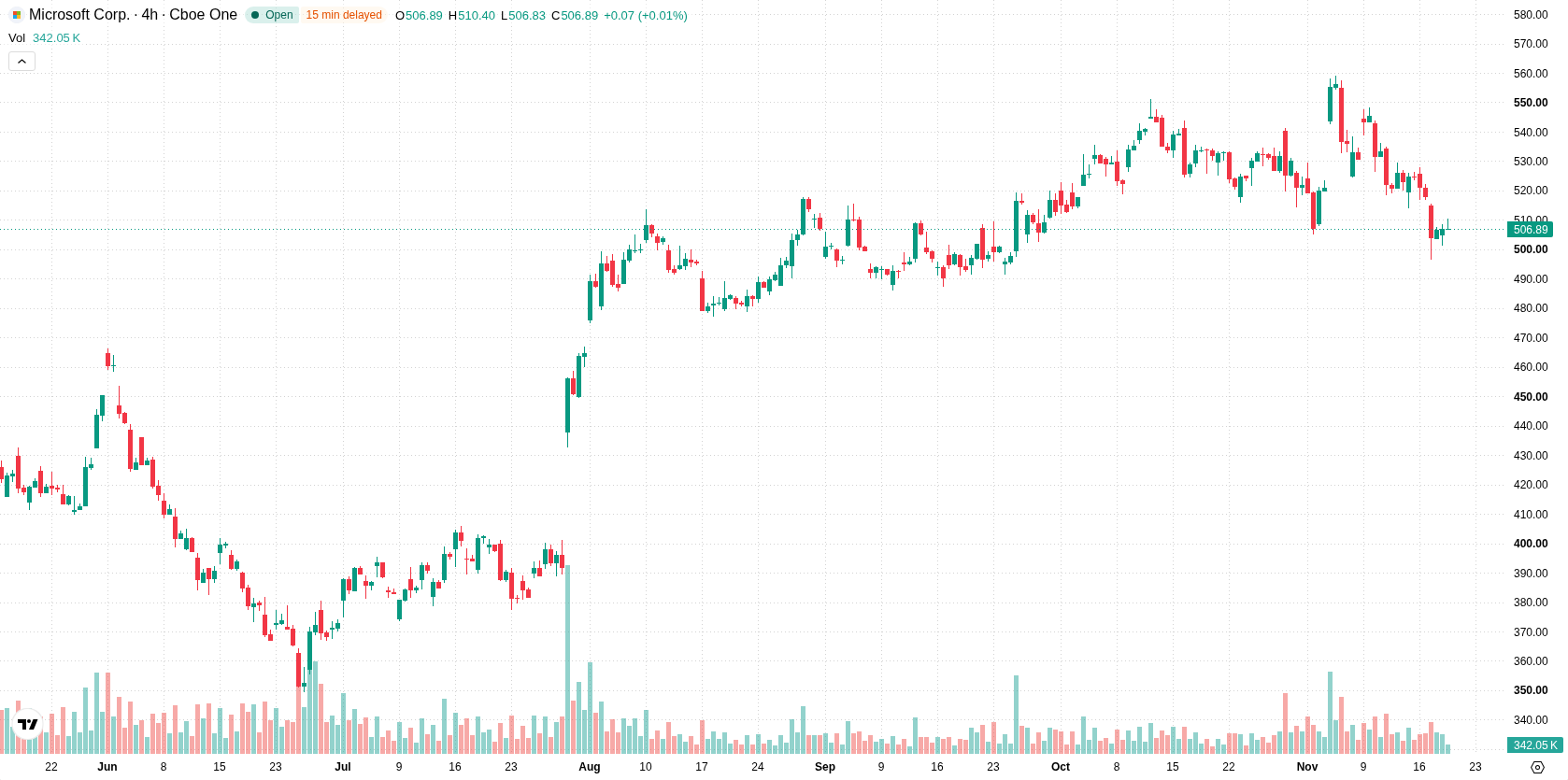
Key resistance levels and bearish momentum amid macro uncertainty
On the technical side, the 4H outlook reflects mixed momentum in the wake of these macro concerns. The D1 SMA-50 sits above the current price at $519.67, while the D1 SMA-200 below at $442.24 suggests longer-term support remains intact.
Shorter-term, the H4 SMA-20 at $524.72 stays well above spot levels, further highlighting cautious momentum. Bearish signals from MACD and ADX indicate sellers are active, with the H4 Kijun resistance at $527.83 providing a clear upper boundary for any rebound attempt.
Policy risk over hardware imports shapes direction near $520 resistance
The immediate outlook hinges on regulatory clarity regarding U.S. import policy for Chinese-made hardware. MSFT will likely remain vulnerable to external supply disruptions unless price action recovers above resistance around $520. Support remains near $442, where buyers may reemerge. Sustained stabilization would require a shift in policy risk sentiment or evidence of diversified component sourcing.
Earlier, analysts noted that Microsoft faced ongoing technical weakness amid broader market selling pressure and highlighted the importance of developments in its enterprise software and cloud infrastructure business. The current analysis adds a new dimension by pointing to U.S. regulatory risks surrounding hardware supply chains as a central factor for MSFT's next move, with clarity on import policy now key to shaping the outlook.






Latest Microsoft News




-
 Afghanistan
-
 Albania
-
 Algeria
-
 Angola
-
 Argentina
-
 Armenia
-
 Australia
-
 Austria
-
 Azerbaijan
-
 Bahamas
-
 Bahrain
-
 Bangladesh
-
 Belarus
-
 Belgium
-
 Bolivia
-
 Botswana
-
 Brazil
-
 Brunei
-
 Bulgaria
-
 Cambodia
-
 Cameroon
-
 Canada
-
 Chile
-
 China
-
 Colombia
-
 Congo
-
 Costa Rica
-
 Cote d'Ivoire
-
 Croatia
-
 Cuba
-
 Cyprus
-
 Czechia
-
 DR Congo
-
 Denmark
-
 Dominican Republic
-
 Ecuador
-
 Egypt
-
 El Salvador
-
 Estonia
-
 Eswatini
-
 Ethiopia
-
 Finland
-
 France
-
 Georgia
-
 Germany
-
 Ghana
-
 Greece
-
 Haiti
-
 Hong Kong
-
 Hungary
-
 India
-
 Indonesia
-
 Iran, Islamic republic
-
 Iraq
-
 Ireland
-
 Israel
-
 Italy
-
 Jamaica
-
 Japan
-
 Jordan
-
 Kazakhstan
-
 Kenya
-
 Korea
-
 Kuwait
-
 Kyrgyzstan
-
 Laos
-
 Latvia
-
 Lebanon
-
 Lesotho
-
 Libya
-
 Lithuania
-
 Luxembourg
-
 Madagascar
-
 Malaysia
-
 Malta
-
 Mauritius
-
 Mexico
-
 Moldova
-
 Mongolia
-
 Montenegro
-
 Morocco
-
 Mozambique
-
 Myanmar
-
 Namibia
-
 Nepal
-
 Netherlands
-
 New Zealand
-
 Nigeria
-
 North Macedonia
-
 Norway
-
 Oman
-
 Pakistan
-
 Palestine
-
 Panama
-
 Papua New Guinea
-
 Paraguay
-
 Peru
-
 Philippines
-
 Poland
-
 Portugal
-
 Puerto Rico
-
 Qatar
-
 Reunion
-
 Romania
-
 Rwanda
-
 Saudi Arabia
-
 Serbia
-
 Singapore
-
 Slovakia
-
 Slovenia
-
 Somalia
-
 South Africa
-
 Spain
-
 Sri Lanka
-
 Sweden
-
 Switzerland
-
 Syria
-
 Taiwan
-
 Tajikistan
-
 Tanzania
-
 Thailand
-
 Trinidad and Tobago
-
 Tunisia
-
 Turkey
-
 UAE
-
 Uganda
-
 Ukraine
-
 United Kingdom
-
United States
-
 Uruguay
-
 Uzbekistan
-
 Venezuela
-
 Vietnam
-
 Yemen
-
 Zambia
-
 Zimbabwe
- Forex
- Crypto












