

Nvidia declines after reporting first earnings since CEO change amid ongoing geopolitical headwinds with Asia

Nvidia (NVDA) stock is trading at $150.35 and declined 3.29% on November 18, 2026. The stock is under pressure as ongoing geopolitical headwinds and export controls cast uncertainty over its future earnings potential. Market participants are closely watching further developments surrounding Nvidia's access to Asian markets and continuing U.S.-China policy risks.
 155.25
167.08
Highlights
- Nvidia reported fiscal Q3 2027 results during its first earnings call since CEO Jensen Huang resigned.
- Geopolitical tensions and U.S.-China export controls present direct risks to Nvidia's growth in Asian markets and global semiconductor demand.
- Shares of Nvidia trade below key moving averages with strong technical weakness, remaining capped by resistance near $179 and continued downside bias.
Geopolitical risks and trade controls weigh on Nvidia's earnings
According to CNBC, Nvidia reported its fiscal third-quarter 2027 results on November 17, 2026, which was the company’s first earnings call since CEO Jensen Huang resigned.
The Q3 2027 release coincided with persistent U.S.-China geopolitical headwinds and active export controls, which pose direct risks to Nvidia’s ability to grow in major Asian markets and support overall global semiconductor demand CNBC.
Analysts cited by CNBC expect these policy and geopolitical pressures to remain a drag on Nvidia’s business outlook, potentially constraining revenue growth even as the leadership transition draws additional market scrutiny.
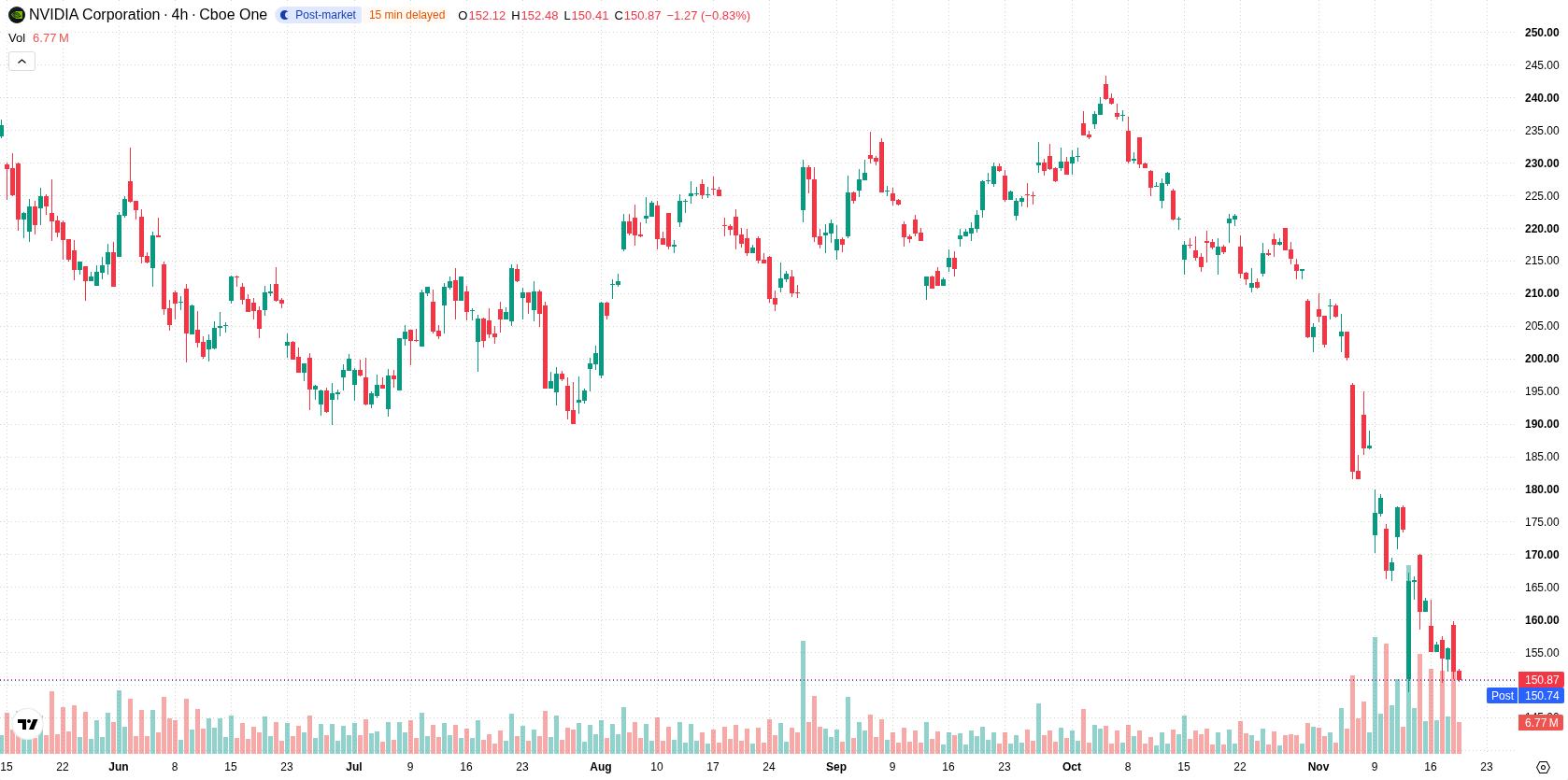
NVDA faces resistance amid sustained technical weakness
On the 4H chart, NVDA remains technically weak, sitting below the D1 SMA-50 at $211.79 and the D1 SMA-200 at $203.86. The price is also under the H4 SMA-20 at $170.57, reflecting sustained downward momentum and an inability to reclaim these key moving averages.
Bearish sentiment is confirmed by an RSI reading of 26.3, placing NVDA in an oversold zone, and by both MACD and ADX pointing to further selling pressure. The H4 Kijun resistance at $179 continues to limit rebound efforts.
Export controls and Asia access shape next move for Nvidia
Barring an improvement in geopolitical conditions or a reduction in export restrictions, NVDA’s rebound prospects are limited below resistance around $179. Sustained moves above this level could open the path to test long-term moving averages, while further escalation in U.S.-China tensions would likely reinforce the current downside bias. Monitoring both regional policy actions and technical stability is critical for gauging the next trend shift.
Earlier, analysts noted that Nvidia occupies a central role in the global artificial intelligence value chain, with extensive partnerships and integrations across industry segments. The current focus shifts to how ongoing U.S.-China geopolitical uncertainties and export controls are set to influence Nvidia’s growth trajectory, highlighting the importance of tracking policy developments and regional access for the company’s next move.











-
 Afghanistan
-
 Albania
-
 Algeria
-
 Angola
-
 Argentina
-
 Armenia
-
 Australia
-
 Austria
-
 Azerbaijan
-
 Bahamas
-
 Bahrain
-
 Bangladesh
-
 Belarus
-
 Belgium
-
 Bolivia
-
 Botswana
-
 Brazil
-
 Brunei
-
 Bulgaria
-
 Cambodia
-
 Cameroon
-
 Canada
-
 Chile
-
 China
-
 Colombia
-
 Congo
-
 Costa Rica
-
 Cote d'Ivoire
-
 Croatia
-
 Cuba
-
 Cyprus
-
 Czechia
-
 DR Congo
-
 Denmark
-
 Dominican Republic
-
 Ecuador
-
 Egypt
-
 El Salvador
-
 Estonia
-
 Eswatini
-
 Ethiopia
-
 Finland
-
 France
-
 Georgia
-
 Germany
-
 Ghana
-
 Greece
-
 Haiti
-
 Hong Kong
-
 Hungary
-
 India
-
 Indonesia
-
 Iran, Islamic republic
-
 Iraq
-
 Ireland
-
 Israel
-
 Italy
-
 Jamaica
-
 Japan
-
 Jordan
-
 Kazakhstan
-
 Kenya
-
 Korea
-
 Kuwait
-
 Kyrgyzstan
-
 Laos
-
 Latvia
-
 Lebanon
-
 Lesotho
-
 Libya
-
 Lithuania
-
 Luxembourg
-
 Madagascar
-
 Malaysia
-
 Malta
-
 Mauritius
-
 Mexico
-
 Moldova
-
 Mongolia
-
 Montenegro
-
 Morocco
-
 Mozambique
-
 Myanmar
-
 Namibia
-
 Nepal
-
 Netherlands
-
 New Zealand
-
 Nigeria
-
 North Macedonia
-
 Norway
-
 Oman
-
 Pakistan
-
 Palestine
-
 Panama
-
 Papua New Guinea
-
 Paraguay
-
 Peru
-
 Philippines
-
 Poland
-
 Portugal
-
 Puerto Rico
-
 Qatar
-
 Reunion
-
 Romania
-
 Rwanda
-
 Saudi Arabia
-
 Serbia
-
 Singapore
-
 Slovakia
-
 Slovenia
-
 Somalia
-
 South Africa
-
 Spain
-
 Sri Lanka
-
 Sweden
-
 Switzerland
-
 Syria
-
 Taiwan
-
 Tajikistan
-
 Tanzania
-
 Thailand
-
 Trinidad and Tobago
-
 Tunisia
-
 Turkey
-
 UAE
-
 Uganda
-
 Ukraine
-
 United Kingdom
-
United States
-
 Uruguay
-
 Uzbekistan
-
 Venezuela
-
 Vietnam
-
 Yemen
-
 Zambia
-
 Zimbabwe
- Forex
- Crypto












