

SPCX advances while Federal Reserve policies increase debt expenses for leveraged firms

SPCX (SPCX) stock is trading at $133.35, moving up 4.24% as of the close on November 23, 2026. Rising yields tied to Federal Reserve inflation policy have pushed corporate funding costs higher, drawing market attention to vulnerable debt-heavy firms. Traders are watching U.S. central bank policy and credit market conditions for further shifts impacting SPCX's financial flexibility.
 132.50
147.29
Highlights
- SpaceX paid a yield of 8.259% for secured financing maturing November 22, 2026, reflecting elevated corporate borrowing costs.
- Higher yields from Federal Reserve policy are increasing funding expenses and balance sheet pressures for companies dependent on capital markets such as SPCX.
- Shares of SPCX remain below key short-term resistance, with downside momentum and a rangebound technical outlook prevailing until $134 is reclaimed.
Fed-driven yield surge raises SPCX funding costs
According to Yahoo Finance, SpaceX (SPCX) paid a yield of 8.259% for secured financing as of November 22, 2026, illustrating that even investment-grade companies are facing higher borrowing costs due to current U.S. monetary policy.
Elevated yields linked to Federal Reserve efforts to combat inflation are increasing the cost of debt across corporate America. For SPCX, which relies significantly on access to the capital markets, these funding constraints can translate into greater interest expenses and pressure on balance sheet management.
While SPCX remains able to access secured financing, the higher yield underlines a broader risk context in which sustained or tighter central bank policy could further impact corporate debt markets and restrict borrowing capacity for similarly leveraged companies.
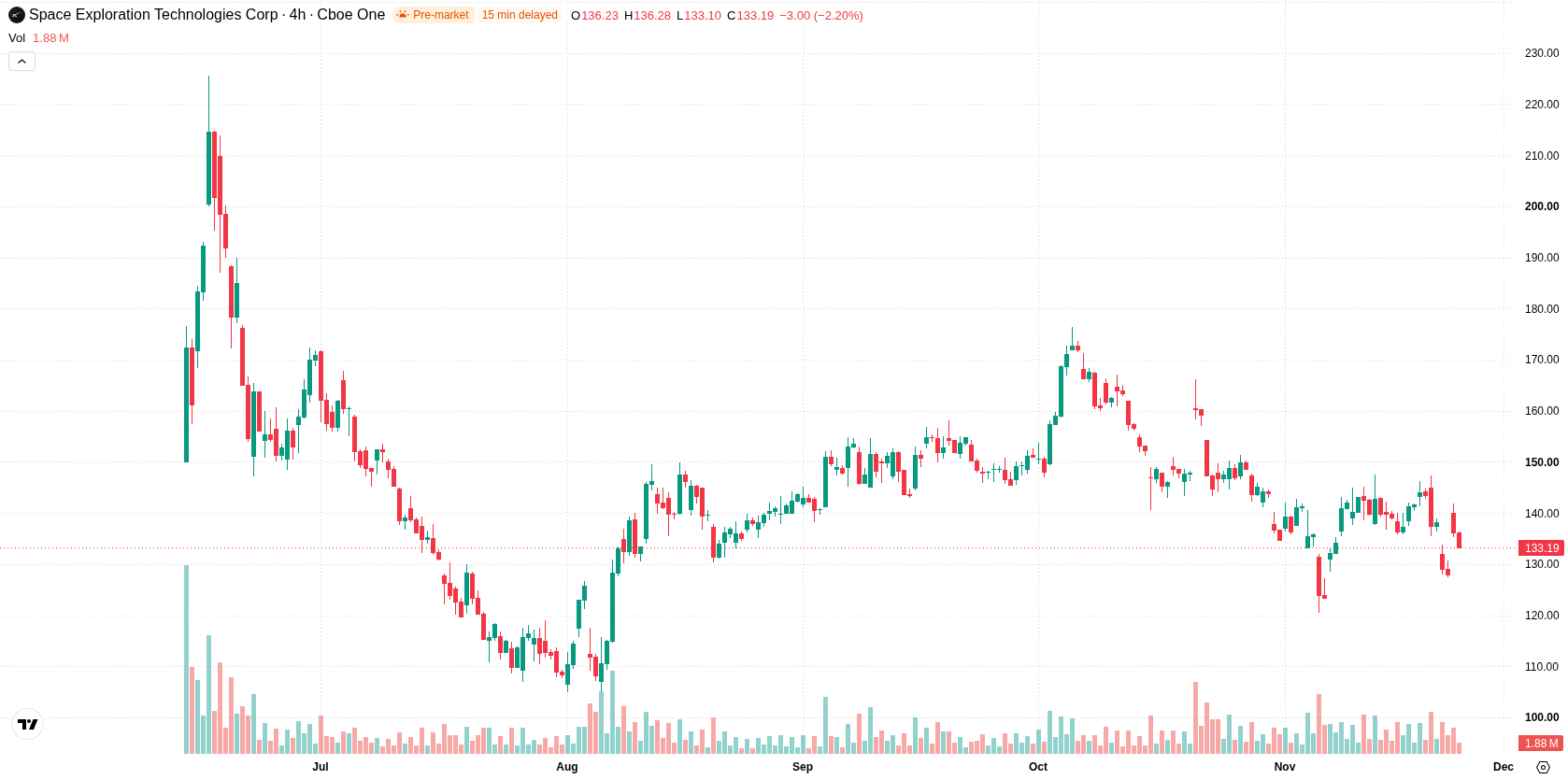
SPCX trades below major 4H and D1 resistance levels
On the 4H timeframe, SPCX remains below both the D1 SMA-50 at $147.4 and H4 SMA-20 at $138.71, signaling ongoing technical pressure from above. The H4 Kijun at $134 also acts as a nearby resistance, aligning with this cautious setup.
Technical signals are mixed: MACD suggests downside momentum with a negative reading, while ADX at 11.77 indicates a neutral or rangebound market environment. These conditions support a scenario of indecision near resistance, rather than a clear trend reversal.
Funding costs and Fed stance shape SPCX’s next move
The funding environment remains a key external risk for SPCX given its borrowing profile. Upside stabilization would require clearing resistance at the H4 Kijun near $134. If macro yield pressures persist or the asset fails to reclaim this level, funding risks could keep price action capped.
Previously it was reported that SpaceX and Tesla had initiated formal internal preparations for potential merger negotiations, appointing special committees to oversee the process. The current analysis adds a fresh layer, highlighting how persistent macro yield pressures and tightening Federal Reserve policy remain the critical factors investors should monitor for SPCX’s next move.











-
 Afghanistan
-
 Albania
-
 Algeria
-
 Angola
-
 Argentina
-
 Armenia
-
 Australia
-
 Austria
-
 Azerbaijan
-
 Bahamas
-
 Bahrain
-
 Bangladesh
-
 Belarus
-
 Belgium
-
 Bolivia
-
 Botswana
-
 Brazil
-
 Brunei
-
 Bulgaria
-
 Cambodia
-
 Cameroon
-
 Canada
-
 Chile
-
 China
-
 Colombia
-
 Congo
-
 Costa Rica
-
 Cote d'Ivoire
-
 Croatia
-
 Cuba
-
 Cyprus
-
 Czechia
-
 DR Congo
-
 Denmark
-
 Dominican Republic
-
 Ecuador
-
 Egypt
-
 El Salvador
-
 Estonia
-
 Eswatini
-
 Ethiopia
-
 Finland
-
 France
-
 Georgia
-
 Germany
-
 Ghana
-
 Greece
-
 Haiti
-
 Hong Kong
-
 Hungary
-
 India
-
 Indonesia
-
 Iran, Islamic republic
-
 Iraq
-
 Ireland
-
 Israel
-
 Italy
-
 Jamaica
-
 Japan
-
 Jordan
-
 Kazakhstan
-
 Kenya
-
 Korea
-
 Kuwait
-
 Kyrgyzstan
-
 Laos
-
 Latvia
-
 Lebanon
-
 Lesotho
-
 Libya
-
 Lithuania
-
 Luxembourg
-
 Madagascar
-
 Malaysia
-
 Malta
-
 Mauritius
-
 Mexico
-
 Moldova
-
 Mongolia
-
 Montenegro
-
 Morocco
-
 Mozambique
-
 Myanmar
-
 Namibia
-
 Nepal
-
 Netherlands
-
 New Zealand
-
 Nigeria
-
 North Macedonia
-
 Norway
-
 Oman
-
 Pakistan
-
 Palestine
-
 Panama
-
 Papua New Guinea
-
 Paraguay
-
 Peru
-
 Philippines
-
 Poland
-
 Portugal
-
 Puerto Rico
-
 Qatar
-
 Reunion
-
 Romania
-
 Rwanda
-
 Saudi Arabia
-
 Serbia
-
 Singapore
-
 Slovakia
-
 Slovenia
-
 Somalia
-
 South Africa
-
 Spain
-
 Sri Lanka
-
 Sweden
-
 Switzerland
-
 Syria
-
 Taiwan
-
 Tajikistan
-
 Tanzania
-
 Thailand
-
 Trinidad and Tobago
-
 Tunisia
-
 Turkey
-
 UAE
-
 Uganda
-
 Ukraine
-
 United Kingdom
-
United States
-
 Uruguay
-
 Uzbekistan
-
 Venezuela
-
 Vietnam
-
 Yemen
-
 Zambia
-
 Zimbabwe
- Forex
- Crypto












