

Quantum Computing stock drops more than 5% after heavy intraday selling and probe announcement

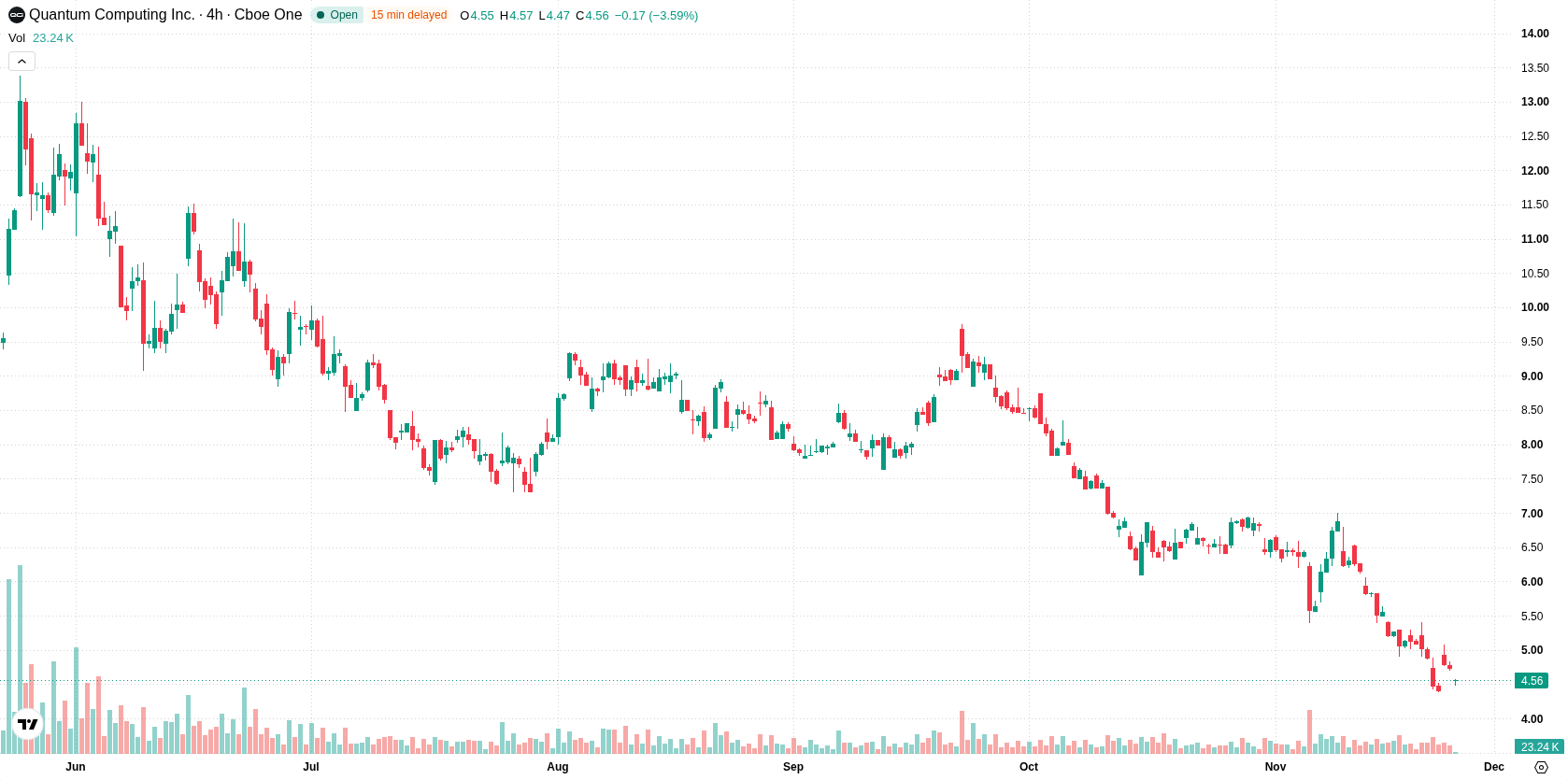
Quantum Computing Inc. (QUBT) fell 5.19% after heavy selling dominated intraday trade, even as news of significant revenue growth and ongoing fiduciary investigations shaped the backdrop. The downtrend is reinforced, with the stock remaining below short-, medium-, and long-term moving averages.
 5.08
5.40
Highlights
- Quantum Computing Inc. reported quarterly revenue of $9.5 million, rising about 25 times compared to a year earlier.
- The company became subject to a fiduciary duty investigation by Halper Sadeh LLC amid spike in call option volumes.
- Shares of Quantum Computing traded at $4.48, under heavy selling pressure with weak momentum signals and a projected 5-day range of $3.97 to $4.99.
Revenue surge and probe drive option activity amid sell pressure
Quantum Computing Inc., a photonic quantum technology and semiconductor company, reported quarterly revenue of $9.5 million—about 25 times higher than a year earlier. The company also became the subject of a fiduciary duty investigation by Halper Sadeh LLC. Unusual options activity was observed, with a high volume of call buying and rising bullish sentiment among traders, though price action has remained under broader selling pressure.
Persistent bearish momentum as key levels contain price action
QUBT is trading below the 20-day, 50-day, and 200-day moving averages ($5.93, $7, and $8.35), signaling persistent downward pressure across all trends. Resistance is marked at $4.71, with support at $4.38. Momentum signals remain weak as both MACD and ADX show a sell stance. RSI and Stochastic RSI are neutral, and the CCI is in the oversold zone. Bull/Bear Power readings reflect continued dominance by sellers, with price action near session lows and intraday volatility elevated at 7.86%.
Previously it was reported that Quantum Computing Inc. faced ongoing downward momentum amid legal scrutiny and technical weaknesses. The latest trading action confirms this bearish pressure despite impressive revenue growth, with the key upside risk being a potential bullish breakout should prices close above short-term resistance.






Latest Quantum Computing News




-
 Afghanistan
-
 Albania
-
 Algeria
-
 Angola
-
 Argentina
-
 Armenia
-
 Australia
-
 Austria
-
 Azerbaijan
-
 Bahamas
-
 Bahrain
-
 Bangladesh
-
 Belarus
-
 Belgium
-
 Bolivia
-
 Botswana
-
 Brazil
-
 Brunei
-
 Bulgaria
-
 Cambodia
-
 Cameroon
-
 Canada
-
 Chile
-
 China
-
 Colombia
-
 Congo
-
 Costa Rica
-
 Cote d'Ivoire
-
 Croatia
-
 Cuba
-
 Cyprus
-
 Czechia
-
 DR Congo
-
 Denmark
-
 Dominican Republic
-
 Ecuador
-
 Egypt
-
 El Salvador
-
 Estonia
-
 Eswatini
-
 Ethiopia
-
 Finland
-
 France
-
 Georgia
-
 Germany
-
 Ghana
-
 Greece
-
 Haiti
-
 Hong Kong
-
 Hungary
-
 India
-
 Indonesia
-
 Iran, Islamic republic
-
 Iraq
-
 Ireland
-
 Israel
-
 Italy
-
 Jamaica
-
 Japan
-
 Jordan
-
 Kazakhstan
-
 Kenya
-
 Korea
-
 Kuwait
-
 Kyrgyzstan
-
 Laos
-
 Latvia
-
 Lebanon
-
 Lesotho
-
 Libya
-
 Lithuania
-
 Luxembourg
-
 Madagascar
-
 Malaysia
-
 Malta
-
 Mauritius
-
 Mexico
-
 Moldova
-
 Mongolia
-
 Montenegro
-
 Morocco
-
 Mozambique
-
 Myanmar
-
 Namibia
-
 Nepal
-
 Netherlands
-
 New Zealand
-
 Nigeria
-
 North Macedonia
-
 Norway
-
 Oman
-
 Pakistan
-
 Palestine
-
 Panama
-
 Papua New Guinea
-
 Paraguay
-
 Peru
-
 Philippines
-
 Poland
-
 Portugal
-
 Puerto Rico
-
 Qatar
-
 Reunion
-
 Romania
-
 Rwanda
-
 Saudi Arabia
-
 Serbia
-
 Singapore
-
 Slovakia
-
 Slovenia
-
 Somalia
-
 South Africa
-
 Spain
-
 Sri Lanka
-
 Sweden
-
 Switzerland
-
 Syria
-
 Taiwan
-
 Tajikistan
-
 Tanzania
-
 Thailand
-
 Trinidad and Tobago
-
 Tunisia
-
 Turkey
-
 UAE
-
 Uganda
-
 Ukraine
-
 United Kingdom
-
United States
-
 Uruguay
-
 Uzbekistan
-
 Venezuela
-
 Vietnam
-
 Yemen
-
 Zambia
-
 Zimbabwe
- Forex
- Crypto












