

Amazon stock declines while higher inflation and Fed signals boost Treasury yields

Amazon (AMZN) stock is trading lower, as rising US Treasury yields following inflation and Federal Reserve commentary present a key external risk. Higher yields translate into costlier funding and can pressure equity valuations, directly affecting Amazon. Traders are watching upcoming US inflation data and Fed statements for further interest rate signals.
 255.52
274.00
Highlights
- US Treasury yields jumped as inflation figures exceeded expectations and Federal Reserve officials maintained restrictive policy signals.
- Shares of AMZN remain exposed to additional yield movements through shifting liquidity and valuation assumptions amid a challenging macro backdrop.
- AMZN stock trades below short-term moving averages with sell signals from MACD and resistance near $255, supported by $245 in the current range.
US inflation rally in yields heightens borrowing risk for Amazon
According to CNN, on November 10, 2026, US Treasury yields surged after inflation data came in stronger than expected, and Federal Reserve officials gave hawkish commentary about the path of interest rates.
The surge in yields increases the cost of capital and can weigh on valuations for companies like AMZN, whose business model often relies on growth and financing conditions.
This ongoing macro backdrop means AMZN remains sensitive to further moves in yields, although the risk channel operates through broader market liquidity and valuation expectations rather than direct company developments.
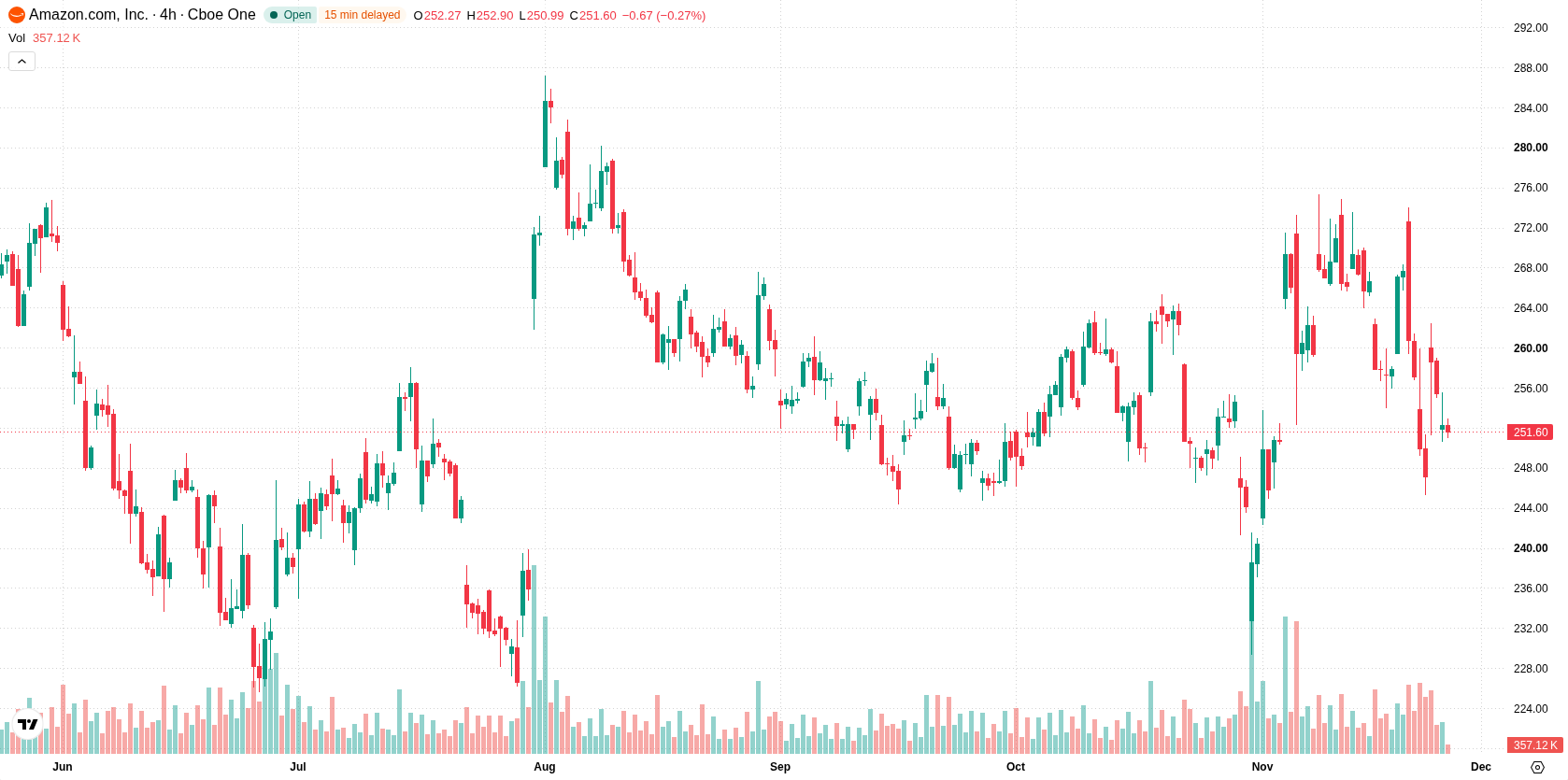
AMZN trades below medium-term MAs amid mixed momentum
On the 4H chart, AMZN is currently positioned below both the D1 SMA-50 at $255.18 and the H4 SMA-20 at $261.79, indicating that downward pressure has persisted in line with the external macro risk. However, the price remains above the longer-term D1 SMA-200 at $245.39, suggesting some underlying support on the daily timeframe.
MACD signals a sell, while ADX readings are neutral, reflecting mixed momentum as the stock trades between key moving averages. The H4 Kijun at $260.31 is acting as immediate resistance within this broader setup.
US macro policy signals and $245–255 support-resistance range
Further upside in US yields or hawkish Fed commentary could keep AMZN stock under pressure, especially if price drops near support around $245. A recovery above resistance in the $255 range would reduce the risk of deeper declines. Market focus stays on inflation data releases and Fed tone for confirmation.
Earlier, analysts noted that Jeff Bezos’ wealth has primarily originated from Amazon and his various technology ventures, rather than any direct exposure to Bitcoin or cryptocurrency investments. The current market focus on US Treasury yields and Federal Reserve commentary introduces a fresh macroeconomic dimension for Amazon's stock, with upcoming inflation data and monetary policy signals likely to drive its next move.






Latest Amazon News




-
 Afghanistan
-
 Albania
-
 Algeria
-
 Angola
-
 Argentina
-
 Armenia
-
 Australia
-
 Austria
-
 Azerbaijan
-
 Bahamas
-
 Bahrain
-
 Bangladesh
-
 Belarus
-
 Belgium
-
 Bolivia
-
 Botswana
-
 Brazil
-
 Brunei
-
 Bulgaria
-
 Cambodia
-
 Cameroon
-
 Canada
-
 Chile
-
 China
-
 Colombia
-
 Congo
-
 Costa Rica
-
 Cote d'Ivoire
-
 Croatia
-
 Cuba
-
 Cyprus
-
 Czechia
-
 DR Congo
-
 Denmark
-
 Dominican Republic
-
 Ecuador
-
 Egypt
-
 El Salvador
-
 Estonia
-
 Eswatini
-
 Ethiopia
-
 Finland
-
 France
-
 Georgia
-
 Germany
-
 Ghana
-
 Greece
-
 Haiti
-
 Hong Kong
-
 Hungary
-
 India
-
 Indonesia
-
 Iran, Islamic republic
-
 Iraq
-
 Ireland
-
 Israel
-
 Italy
-
 Jamaica
-
 Japan
-
 Jordan
-
 Kazakhstan
-
 Kenya
-
 Korea
-
 Kuwait
-
 Kyrgyzstan
-
 Laos
-
 Latvia
-
 Lebanon
-
 Lesotho
-
 Libya
-
 Lithuania
-
 Luxembourg
-
 Madagascar
-
 Malaysia
-
 Malta
-
 Mauritius
-
 Mexico
-
 Moldova
-
 Mongolia
-
 Montenegro
-
 Morocco
-
 Mozambique
-
 Myanmar
-
 Namibia
-
 Nepal
-
 Netherlands
-
 New Zealand
-
 Nigeria
-
 North Macedonia
-
 Norway
-
 Oman
-
 Pakistan
-
 Palestine
-
 Panama
-
 Papua New Guinea
-
 Paraguay
-
 Peru
-
 Philippines
-
 Poland
-
 Portugal
-
 Puerto Rico
-
 Qatar
-
 Reunion
-
 Romania
-
 Rwanda
-
 Saudi Arabia
-
 Serbia
-
 Singapore
-
 Slovakia
-
 Slovenia
-
 Somalia
-
 South Africa
-
 Spain
-
 Sri Lanka
-
 Sweden
-
 Switzerland
-
 Syria
-
 Taiwan
-
 Tajikistan
-
 Tanzania
-
 Thailand
-
 Trinidad and Tobago
-
 Tunisia
-
 Turkey
-
 UAE
-
 Uganda
-
 Ukraine
-
 United Kingdom
-
United States
-
 Uruguay
-
 Uzbekistan
-
 Venezuela
-
 Vietnam
-
 Yemen
-
 Zambia
-
 Zimbabwe
- Forex
- Crypto












