

Can TSMC recover with tightened U.S. controls affecting China shipments and foreign client access?

TSMC (TSM) stock is trading lower, last quoted at $350.2 and down 3.69% on the session. The slide follows the introduction of new U.S. export controls that restrict the company’s chip shipments to several key foreign markets, with traders watching for potential licensing developments and any escalation in U.S.-China trade tensions.
 352.18
386.90
Highlights
- TSMC confirmed total compliance with new U.S. export controls that restrict advanced logic chip shipments to Chinese and non-whitelisted foreign customers without approval.
- These expanded rules limit TSMC’s access to high-end chip export markets and introduce new supply chain disruption risks with no offsetting mitigation reported.
- Shares of TSMC trade below major moving averages with downward pressure persisting and no clear momentum reversal, as resistance is set near $368.
Expanded U.S. export controls limit TSMC’s shipments to China
According to Digitimes, on November 19, 2026, new U.S. government export controls took effect, requiring TSMC to suspend advanced logic chip shipments to Chinese and other non-whitelisted foreign customers unless appropriate licenses are secured. TSMC confirmed that it would comply fully with these expanded rules.
These new restrictions constrain TSMC’s ability to supply high-end chips to several export markets, limiting access to Chinese clients and any other customers not granted U.S. approval. The move directly affects both revenue generation from the restricted regions and the company’s exposure to potential supply chain disruptions.
No material counterweight to this policy risk was reported, leaving the compliance requirements and their impact as the main drag on sentiment for TSM at this time.
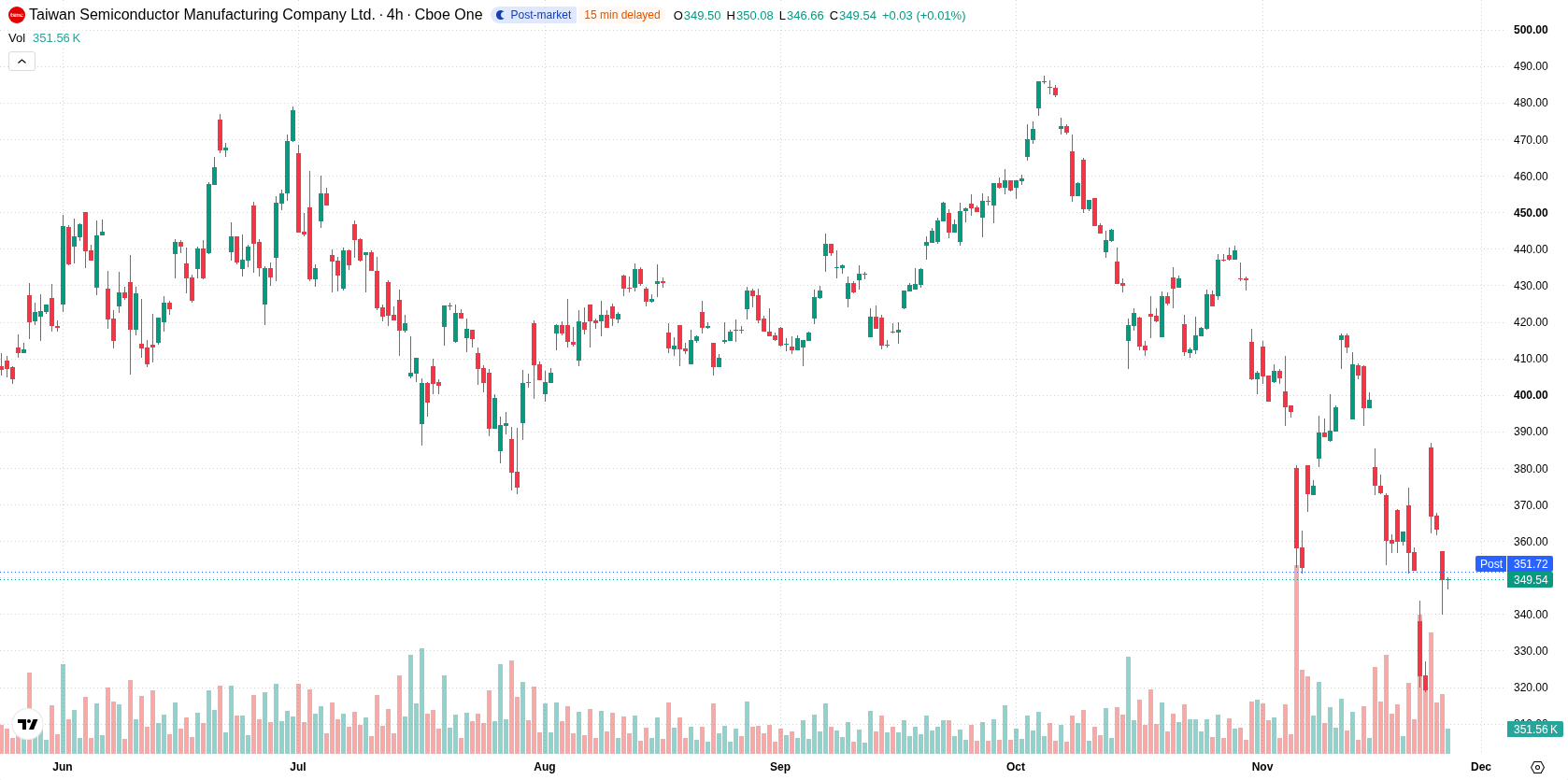
TSM trades below key moving averages with Kijun resistance
TSM’s position has weakened on the 4H chart, with price currently trading below the D1 SMA-50 at $421.17 and the D1 SMA-200 at $403.63. The H4 SMA-20 at $374.95 remains above the last quote, indicating persistent short-term downward pressure.
The MACD gives a Sell forecast while the ADX reads Buy, producing mixed signals. The H4 Kijun at $367.64 is acting as immediate resistance, helping define the current technical boundary with no clear momentum reversal indicated.
Further export licensing clarity needed to break resistance
The outlook remains clouded by ongoing regulatory risk and potential further U.S.-China trade friction. Recovery would need confirmation above resistance around $368, currently set by the H4 Kijun. Sustained price action below this level could continue to limit upside until geopolitical clarity improves. Monitoring of export licensing decisions is critical for gauging next steps.
Earlier, analysts noted that TSMC was under persistent bearish pressure amid mounting operational and geopolitical risks, with ongoing U.S. export controls contributing to volatility. That assessment is reinforced by the latest expansion of U.S. export restrictions, as continued monitoring of licensing developments and U.S.-China trade tensions remains critical for determining the company's near-term prospects.











-
 Afghanistan
-
 Albania
-
 Algeria
-
 Angola
-
 Argentina
-
 Armenia
-
 Australia
-
 Austria
-
 Azerbaijan
-
 Bahamas
-
 Bahrain
-
 Bangladesh
-
 Belarus
-
 Belgium
-
 Bolivia
-
 Botswana
-
 Brazil
-
 Brunei
-
 Bulgaria
-
 Cambodia
-
 Cameroon
-
 Canada
-
 Chile
-
 China
-
 Colombia
-
 Congo
-
 Costa Rica
-
 Cote d'Ivoire
-
 Croatia
-
 Cuba
-
 Cyprus
-
 Czechia
-
 DR Congo
-
 Denmark
-
 Dominican Republic
-
 Ecuador
-
 Egypt
-
 El Salvador
-
 Estonia
-
 Eswatini
-
 Ethiopia
-
 Finland
-
 France
-
 Georgia
-
 Germany
-
 Ghana
-
 Greece
-
 Haiti
-
 Hong Kong
-
 Hungary
-
 India
-
 Indonesia
-
 Iran, Islamic republic
-
 Iraq
-
 Ireland
-
 Israel
-
 Italy
-
 Jamaica
-
 Japan
-
 Jordan
-
 Kazakhstan
-
 Kenya
-
 Korea
-
 Kuwait
-
 Kyrgyzstan
-
 Laos
-
 Latvia
-
 Lebanon
-
 Lesotho
-
 Libya
-
 Lithuania
-
 Luxembourg
-
 Madagascar
-
 Malaysia
-
 Malta
-
 Mauritius
-
 Mexico
-
 Moldova
-
 Mongolia
-
 Montenegro
-
 Morocco
-
 Mozambique
-
 Myanmar
-
 Namibia
-
 Nepal
-
 Netherlands
-
 New Zealand
-
 Nigeria
-
 North Macedonia
-
 Norway
-
 Oman
-
 Pakistan
-
 Palestine
-
 Panama
-
 Papua New Guinea
-
 Paraguay
-
 Peru
-
 Philippines
-
 Poland
-
 Portugal
-
 Puerto Rico
-
 Qatar
-
 Reunion
-
 Romania
-
 Rwanda
-
 Saudi Arabia
-
 Serbia
-
 Singapore
-
 Slovakia
-
 Slovenia
-
 Somalia
-
 South Africa
-
 Spain
-
 Sri Lanka
-
 Sweden
-
 Switzerland
-
 Syria
-
 Taiwan
-
 Tajikistan
-
 Tanzania
-
 Thailand
-
 Trinidad and Tobago
-
 Tunisia
-
 Turkey
-
 UAE
-
 Uganda
-
 Ukraine
-
 United Kingdom
-
United States
-
 Uruguay
-
 Uzbekistan
-
 Venezuela
-
 Vietnam
-
 Yemen
-
 Zambia
-
 Zimbabwe
- Forex
- Crypto












