

What's behind Quantum Computing's latest 6.9% stock surge?

Quantum Computing Inc. (QUBT) rebounded 6.86% as buyers stepped in following recent sector-driven declines. The move looks limited, with the stock remaining below its 20-day, 50-day, and 200-day moving averages, signaling ongoing downward pressure.
 4.95
5.08
Highlights
- Quantum Computing stock came under pressure as the broader technology sector selloff impacted quantum computing names.
- The company is recognized for its substantial cash position and strong sector potential.
- Shares trade below key moving averages with a bearish technical setup, expected to range from $4.36 to $5.46 short term.
Tech selloff weighs despite robust balance sheet and sector optimism
Quantum Computing Inc. has recently been impacted by a broader technology sector selloff that put pressure on quantum computing stocks. The company was highlighted for its sector potential and substantial cash and investment balance.
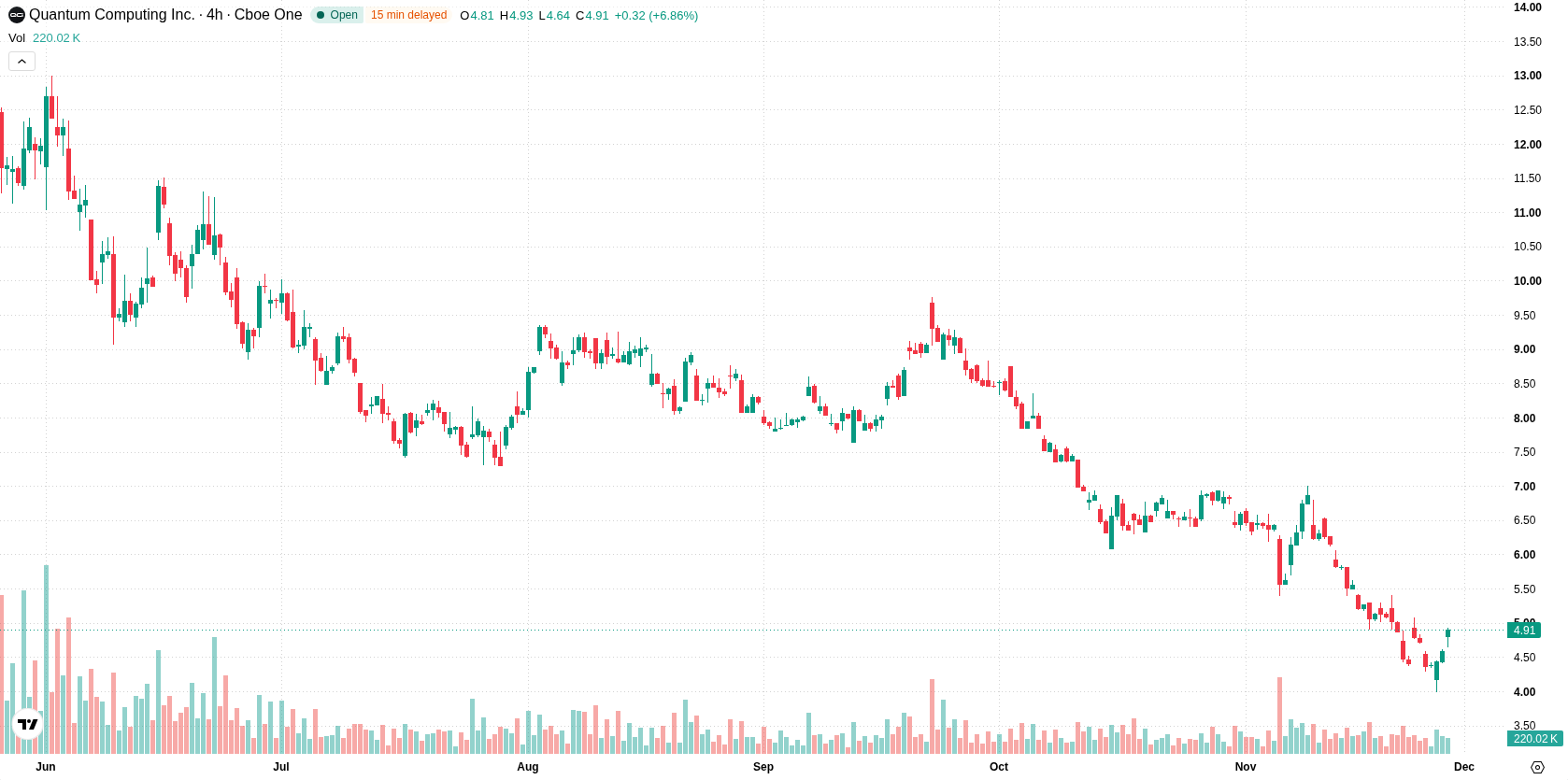
Bearish structure confirmed as resistance holds and momentum weakens
QUBT is trading below its 20-day, 50-day, and 200-day moving averages, reflecting a broadly bearish setup across all timeframes. The immediate resistance is at $5.08, while the nearest support level is $4.62. Higher moving averages and the Ichimoku Kijun at $5.49 reinforce the prevailing downward trend. Momentum indicators, including the MACD and ADX, continue to reflect dominant selling forces. The RSI and Stochastic RSI remain neutral, and the CCI is oversold. Intraday bias favors sellers as negative Bull/Bear Power and the Awesome Oscillator suggest caution, but today’s price is near the high end of the daily range amid noticeable volatility.
Previously it was reported that Quantum Computing Inc. shares were experiencing heightened volatility with mixed momentum, pointing to choppy price action amid persistent downside pressure. With new data confirming both the continuation of bearish technical setups and elevated intraday volatility, traders should closely monitor the $4.36 to $5.46 band for potential breakouts from the prevailing consolidation range.






Latest Quantum Computing News




-
 Afghanistan
-
 Albania
-
 Algeria
-
 Angola
-
 Argentina
-
 Armenia
-
 Australia
-
 Austria
-
 Azerbaijan
-
 Bahamas
-
 Bahrain
-
 Bangladesh
-
 Belarus
-
 Belgium
-
 Bolivia
-
 Botswana
-
 Brazil
-
 Brunei
-
 Bulgaria
-
 Cambodia
-
 Cameroon
-
 Canada
-
 Chile
-
 China
-
 Colombia
-
 Congo
-
 Costa Rica
-
 Cote d'Ivoire
-
 Croatia
-
 Cuba
-
 Cyprus
-
 Czechia
-
 DR Congo
-
 Denmark
-
 Dominican Republic
-
 Ecuador
-
 Egypt
-
 El Salvador
-
 Estonia
-
 Eswatini
-
 Ethiopia
-
 Finland
-
 France
-
 Georgia
-
 Germany
-
 Ghana
-
 Greece
-
 Haiti
-
 Hong Kong
-
 Hungary
-
 India
-
 Indonesia
-
 Iran, Islamic republic
-
 Iraq
-
 Ireland
-
 Israel
-
 Italy
-
 Jamaica
-
 Japan
-
 Jordan
-
 Kazakhstan
-
 Kenya
-
 Korea
-
 Kuwait
-
 Kyrgyzstan
-
 Laos
-
 Latvia
-
 Lebanon
-
 Lesotho
-
 Libya
-
 Lithuania
-
 Luxembourg
-
 Madagascar
-
 Malaysia
-
 Malta
-
 Mauritius
-
 Mexico
-
 Moldova
-
 Mongolia
-
 Montenegro
-
 Morocco
-
 Mozambique
-
 Myanmar
-
 Namibia
-
 Nepal
-
 Netherlands
-
 New Zealand
-
 Nigeria
-
 North Macedonia
-
 Norway
-
 Oman
-
 Pakistan
-
 Palestine
-
 Panama
-
 Papua New Guinea
-
 Paraguay
-
 Peru
-
 Philippines
-
 Poland
-
 Portugal
-
 Puerto Rico
-
 Qatar
-
 Reunion
-
 Romania
-
 Rwanda
-
 Saudi Arabia
-
 Serbia
-
 Singapore
-
 Slovakia
-
 Slovenia
-
 Somalia
-
 South Africa
-
 Spain
-
 Sri Lanka
-
 Sweden
-
 Switzerland
-
 Syria
-
 Taiwan
-
 Tajikistan
-
 Tanzania
-
 Thailand
-
 Trinidad and Tobago
-
 Tunisia
-
 Turkey
-
 UAE
-
 Uganda
-
 Ukraine
-
 United Kingdom
-
United States
-
 Uruguay
-
 Uzbekistan
-
 Venezuela
-
 Vietnam
-
 Yemen
-
 Zambia
-
 Zimbabwe
- Forex
- Crypto












