
Synthetic Indices Prop Firms: How They Work and What To Consider


Editorial Note: While we adhere to strict Editorial Integrity, this post may contain references to products from our partners. Here's an explanation for How We Make Money. None of the data and information on this webpage constitutes investment advice according to our Disclaimer.
Best synthetic indices prop firms:
- FundedNext - Beginners-friendly offers (free trial, trade copier software is allowed)
- Goat Funded Trader - A prop trading firm offering simulated capital of up to $400,000 for Forex and CFD trading
- SabioTrade - Best for those who want to work as non-staff traders with up to 90% of profit
- Funded Trading Plus - Instant funding accounts without profit target (max drawdown 6%)
- Plutus Trade Base - A proprietary trading firm, offering profit split up to 95%, and multiple evaluation models for Forex and CFD trading.
Synthetic indices combine algorithm-generated markets with the funded trading model used by prop firms. Unlike traditional Forex or CFD markets, their prices are generated according to rules set by the provider rather than directly reflecting the price of an underlying asset.
For traders considering a synthetic indices prop firm, this makes pricing, execution, trading rules, and payout conditions particularly important. Understanding how these firms operate and what risks they involve is essential before choosing a funded account.
Risk warning: Proprietary trading involves substantial financial risk. Using firm capital can lead to gains or losses, and failure to meet targets may result in account closure. Over 85% of prop traders do not achieve long-term profitability. Understand the risks and seek professional guidance.
Top prop firms for synthetic indices
When comparing prop firms for synthetic indices, access to the instruments is only the starting point. Evaluation costs, drawdown limits, profit splits, account size, and trading rules can all affect whether a funded account suits a trader's strategy.
The table below compares top prop firms and their key trading conditions.
| FundedNext | Goat Funded Trader | SabioTrade | Funded Trading Plus | Plutus Trade Base | FTMO | |
|---|---|---|---|---|---|---|
|
Max. Leverage |
1:100 | 1:100 | 1:30 | 1:30 | 1:100 | 1:100 |
|
Refundable Fee |
Yes | No | Yes | No | No | Yes |
|
Funding Up To, $ |
4 000 000 | 2 000 000 | 1 000 000 | 200 000 | 500 000 | 2 000 000 |
|
Profit split up to, % |
95 | 95 | 90 | 90 | 95 | 90 |
|
Trading period |
Unlimited | Unlimited | Unlimited | Unlimited | 7 | Unlimited |
|
One-time-payment |
Yes | Yes | Yes | Yes | Yes | Yes |
|
TU overall score |
9.4 | 9.2 | 9.1 | 8.7 | 8.37 | 8.16 |
|
Open an account |
Go to broker Your capital is at risk. |
Go to broker Your capital is at risk.
|
Go to broker Your capital is at risk.
|
Go to broker Your capital is at risk. |
Go to broker Your capital is at risk. |
Go to broker Your capital is at risk. |






Why trust us
15+ years of independent market analysis
140+ evaluation criteria, reviewed by 50+ experts
Data-driven reviews of 200+ platforms, updated regularly
20+ industry awards & a wide network of global media partners
Learn more about our methodology and editorial policies.


What are synthetic indices?
Synthetic indices are provider-generated instruments designed to simulate market-like price movements without tracking a specific stock, currency, commodity, or other underlying asset. Their behavior is determined by the provider's pricing system, with some indices designed around predefined volatility characteristics.
Unlike traditional markets, synthetic indices can operate continuously and are not directly driven by economic releases, company results, or changes in the price of an underlying asset.
How synthetic indices differ from Forex and CFDs
The main differences come down to how prices are generated, when the instruments can be traded, and what risks traders face.
Market structure
Forex and CFDs typically derive their prices from underlying financial markets, while synthetic indices are generated according to rules set by the provider. This means their price movements do not depend directly on market liquidity, economic news, or trading activity in an underlying asset.
For traders considering a prop firm for synthetic indices, this difference makes the source of the price feed and the firm's execution model particularly important.
Trading conditions
Depending on the provider, synthetic indices may offer:
24/7 trading;
defined volatility characteristics;
trading without traditional market sessions;
no price gaps caused by market closures.
These features can make prop firms for synthetic indices attractive to traders who want to trade outside traditional Forex and stock market hours.
Risk dynamics
Synthetic indices are not driven by economic releases, company news, or other traditional market events. However, this does not make them predictable or lower risk. Continuous availability can also encourage traders to trade more frequently, increasing the risk of overtrading and poor risk management.
How synthetic indices prop firms work
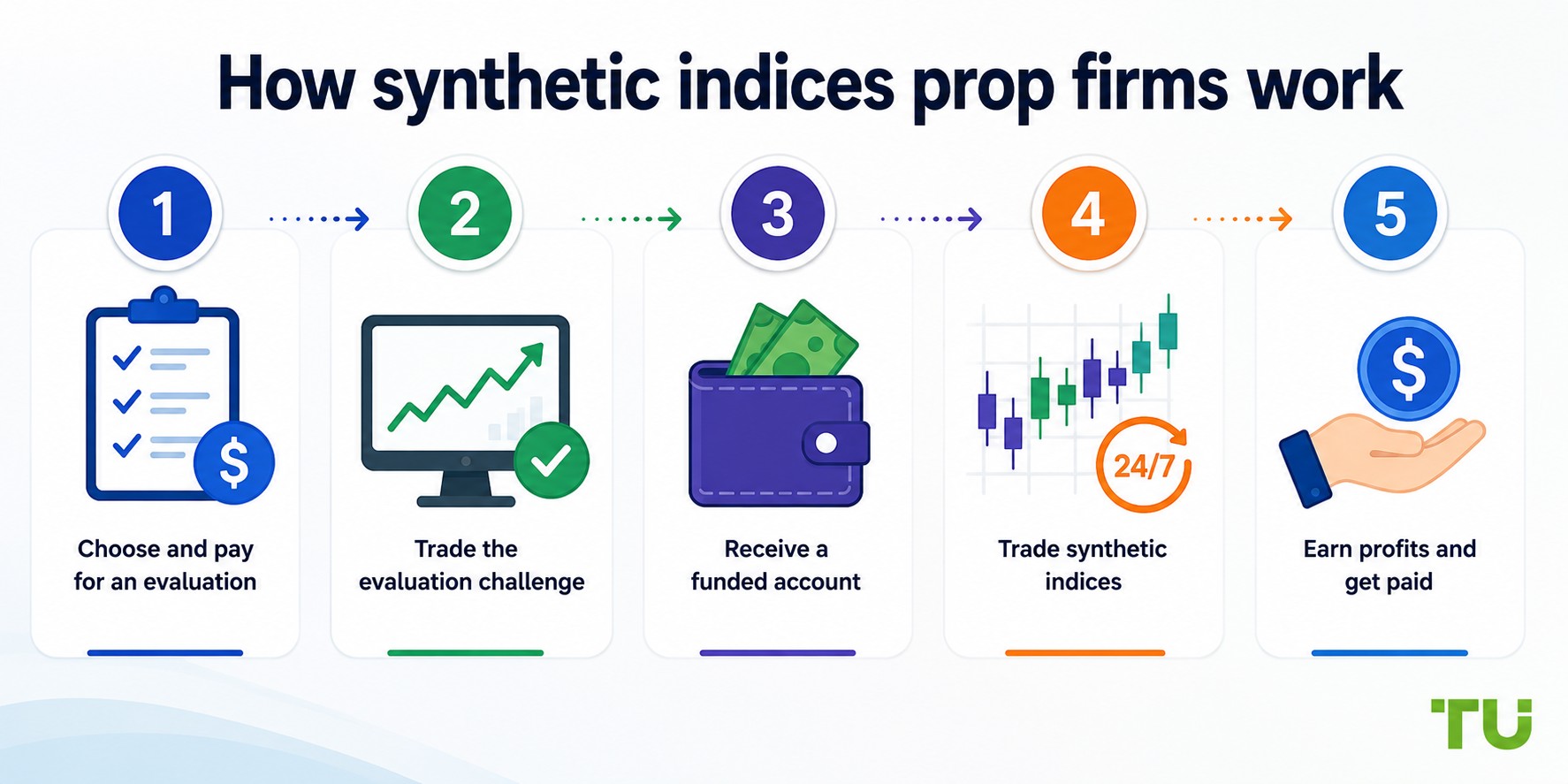
Synthetic indices prop firms generally follow the same basic funded trading model as other prop firms, but the instruments and pricing infrastructure are different. Instead of trading markets such as Forex or stocks, traders receive access to synthetic indices offered or simulated through the firm's trading platform.
Depending on the firm, funded accounts may be offered through:
Evaluation programs. Traders must meet profit targets and stay within risk limits before qualifying for a funded account.
Instant funding. Traders receive funded access without completing a traditional evaluation, usually under a different fee and rule structure.
Simulated funding. Trading takes place in a simulated environment, with eligible profits paid according to the firm's payout rules.
A prop firm that offers synthetic indices may connect to an external synthetic indices provider or use its own trading environment. Traders should therefore check where the price feed comes from, how trades are executed, and whether funded accounts are simulated or connected to live trading infrastructure.
What to check before choosing a synthetic indices prop firm
Not all prop firms offering synthetic indices use the same pricing, funding, or execution model. Before opening an account, traders should understand how the firm provides access to synthetic indices and what conditions apply to trading and withdrawals.
Pricing and execution
Check where the firm's synthetic indices prices come from and how orders are executed. Some synthetic prop firms connect to established providers such as Deriv, while others may use their own or simulated trading environments.
A prop firm that allows synthetic indices should clearly explain its price feed, execution model, and how drawdown and profit calculations work. Access to reliable historical data is also important for testing a strategy before using it in an evaluation.
Evaluation, costs and payouts
Evaluation requirements can include profit targets, maximum drawdown limits, minimum trading days, and restrictions on particular strategies. Traders should also compare evaluation fees, reset costs, profit splits, payout schedules, and withdrawal requirements.
The best prop firm for synthetic indices is not necessarily the one advertising the highest profit share. The complete set of trading and payout conditions matters more than any single number.
| Factor | What to check | Why it matters |
|---|---|---|
| Price feed | Source of synthetic indices prices | Shows how prices are generated |
| Evaluation rules | Profit targets and drawdown limits | Determines challenge difficulty |
| Trading platform | Available platforms, tools and automation | Affects strategy compatibility |
| Costs | Evaluation fees and reset costs | Affects the total cost of trading |
| Payouts | Profit split, payout schedule and withdrawal rules | Determines how profits are accessed |
When deciding which prop firm offers synthetic indices under suitable conditions, traders should compare these factors together rather than choosing a firm based on its profit split or challenge price alone.
Common risks traders overlook
Synthetic indices introduce risks that differ from those associated with traditional Forex or equity markets. These risks largely come from how prices are generated and how the trading infrastructure is structured.
Centralized pricing
Synthetic indices are generated within a provider's own system rather than through trading across multiple market venues. This makes transparency particularly important because traders cannot compare the price against the same type of external market used for currencies or listed stocks.
When reading a synthetic indices prop firm review, check whether it explains the source of the price feed and execution process rather than simply discussing challenge prices and profit splits.
Regulatory and firm risk
Prop firms and synthetic indices providers may operate under different legal and regulatory structures depending on the jurisdiction. Traders should therefore check the entities behind both the firm and the trading platform rather than assuming that one regulatory status covers the entire setup.
Platform dependency
A firm that relies on a single provider or proprietary trading environment can be more exposed to technical outages, pricing disruptions, or changes in platform availability. This dependency may also make it harder for traders to transfer a strategy between firms.
For anyone considering a prop firm account for synthetic indices, these structural risks should be evaluated alongside the usual prop trading risks, including drawdown rules, account termination conditions, fees, and payout restrictions.
Deriv-based synthetic indices prop firms
Deriv is one of the best-known providers of synthetic indices, with instruments including Volatility Indices, Crash/Boom Indices, and Range Break Indices. These markets are generated by Deriv’s own systems and can be traded around the clock rather than following traditional market hours.
A Deriv synthetic indices prop firm gives funded traders access to Deriv-based instruments, either through direct platform integration or a trading environment that replicates them. This distinction matters because the source of the price feed, execution model, and available trading conditions can differ between firms.
When looking for the best prop firm for Deriv synthetic indices, traders should compare the same factors that matter with other funded accounts: evaluation rules, drawdown limits, fees, platform stability, and payout conditions. It is also important to establish whether the prop firm for Deriv synthetic indices provides direct access to Deriv-generated prices or uses a simulated environment, particularly when testing strategies that depend on execution speed or short-term price movements.
Who may benefit from synthetic indices prop firms
Synthetic indices prop firms may suit traders who:
want access to trading outside traditional market hours;
use algorithmic or short-term strategies suited to synthetic markets;
prefer instruments that are not directly affected by economic news or company events;
understand the differences between provider-generated prices and traditional market pricing.
A synthetic prop firm account can provide access to funded trading without relying on traditional Forex, stock, or commodity markets. However, traders should be comfortable with the provider's pricing model, platform, and risk rules before choosing this type of account.
Set your trading limits before entering a 24/7 market

One of the biggest mistakes traders can make with synthetic indices is treating 24/7 access as a reason to trade more often. I would set clear conditions for entering a trade, define the risk per position in advance, and stop trading when those conditions are no longer met. Constant market access is useful only if you can resist the temptation to chase every setup.
It is also important to test your strategy in the specific environment you plan to trade. Price behavior, execution, spreads, and platform conditions can differ between providers, so a strategy that performs well in one environment may not produce the same results in another. Forward testing can help show whether the strategy remains consistent before using it on a funded account.
Finally, treat the prop firm's rules as part of the strategy rather than something to think about after a profitable trade. Drawdown limits, payout requirements, and account conditions should determine how much risk you take and how aggressively you trade. With synthetic indices, disciplined exposure is generally more useful than trying to take advantage of every available trading opportunity.
Methodology for compiling our ratings of prop firms
Traders Union applies a rigorous methodology to evaluate prop companies using over 100 quantitative and qualitative criteria. Multiple parameters are given individual scores that feed into an overall rating.
Key aspects of the assessment include:
-
Trader testimonials and reviews. Collecting and analyzing feedback from existing and past traders to understand their experiences with the firm.
-
Trading instruments. Companies are evaluated on the range of assets offered, as well as the breadth and depth of available markets.
-
Challenges and evaluation process. Analyzing the firm's challenge system, account types, evaluation criteria, and the process for granting funding.
-
Profit split. Reviewing the profit split structure and terms, scaling plans, and how the firm handles profit distributions.
-
Trading conditions. Examining leverage, execution speeds, commissions, and other trading costs associated with the firm.
-
Platform and technology. Assessing the firm's proprietary trading platform or third-party platforms it supports, including ease of use, functionality, and stability.
-
Education and support. Quality and availability of training materials, webinars, and one-on-one coaching.
Conclusion
Synthetic indices prop firms offer traders unique opportunities through 24/7 access and risk profiles that differ from traditional Forex or CFD markets. The main takeaway is that understanding how these prop firms generate prices and manage execution is essential before committing to a funded account, as transparency and reliable pricing can greatly impact trading results. For example, Deriv-based prop firms provide direct or simulated access to popular synthetic indices, each with its own rules and trading environment, making due diligence critical. Ultimately, the discipline to follow firm rules and adapt risk management to this unconventional market is what separates consistently profitable traders from those who chase every available opportunity.
FAQs
What trading strategies are best suited for synthetic indices prop firms?
How does the evaluation process differ between synthetic indices prop firms and traditional prop firms?
What are some key factors to consider when selecting a trading platform for synthetic indices prop firms?
Can trading with synthetic indices prop firms reduce market-related risks compared to traditional assets?
Editors' Top Picks and Insights






Related Articles
Team that worked on the article
Aleksandra Chaikina has been a contributor to Traders Union since 2021. With over 15 years of experience in copywriting and more than 5 years focused on financial content, she specializes in producing detailed guides, analytics, and comparative reviews across various sectors, including cryptocurrencies, Forex, investment strategies, and financial technologies.
Ciaran Ryan is a veteran financial journalist based in South Africa, where he covers cryptocurrency, mining, stock markets, and governance for Moneyweb. He also hosts the weekly Moneyweb Crypto Podcast.
Chinmay Soni is a financial analyst with more than 5 years of experience in working with stocks, Forex, derivatives, and other assets. As a founder of a boutique research firm and an active researcher, he covers various industries and fields, providing insights backed by statistical data.
Risk management is a risk management model that involves controlling potential losses while maximizing profits. The main risk management tools are stop loss, take profit, calculation of position volume taking into account leverage and pip value.
CFD is a contract between an investor/trader and seller that demonstrates that the trader will need to pay the price difference between the current value of the asset and its value at the time of contract to the seller.
Cryptocurrency is a type of digital or virtual currency that relies on cryptography for security. Unlike traditional currencies issued by governments (fiat currencies), cryptocurrencies operate on decentralized networks, typically based on blockchain technology.
Overtrading is a phenomenon where a trader executes too many transactions in the market, surpassing their strategy and trading more frequently than planned. It's a common mistake that can lead to financial losses.
Forex leverage is a tool enabling traders to control larger positions with a relatively small amount of capital, amplifying potential profits and losses based on the chosen leverage ratio.


