
Bitcoin, Stocks, Or Gold: What’s The Smart Choice?



Editorial Note: While we adhere to strict Editorial Integrity, this post may contain references to products from our partners. Here's an explanation for How We Make Money. None of the data and information on this webpage constitutes investment advice according to our Disclaimer.
Bitcoin vs stocks vs gold and real estate – which is better:
Bitcoin offers high volatility and is less regulated. Potential for large short-term gains.
Stocks provide steady growth and dividends. Lower volatility with consistent returns.
Gold is a safe haven. Protects against inflation and economic downturns.
This article takes a deep dive into Bitcoin, stocks, gold, and other assets, analyzing their returns, market capitalizations, and other factors that influence their investment potential.
Comparison of asset returns over the last 10 years
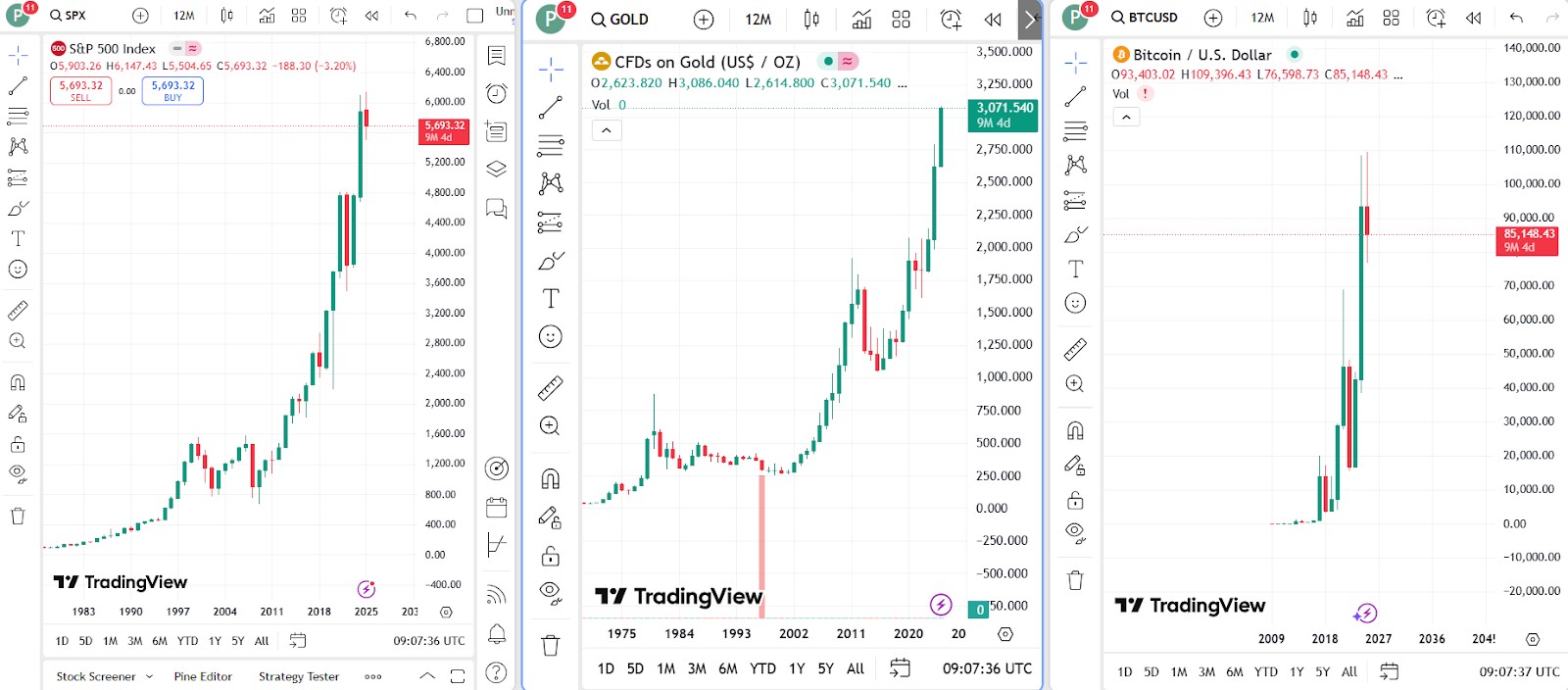
Bitcoin: price growth and volatility analysis
Over the past decade, Bitcoin has shown impressive growth, delivering a 26,931% return from 2014 to 2024. In 2024 alone, its return was 120.8%, significantly outperforming traditional assets. However, its significant price swings are a key characteristic, with annualized volatility around 47%, requiring investors to be prepared for substantial price fluctuations.
Stocks: returns of the S&P 500 and other key indices
The S&P 500 Index, which tracks the performance of the 500 largest U.S. companies, has shown strong growth over the past decade. As of January 31, 2025, the 10-year return is around 202.8%, indicating a solid annual growth rate of about 12.8%. In 2024, the S&P 500 had a total return of 23.3%, continuing a two-year streak of over 20% returns.
These figures highlight the S&P 500's strong performance in recent years, making it an attractive choice for long-term investors looking for growth opportunities.
Gold: price trends and stability
Gold has traditionally been regarded as a safe-haven asset. Over the last decade, its value has increased by approximately 90%, reaching an all-time high of $2,427 per ounce in May 2024. In 2024 alone, gold delivered a 27.54% return, with an average annual growth rate of 9.8%, reflecting its stability during periods of economic uncertainty.
In contrast, U.S. stocks had an average 10-year return rate of 13.1% as of December 2024, while gold had a return rate of 8.33%.
Other Bitcoin alternatives
Real estate: property price growth in major cities
The real estate markets in Israel, Switzerland, and Germany have seen significant changes over the past decade. Here’s a breakdown:
Israel. Property prices in Israel jumped by about 345.7% from 2010 to 2020, marking the biggest rise among these countries. In early 2023, the average price of homes in Tel Aviv hit over 4.2 million Israeli shekels (around 1.13 million USD).
Switzerland. From 2010 to 2020, Swiss property prices grew by about 165.5%. In the second quarter of 2024, prices for high-end residential properties rose by 3% compared to the previous year.
Germany. German home prices climbed by roughly 162% from 2010 to 2020. However, in the second quarter of 2024, prices dropped by about 2.6% year-over-year, though there are signs of stability.
This shows that while Israel has experienced the largest price jumps, Switzerland's market has seen steady increases, and Germany's market has recently cooled off but is starting to stabilize. Keep in mind that local economic policies, interest rates, and other factors will continue to shape how these markets perform in the future.
Oil: price fluctuations and investment impact
Crude oil prices have been quite unpredictable over the past decade, with significant rises and falls influenced by global events, economic factors, and market trends. In 2024, the average price of Brent crude oil was about $80.53 per barrel, lower than the previous year's average of $100.53 per barrel.
Overall, the average price of Brent crude oil in 2024 was about $80.53 per barrel, lower than the previous year's average of $100.53 per barrel. These ups and downs show how volatile the oil market can be, affected by a mix of global events, economic factors, and market trends.
Pros and cons of different assets
Despite differences in market capitalization and liquidity, each asset has its strengths and weaknesses.
Bitcoin (BTC) pros and cons
- Pros
- Cons
Decentralization, independence from central banks and political decisions.
High mobility – you can trade 24/7, seven days a week.
Limited emission (21 million BTC) reduces the risk of inflationary depreciation.
High volatility, sharp fluctuations in the exchange rate in a short time.
Unlike stocks, does not generate passive income (dividends).
Regulatory risks may affect the availability of trading.
We’ve selected top brokers that provide secure, high-liquidity platforms for trading Bitcoin with competitive fees and fast execution.
| Foundation year | Min. Deposit, $ | Spot Taker fee, % | Spot Maker Fee, % | Deposit fee | Withdrawal fee | Demo account | Regulation | TU overall score | Open an account | |
|---|---|---|---|---|---|---|---|---|---|---|
| 2011 | 10 | 0.4 | 0.25 | No | 0.0005 BTC | No | No | 9.2 | Go to broker Your capital is at risk. |
|
| 2017 | 10 | 0.1 | 0.08 | No | 0.0004 BTC 2.6 USDT | Yes | No | 8.9 | Go to broker Your capital is at risk. |
|
| 2011 | 10 | 0.3 | 0.2 | No | 0.0004 BTC 0.005 ETH 6%. if there was no futures trading | Yes | FCIS, FinCEN, FINTRAC | 7.84 | Go to broker Your capital is at risk.
|
|
| 2012 | 10 | 0.5 | 0.5 | No | Fixed fee - 25 USD PayPal - 1.5% USDC - 10 USD | No | No | 7.68 | Go to broker Your capital is at risk. |
|
| 2014 | 5 | Not available | Not available | No | Varies | No | Bank of Spain, FCA, CNV | 7.6 | Go to broker Your capital is at risk.
|
Gold pros and cons
- Pros
- Cons
Historically stable asset that retains value.
Low correlation with the stock market, useful for diversification.
Physical storage reduces the risk of cyberattacks and technical failures.
Does not generate passive income, unlike stocks and bonds.
Costs of storing physical gold (safes, insurance).
Limited growth opportunities compared to stocks or bitcoin.
Explore trusted platforms that make gold investing simple — offering stable pricing, high liquidity, and flexible investment options.
| Foundation year | Account min. | Metals | Deposit Fee | Withdrawal fee | Inactivity fee | Demo | Regulation | TU overall score | Open an account | |
|---|---|---|---|---|---|---|---|---|---|---|
| 2007 | 50 | No | No | No | No | Yes | SEC, FINRA | 8.8 | Go to broker Your capital is at risk. |
|
| 2008 | EUR500 | No | No | No | No | Yes | CySEC, FCA, ASIC, FMA, FSCA, FSA Seychelles, EFSA, MAS, DFSA, SCB | 8.48 | Go to broker 80% of retail CFD accounts lose money. |
|
| 2007 | No | No | Not specified | Not specified | Not specified | Yes | FINRA, SIPC | 7.93 | Study review | |
| 2015 | No | Yes | No | No charge up to a limit | Not specified | No | FCA, SEC, FINRA | 8.6 | Study review | |
| 1978 | No | Yes | No | No | No | Yes | SEC, FINRA, SIPC, FCA, NSE, BSE, SEBI, SEHK, HKFE, IIROC, ASIC, CFTC, NFA | 8.53 | Study review |
Stock market (S&P 500, company stocks) pros and cons
- Pros
- Cons
Ability to receive dividends and participate in company profits.
Long-term growth: S&P 500 has grown by 202.8% over the past 10 years.
Regulated environment, investor protection in developed markets.
Susceptible to crises and economic downturns.
Highly dependent on the macroeconomic situation (Fed, inflation, rates).
Risk of devaluation of individual companies in case of poor management
Market capitalization alone does not determine an asset’s investment attractiveness. Liquidity, risk levels, and income potential are crucial factors for investors. Stocks and gold remain the most liquid assets, while Bitcoin offers high returns but comes with significant volatility. Investors should consider these factors when building their portfolios, aligning their choices with their investment goals and time horizon.
Our list features reliable brokers that offer access to global stock markets, dividend-paying shares, and user-friendly investing tools.
| Demo | Account min. | Interest rate | Basic stock/ETF fee | Min. stock/ETF fee | TU overall score | Open an account | |
|---|---|---|---|---|---|---|---|
| Yes | 50 | 3,75 | No | No | 8.8 | Go to broker Your capital is at risk. |
|
| Yes | EUR500 | No | $0.006 | Not specified | 8.48 | Go to broker 80% of retail CFD accounts lose money. |
|
| Yes | No | 8.95% | $0 | $0 | 7.93 | Study review | |
| No | No | 0%-4% | 0.12%-0.25% | £1.00/€1.00 | 8.6 | Study review | |
| Yes | No | 4.83% | 0-0,0035% | $1,00 | 8.53 | Study review |
Why trust us
15+ years of independent market analysis
140+ evaluation criteria, reviewed by 50+ experts
Data-driven reviews of 200+ platforms, updated regularly
20+ industry awards & a wide network of global media partners
Learn more about our methodology and editorial policies.


Comparison of market capitalization
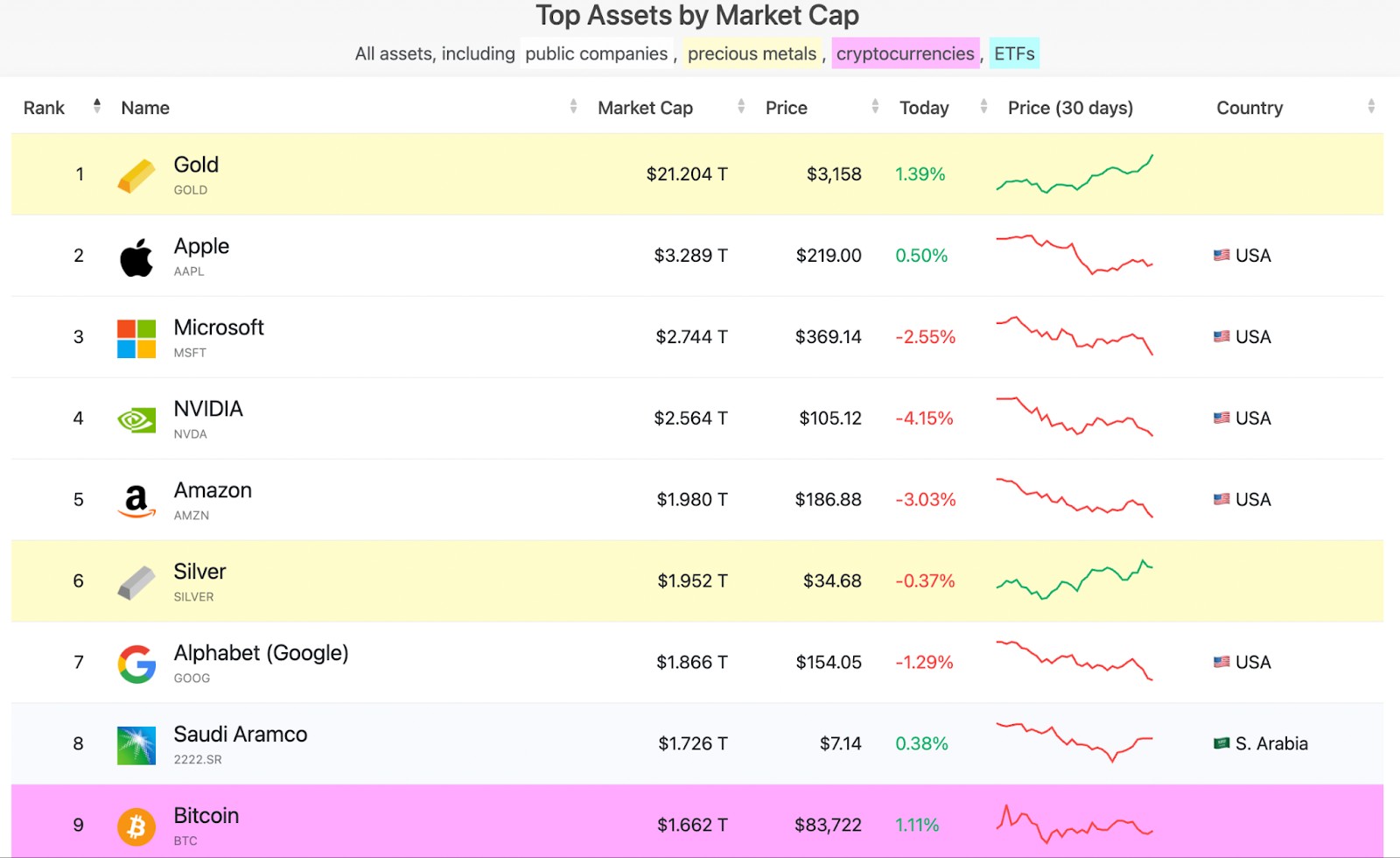
Market сapitalization
Gold is the largest asset ($21.204T), significantly surpassing both stocks and cryptocurrencies.
Bitcoin ($1.662T) is much smaller than gold (over 12 times less) but comparable to leading tech companies.
Stocks of major tech giants range from $3.289T (Apple) to $1.866T (Google), showcasing strong market capitalization.
Price trends
Gold is rising (+1.39%) and shows a steady upward trend over the past 30 days.
Bitcoin is also increasing (+1.11%) but with more volatility in its price chart.
Stocks of most companies are declining (Microsoft -2.55%, NVIDIA -4.15%, Amazon -3.03%), reflecting current market pressures.
Volatility and investment appeal
Gold remains stable, with slow but consistent growth, reinforcing its status as a safe-haven asset.
Bitcoin has high growth potential but is significantly more volatile than gold and stocks.
Stocks are under pressure but remain a key long-term investment vehicle.
Factors influencing value

Bitcoin: demand, regulation, and technology
Bitcoin’s value is driven by limited supply (21 million coins), investor demand, and adoption as a store of value. Government regulations can either boost confidence and participation or restrict demand. Technological advancements, such as network upgrades and integration with financial systems, further impact its market price.
Stocks: corporate performance and economic conditions
Stock prices depend on earnings, revenue growth, and industry positioning. Companies in high-barrier sectors (e.g., pharmaceuticals, tech) are more resilient to downturns, while competitive industries face greater volatility. Interest rates, inflation, and geopolitical trends also shape stock market performance, influencing investor sentiment and risk exposure.
Gold: inflation, geopolitics, and commodity demand
Gold acts as a hedge against inflation, but its price reacts to real interest rates rather than inflation alone. Geopolitical instability, trade wars, and central bank gold purchases increase its demand as a safe-haven asset. Additionally, global commodity trends, such as oil price fluctuations, can indirectly affect gold’s value.
Bitcoin’s volatility offers unique growth potential compared to stocks and gold

When comparing Bitcoin to stocks and gold, it's essential to understand that Bitcoin isn’t just a digital asset; it’s a financial revolution. Unlike stocks that represent ownership in companies and gold which is a centuries-old store of value, Bitcoin provides a hedge against both inflation and traditional financial systems. Bitcoin’s decentralized nature means it operates independently of government regulations, offering the potential for unparalleled growth in the future.
But what truly sets it apart is its volatility, which can be seen as an opportunity for those willing to manage risk. For a beginner, learning how to navigate this volatility with proper risk management strategies can unlock the potential for exponential gains — something neither stocks nor gold offer in such a short time span.
Conclusion
Investing in Bitcoin, stocks, and gold requires taking into account their characteristics and role in the portfolio. Bitcoin has high growth potential, but its volatility requires careful management. Stocks provide stable capital growth and the possibility of passive income through dividends. Gold protects against inflation and market shocks, but its long-term profitability is lower. The best option is to combine assets taking into account the investment horizon and risk level. Proper capital allocation reduces risks and makes the portfolio sustainable in different economic conditions.
FAQs
How to determine how much Bitcoin to include in a portfolio?
The optimal share depends on the level of risk. For a balanced portfolio, 5-10% is often used to benefit from growth without excessive volatility. Aggressive investors can increase the share, but this increases the risk of short-term drawdowns.
When does gold show the best returns?
Gold grows during low interest rates, economic instability, and a falling stock market. Examples are the 2008 crisis and the 2020 pandemic, when its price reached new highs. During periods of economic growth, gold usually shows weak dynamics.
Why are stocks historically considered the most reliable asset?
The stock market shows an average annual return of 7-10% over long periods of time, including crises. Companies develop, pay dividends, and the value of shares grows along with the economy. It is important to choose assets based on fundamental analysis, not short-term trends.
How to minimize risks when investing in Bitcoin?
Risks can be reduced by using cost averaging (buying in small parts) and a fixed percentage in the portfolio. It is also worth keeping some assets in stable instruments to compensate for possible falls in the crypto market.
Editors' Top Picks and Insights

Lindsey Graham death: U.S. senator’s crypto legacy

Tether under pressure: USDT in Europe, audit questions, and the fight for trust

Lean Ethereum: Why Buterin wants to rebuild the network

SK Hynix debuts on Nasdaq: Largest U.S. offering by foreign company

SpaceX falls out of orbit: Does anyone still want Musk’s stock?

The crypto IPO problem: How high-profile listings became investor traps
Related Articles
Team that worked on the article
Maxim Nechiporenko has been a contributor to Traders Union since 2023. He started his professional career in the media in 2006.
Chinmay Soni is a financial analyst with more than 5 years of experience in working with stocks, Forex, derivatives, and other assets. As a founder of a boutique research firm and an active researcher, he covers various industries and fields, providing insights backed by statistical data.
Mirjan Hipolito is a journalist and news editor at Traders Union. She is an expert crypto writer with five years of experience in the financial markets.
Risk management is a risk management model that involves controlling potential losses while maximizing profits. The main risk management tools are stop loss, take profit, calculation of position volume taking into account leverage and pip value.
Fundamental analysis is a method or tool that investors use that seeks to determine the intrinsic value of a security by examining economic and financial factors. It considers macroeconomic factors such as the state of the economy and industry conditions.
Ethereum is a decentralized blockchain platform and cryptocurrency that was proposed by Vitalik Buterin in late 2013 and development began in early 2014. It was designed as a versatile platform for creating decentralized applications (DApps) and smart contracts.
Volatility refers to the degree of variation or fluctuation in the price or value of a financial asset, such as stocks, bonds, or cryptocurrencies, over a period of time. Higher volatility indicates that an asset's price is experiencing more significant and rapid price swings, while lower volatility suggests relatively stable and gradual price movements.
Cryptocurrency is a type of digital or virtual currency that relies on cryptography for security. Unlike traditional currencies issued by governments (fiat currencies), cryptocurrencies operate on decentralized networks, typically based on blockchain technology.

-
 Afghanistan
-
 Albania
-
 Algeria
-
 Angola
-
 Argentina
-
 Armenia
-
 Australia
-
 Austria
-
 Azerbaijan
-
 Bahamas
-
 Bahrain
-
 Bangladesh
-
 Belarus
-
 Belgium
-
 Bolivia
-
 Botswana
-
 Brazil
-
 Brunei
-
 Bulgaria
-
 Cambodia
-
 Cameroon
-
 Canada
-
 Chile
Chile
-
 China
China
-
 Colombia
-
 Congo
Congo
-
 Costa Rica
-
 Cote d'Ivoire
-
 Croatia
-
 Cuba
Cuba
-
 Cyprus
-
 Czechia
-
 DR Congo
-
 Denmark
-
 Dominican Republic
-
 Ecuador
-
 Egypt
Egypt
-
 El Salvador
-
 Estonia
-
 Eswatini
-
 Ethiopia
-
 Finland
-
 France
-
 Georgia
-
 Germany
-
 Ghana
Ghana
-
 Greece
-
 Haiti
Haiti
-
 Hong Kong
-
 Hungary
-
 India
India
-
 Indonesia
-
 Iran, Islamic republic
-
 Iraq
Iraq
-
 Ireland
-
 Israel
-
 Italy
Italy
-
 Jamaica
-
 Japan
Japan
-
 Jordan
-
 Kazakhstan
-
 Kenya
Kenya
-
 Korea
Korea
-
 Kuwait
-
 Kyrgyzstan
-
 Laos
Laos
-
 Latvia
-
 Lebanon
-
 Lesotho
-
 Libya
Libya
-
 Lithuania
-
 Luxembourg
-
 Madagascar
-
 Malaysia
-
 Malta
Malta
-
 Mauritius
-
 Mexico
-
 Moldova
-
 Mongolia
-
 Montenegro
-
 Morocco
-
 Mozambique
-
 Myanmar
-
 Namibia
-
 Nepal
Nepal
-
 Netherlands
-
 New Zealand
-
 Nigeria
-
 North Macedonia
-
 Norway
-
 Oman
Oman
-
 Pakistan
-
 Palestine
-
 Panama
-
 Papua New Guinea
-
 Paraguay
-
 Peru
Peru
-
 Philippines
-
 Poland
-
 Portugal
-
 Puerto Rico
-
 Qatar
Qatar
-
 Reunion
-
 Romania
-
 Rwanda
-
 Saudi Arabia
-
 Serbia
-
 Singapore
-
 Slovakia
-
 Slovenia
-
 Somalia
-
 South Africa
-
 Spain
Spain
-
 Sri Lanka
-
 Sweden
-
 Switzerland
-
 Syria
Syria
-
 Taiwan
-
 Tajikistan
-
 Tanzania
-
 Thailand
-
 Trinidad and Tobago
-
 Tunisia
-
 Turkey
-
 UAE
UAE
-
 Uganda
-
 Ukraine
-
 United Kingdom
-
United States
-
 Uruguay
-
 Uzbekistan
-
 Venezuela
-
 Vietnam
-
 Yemen
Yemen
-
 Zambia
-
 Zimbabwe
- Forex
- Crypto











