
Which Google Stock Should You Invest In?



Editorial Note: While we adhere to strict Editorial Integrity, this post may contain references to products from our partners. Here's an explanation for How We Make Money. None of the data and information on this webpage constitutes investment advice according to our Disclaimer.
GOOGL (Class A) comes with voting rights, allowing you to vote on company decisions like electing board members. On the other hand, GOOG (Class C) has no voting rights but usually trades at a similar price to GOOGL. For most investors, the voting power of GOOGL is not significant enough to affect long-term returns, so you can choose either based on your personal preference regarding voting or simply go for the stock with the lower price at the time of purchase.
An investment in Google isn’t really questionable, especially considering its consistent growth and leadership in the tech industry. However, choosing between Alphabet's two types of publicly traded shares — GOOGL (Class A) and GOOG (Class C) — can be confusing. In this article, we’ll help you understand the differences and provide a step-by-step guide for choosing the right stock for your investment goals.
Choosing between GOOGL and GOOG
GOOGL (Class A) stock comes with voting rights — meaning you can vote on corporate matters such as electing board members and approving major company decisions. Each GOOGL share gives you one vote. GOOG (Class C) shares, on the other hand, do not come with any voting rights.
Should you care about voting rights?
For most retail investors, the voting power offered by GOOGL won’t significantly affect their investment. Major shareholders, such as Alphabet insiders who hold Class B shares (which have ten votes per share), control the bulk of the voting power. If you’re an everyday investor, the absence of voting rights in GOOG shares is unlikely to impact your returns.
Company background
Google was founded in 1998 by Larry Page and Sergey Brin, and it quickly became the world’s most popular search engine. In 2015, Google restructured under the parent company Alphabet to better manage its growing list of businesses, from YouTube and Android to self-driving cars and cloud computing.
Alphabet's market dominance and diverse revenue streams ensure its continued success, making it one of the most valuable companies in the world. Investors who choose Alphabet stock are betting on the future of technology, AI, and digital transformation.
Alphabet has three classes of shares:
GOOGL (Class A): Publicly traded with 1 vote per share.
GOOG (Class C): Publicly traded with no voting rights.
Class B: Held by insiders like founders and employees, with 10 votes per share, and not publicly traded.
While GOOGL shareholders can vote at company meetings, their influence is usually minimal due to the controlling power of Class B shareholders. GOOG shareholders, meanwhile, enjoy the same financial benefits without any voting power.
Price differences between GOOGL and GOOG
Historically, the price difference between GOOGL and GOOG has been minimal. Any fluctuations typically result from temporary market factors, so for most investors, the choice between these two stocks comes down to personal preference about voting rights rather than price.
Check current stock prices
Before investing, compare the real-time prices of GOOGL and GOOG shares on major stock exchanges like NASDAQ. Both stocks are highly liquid, meaning they can be easily bought and sold on public markets.
Long-term investment focus
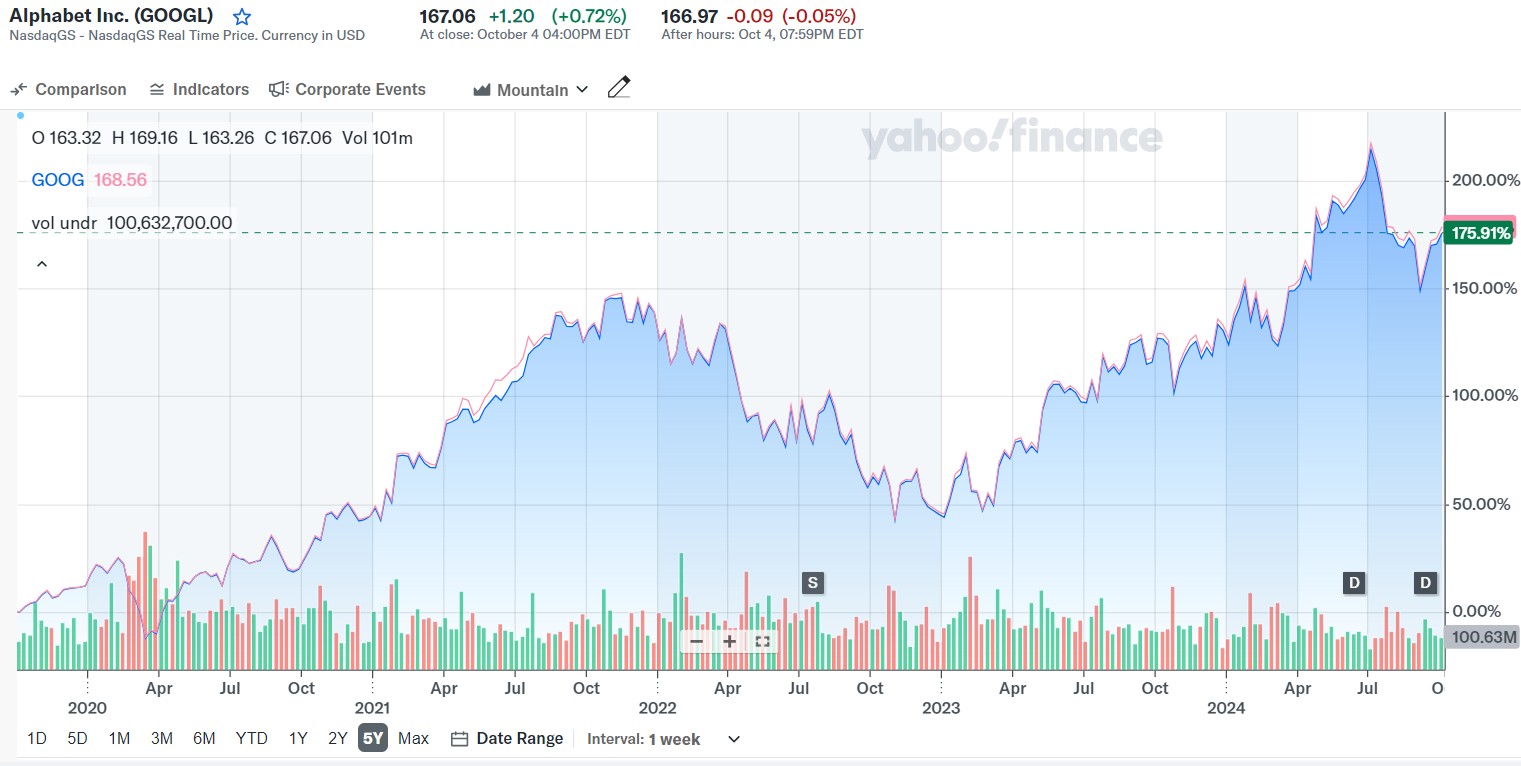
Alphabet’s stock has shown consistent long-term growth due to its leadership in search, advertising, and its push into innovative technologies like cloud computing and artificial intelligence. Whether you choose GOOGL or GOOG, both stocks are well-suited for long-term investors.
Factors to consider for beginners
Understand the voting rights
For beginners, the lack of voting rights in GOOG isn’t a deal breaker. Most retail investors hold too few shares for their votes to make a difference in corporate decisions.Fractional shares for small investors
If the price of Alphabet stock seems high, you can buy fractional shares from brokers that offer the facility. This allows you to start small and grow your investment over time.Long-term growth focus
Beginners should focus on Alphabet’s long-term growth potential rather than short-term fluctuations. Alphabet’s dominant position in the tech industry makes it a stable choice for long-term investors.
Pros and cons of investing in Google stocks
- Pros
- Cons
Market leader. Google is the dominant search engine and a leader in digital advertising.
Revenue growth. Alphabet has shown consistent revenue growth, thanks to its diverse business lines.
Strong financials. Alphabet boasts a strong balance sheet and significant cash reserves, making it a resilient investment.
High share price. Alphabet's stock price may be prohibitive for smaller investors, though fractional shares can mitigate this.
Limited voting influence. Even with GOOGL, retail investors have limited impact on corporate governance.
Short-term volatility. Alphabet's stock can experience sharp price swings, especially in response to market news.
How much can I earn by investing in Google stock?
Since its IPO in 2004, Google’s stock has delivered significant returns to long-term investors. For example, a $10,000 investment in Google in 2004 would be worth more than $1 million today. While past performance is not indicative of future results, Alphabet’s diverse revenue streams and dominance in the tech industry position it for continued growth.
How to buy Google stock: a step-by-step guide
Choose a broker. Find a reliable online broker. We have researched the top options and prepared a comparison table below for you to make a choice.
| Demo | Stocks | Account min. | Interest rate | Basic stock/ETF fee | Min. stock/ETF fee | Open an account | |
|---|---|---|---|---|---|---|---|
| Yes | Yes | 50 | 3,75 | No | No | Go to broker Your capital is at risk. |
|
| Yes | Yes | EUR500 | No | $0.006 | Not specified | Go to broker 80% of retail CFD accounts lose money. |
|
| Yes | Yes | No | 8.95% | $0 | $0 | Study review | |
| No | Yes | No | 0%-4% | 0.12%-0.25% | £1.00/€1.00 | Study review | |
| Yes | Yes | No | 4.97% | No | No | Study review |
Open a brokerage account. Set up an account with the chosen broker.
Deposit funds. Add funds to your account.
Buy alphabet shares. Purchase GOOGL or GOOG shares based on your research.
Monitor your investment. Regularly review your portfolio and make adjustments as necessary.
Risks and warnings
Market volatility
As with any stock, Alphabet shares are subject to market volatility. Short-term investors need to be prepared for fluctuations.Regulatory challenges
Alphabet is frequently under scrutiny from regulators regarding its data practices, antitrust issues, and monopoly status. Any adverse rulings could negatively affect its stock price.Regulatory pressure on AI and data. Governments are cracking down on how companies use personal data, and Google’s AI-driven ad business could take a hit from new privacy laws, especially in Europe.
Declining search dominance. Fewer people are Googling everything. AI-based alternatives and social media searches are chipping away at Google’s search business.
Emerging market risks. Google’s growth in places like India is uncertain due to unpredictable regulations and competition from local players.
Costly innovation bets. Google’s investments in futuristic projects like Waymo are exciting but risky, with long timelines and no guarantee of payoff.
Ad market saturation. Digital ad space is crowded. Platforms like TikTok and Instagram are taking away younger audiences, which could shrink Google’s ad revenue over time.
Focus on the stock that’s priced lower

For most retail investors, the difference between GOOGL and GOOG is minimal. Both stocks track the performance of Alphabet, and historically, they’ve moved in almost perfect sync. The decision ultimately comes down to whether you care about participating in shareholder votes. If you’re planning on holding these shares for the long term, then either stock can be a solid investment.
If you’re new to investing or prefer simplicity, I’d suggest focusing more on the stock that’s priced lower at the time you’re ready to buy. Alphabet’s core business is strong, with its dominance in digital advertising, cloud computing, and new ventures like AI offering long-term growth potential. Whether you go with GOOGL or GOOG, what matters more is your timing, your investment horizon, and your ability to ride out short-term market fluctuations. Long-term, Alphabet has proven to be a resilient and profitable stock in my experience.
Also, don't overlook the basics — stay informed about the company's financial health, follow quarterly earnings reports, and keep an eye on major news that might impact stock performance. Diversification is key too; even with a tech giant like Alphabet, it’s always smart to spread your risk across different sectors.
Conclusion
When deciding between GOOGL and GOOG, the key differentiator is voting power—GOOGL shareholders have the right to vote on company matters, while GOOG investors do not. For those who value a say in the future direction of Alphabet Inc., GOOGL is the clear choice, even if it trades at a slight premium. However, investors solely interested in price gains may find GOOG just as compelling, given their near-identical financial performance and growth prospects. Ultimately, the most powerful takeaway is that both stocks offer exposure to Google’s robust growth engine, but your investment should align with your priorities: influence through voting rights or maximizing returns. In the world of tech giants, even a small difference in shares can shape your role in the company’s evolution.
FAQs
What are the primary differences in shareholder rights between GOOGL and GOOG stock classes?
How does Alphabet’s corporate structure impact the control individual investors have over the company?
What long-term investment considerations should be evaluated before choosing between GOOGL or GOOG?
What are the main risks associated with investing in Alphabet stock, regardless of share class?
Editors' Top Picks and Insights
Intel's comeback: Apple, Trump and the AI bet

Bitcoin price prediction based on RSI: Is BTC poised for a new rally?

Toncoin becomes Gram: Why Durov restored token's original name

Why Tether flipping Ethereum is a pivotal moment for crypto

MiCA deadline: Why crypto companies are leaving Europe

From “Holy Trinity” to WLD crash: How Arthur Hayes became a market-moving seller
Related Articles
Team that worked on the article
Parshwa is a content expert and finance professional possessing deep knowledge of stock and options trading, technical and fundamental analysis, and equity research. As a Chartered Accountant Finalist, Parshwa also has expertise in Forex, crypto trading, and personal taxation.
Chinmay Soni is a financial analyst with more than 5 years of experience in working with stocks, Forex, derivatives, and other assets. As a founder of a boutique research firm and an active researcher, he covers various industries and fields, providing insights backed by statistical data.
Mirjan Hipolito is a journalist and news editor at Traders Union. She is an expert crypto writer with five years of experience in the financial markets.
CFD is a contract between an investor/trader and seller that demonstrates that the trader will need to pay the price difference between the current value of the asset and its value at the time of contract to the seller.
Diversification is an investment strategy that involves spreading investments across different asset classes, industries, and geographic regions to reduce overall risk.
Index in trading is the measure of the performance of a group of stocks, which can include the assets and securities in it.
Volatility refers to the degree of variation or fluctuation in the price or value of a financial asset, such as stocks, bonds, or cryptocurrencies, over a period of time. Higher volatility indicates that an asset's price is experiencing more significant and rapid price swings, while lower volatility suggests relatively stable and gradual price movements.
Crypto trading involves the buying and selling of cryptocurrencies, such as Bitcoin, Ethereum, or other digital assets, with the aim of making a profit from price fluctuations.

-
 Afghanistan
-
 Albania
-
 Algeria
-
 Angola
-
 Argentina
-
 Armenia
-
 Australia
-
 Austria
-
 Azerbaijan
-
 Bahamas
-
 Bahrain
-
 Bangladesh
-
 Belarus
-
 Belgium
-
 Bolivia
-
 Botswana
-
 Brazil
-
 Brunei
-
 Bulgaria
-
 Cambodia
-
 Cameroon
-
 Canada
-
 Chile
Chile
-
 China
China
-
 Colombia
-
 Congo
Congo
-
 Costa Rica
-
 Cote d'Ivoire
-
 Croatia
-
 Cuba
Cuba
-
 Cyprus
-
 Czechia
-
 DR Congo
-
 Denmark
-
 Dominican Republic
-
 Ecuador
-
 Egypt
Egypt
-
 El Salvador
-
 Estonia
-
 Eswatini
-
 Ethiopia
-
 Finland
-
 France
-
 Georgia
-
 Germany
-
 Ghana
Ghana
-
 Greece
-
 Haiti
Haiti
-
 Hong Kong
-
 Hungary
-
 India
India
-
 Indonesia
-
 Iran, Islamic republic
-
 Iraq
Iraq
-
 Ireland
-
 Israel
-
 Italy
Italy
-
 Jamaica
-
 Japan
Japan
-
 Jordan
-
 Kazakhstan
-
 Kenya
Kenya
-
 Korea
Korea
-
 Kuwait
-
 Kyrgyzstan
-
 Laos
Laos
-
 Latvia
-
 Lebanon
-
 Lesotho
-
 Libya
Libya
-
 Lithuania
-
 Luxembourg
-
 Madagascar
-
 Malaysia
-
 Malta
Malta
-
 Mauritius
-
 Mexico
-
 Moldova
-
 Mongolia
-
 Montenegro
-
 Morocco
-
 Mozambique
-
 Myanmar
-
 Namibia
-
 Nepal
Nepal
-
 Netherlands
-
 New Zealand
-
 Nigeria
-
 North Macedonia
-
 Norway
-
 Oman
Oman
-
 Pakistan
-
 Palestine
-
 Panama
-
 Papua New Guinea
-
 Paraguay
-
 Peru
Peru
-
 Philippines
-
 Poland
-
 Portugal
-
 Puerto Rico
-
 Qatar
Qatar
-
 Reunion
-
 Romania
-
 Rwanda
-
 Saudi Arabia
-
 Serbia
-
 Singapore
-
 Slovakia
-
 Slovenia
-
 Somalia
-
 South Africa
-
 Spain
Spain
-
 Sri Lanka
-
 Sweden
-
 Switzerland
-
 Syria
Syria
-
 Taiwan
-
 Tajikistan
-
 Tanzania
-
 Thailand
-
 Trinidad and Tobago
-
 Tunisia
-
 Turkey
-
 UAE
UAE
-
 Uganda
-
 Ukraine
-
 United Kingdom
-
United States
-
 Uruguay
-
 Uzbekistan
-
 Venezuela
-
 Vietnam
-
 Yemen
Yemen
-
 Zambia
-
 Zimbabwe
- Forex
- Crypto












