
Best International Brokers For Global Market Access



Editorial Note: While we adhere to strict Editorial Integrity, this post may contain references to products from our partners. Here's an explanation for How We Make Money. None of the data and information on this webpage constitutes investment advice according to our Disclaimer.

If you're too busy to read the entire article and want a quick answer, the best international broker for global market is zForex. Why? Here are its key advantages:
- Is legit in your country (Identified as United States
 )
) - Has a good user satisfaction score
- Wide access to markets - including stocks, bonds, ETFs and other instruments - allows you to effectively diversify your investment portfolio.
- Competitive commissions and fees - a transparent and competitive commission structure, including low spreads and no hidden fees, helps reduce trading costs.
Best international brokers for global market trading:
- zForex - High transaction speeds, automatic tracking system of clients’ risks..
- Plus500 - Best premium client support (personal manager, exclusive analysis, webinars)
- Vantage Markets - Best for trading CFDs on major U.S. Stocks (zero fees apply)
- Trading.com USA - A broker registered with the CFTC and NFA that focuses on spot Forex trading through MT5 and proprietary platforms.
- OANDA - Best for trading with advanced technical analysis tools (TradingView charts support)
In this day and age, it is important to be smart with money. If you have extra money, investing it is always a good idea. This allows it to grow and even double in value, rather than gathering dust somewhere in your bank account. International brokers can help in this matter - they open access to a wide range of assets and markets around the world, and also increase your capital.
Choosing the right broker requires careful consideration and responsibility. This article highlights reputable brokers that offer excellent trading conditions for international markets. These brokers are known for transparent commission structures, user-friendly platforms, and reliable customer support. Explore their features to select the best partner for trading in global markets.
Best international brokers
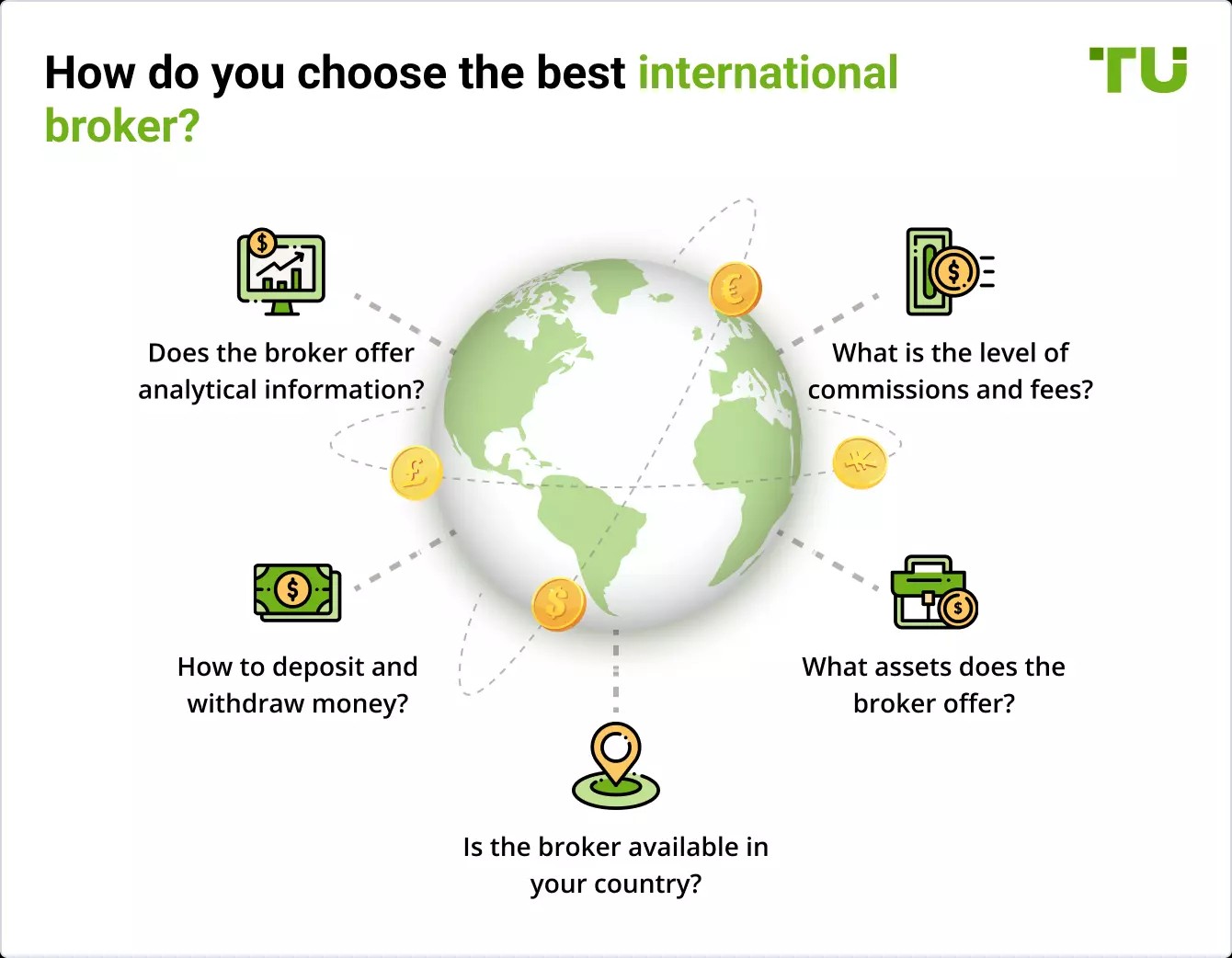
An international broker's reach is determined by its access to specific markets, which can be critical to your investment goals. If you plan to trade, pay attention to the broker's regulation.
| Max. Regulation Level | FCA UK | CySec | ASIC | BaFin | ASIC | Open an account | |
|---|---|---|---|---|---|---|---|
| Not regulated | No | No | No | No | No | Go to broker Your capital is at risk.
|
|
| Tier-1 | Yes | Yes | Yes | No | Yes | Go to broker 80% of retail CFD accounts lose money. |
|
| Tier-1 | Yes | No | Yes | No | Yes | Go to broker Your capital is at risk. |
|
| Tier-1 | No | No | No | No | No | Go to broker Your capital is at risk. |
|
| Tier-1 | Yes | No | Yes | No | Yes | Go to broker Your capital is at risk. |
The first step in choosing a broker should be to determine the priority market - international or local. This choice will help narrow down the range of suitable platforms and find the best partner for your needs.
International brokers - comparison table
Let's compare our handpicked brokers based on the types of products they offer, fees, deposit and withdrawal methods, and overall user friendliness. This will give you a better idea of which one is best for you.
Compare products
Learn what assets are available to trade on each platform. Each broker also has specific products they specialize in, so let's take a look together at how they stack up against each other.
| Currency pairs | Options | Futures | ETFs | Commodities | Crypto | Stocks | Bonds | Open an account | |
|---|---|---|---|---|---|---|---|---|---|
| 50 | No | No | No | Yes | Yes | Yes | No | Go to broker Your capital is at risk.
|
|
| 60 | Yes | Yes | Yes | Yes | Yes | Yes | No | Go to broker 80% of retail CFD accounts lose money. |
|
| 40 | No | No | Yes | Yes | Yes | Yes | Yes | Go to broker Your capital is at risk. |
|
| 69 | No | No | No | No | No | No | No | Go to broker Your capital is at risk. |
|
| 68 | No | No | No | Yes | Yes | Yes | Yes | Go to broker Your capital is at risk. |
Stocks, ETFs, and options are perhaps the assets that are most commonly traded and easiest to understand. More people have a deeper knowledge of market trends and thus, can predict outcomes more accurately. Forex, сrypto, and CFDs - to name a few - are quite volatile. They may bring larger returns, but also pose a substantial amount of risk. It takes a real expert to analyze them properly.
For beginners, we would recommend focusing on the first set of products, at least to accumulate enough experience. It is only then that you can move on to more challenging endeavors.
Fee comparison
To make a profit, these firms typically charge a small fee. This is used to maintain the system, conduct research, and serves as their commission. Since this technically appears as a cost to users, brokerages aim to remain competitive by offering fees at a lower price than similar companies.
Here is a quick comparison of each.
| Min Spread EUR/USD, pips | Max Spread EUR/USD, pips | ECN Commission | ECN Spread EUR/USD | |
|---|---|---|---|---|
| 0.1 | 0.4 | 7 | 0.1 | |
| 0.5 | 0.9 | No | No | |
| 0.3 | 1.4 | 3 | 0.3 | |
| 0.9 | No | No | No | |
| 0.1 | 0.5 | 3.5 | 0.15 |
As you can see, the required fees vary from company to company, as well as the assets being traded. As a banking institution, they likely have more requirements to comply with, which increases their overall costs.
Deposits and withdrawals
Ease of moving money, especially to maintain flexibility. So having a platform with multiple options will be convenient not only for the user but also for tracking transactions. Once again, here is a head-to-head comparison of each of the top 5 international brokers.
| Bank Card | Bank Wire | Neteller | Skrill | PayPal | BTC | Deposit fee, % | Withdrawal fee, % | |
|---|---|---|---|---|---|---|---|---|
| Yes | No | No | No | No | Yes | No | No | |
| Yes | Yes | No | Yes | Yes | No | No | No | |
| Yes | Yes | Yes | Yes | No | Yes | No | No | |
| Yes | Yes | No | No | No | No | No | No | |
| Yes | Yes | Yes | No | Yes | Yes | No | No |
Bank transfers or transactions made through an official bank account are the most common way to withdraw and deposit funds - and it's no surprise. Since we're dealing with money, security is a top priority. Of all the options, this is by far the safest for doing business.
If you don't want to pay a fee, use the platform's ACH option instead. The trade-off, I suppose, is that they're the only ones to offer a cryptocurrency payout option. This includes Bitcoin, Bitcoin Cash, Ethereum, Litecoin, and Ripple.
Trading platforms
It is no longer enough to have a web app. Having a mobile and desktop program will allow users to access your platform from different gadgets, even simultaneously or on the go. You will be surprised how many traders multitask, and this certainly helps them.
A clean and neat layout is also important, especially for beginners. This plays a key role in encouraging people to continue using it for a longer period of time. Otherwise, if everything is too complicated, they will simply give up completely.
| MT4 | MT5 | cTrader | WebTrader | Android | iOS | |
|---|---|---|---|---|---|---|
| No | Yes | No | No | Yes | Yes | |
| No | No | No | Yes | Yes | Yes | |
| Yes | Yes | No | Yes | Yes | Yes | |
| No | Yes | No | Yes | Yes | Yes | |
| Yes | Yes | No | Yes | Yes | Yes |
Every international brokerage firm we looked at is present in the top three places, that is, desktop, mobile, and web apps. Only Degiro is missing one, but they make up for it by really improving the other two platforms they use.
How to choose an international broker
Selecting the right international broker is crucial for successful global trading. Here's a guide to help you make an informed decision:
Regulatory compliance and security. Ensure the broker is regulated by respected financial authorities, such as the U.S. Securities and Exchange Commission (SEC), the Financial Conduct Authority (FCA) in the UK, or the Australian Securities and Investments Commission (ASIC). Regulation offers added security and ensures adherence to industry standards.
Market access. Choose a broker that provides access to the international markets you wish to trade in. For example, Interactive Brokers gives access to over 150 global markets, enabling trading across various countries and currencies.
Fees and commissions. Compare fees across different brokers, including trading commissions, currency conversion costs, and any account maintenance charges. Some brokers, like Fidelity, may offer commission-free trades for U.S. stocks but charge fees for international transactions.
Trading platforms and tools. Evaluate the trading platform for ease of use, reliability, and the availability of advanced trading tools. Platforms such as Charles Schwab’sStreetSmart Edge offer features that cater to both beginners and experienced traders.
Customer support. Responsive and knowledgeable customer service is crucial when dealing with international markets. Some brokers, such as Charles Schwab, provide dedicated international trading support to ensure assistance when needed.
Account types and minimums. Check the types of accounts offered and their minimum deposit requirements. Some brokers have no minimum deposit, making them more accessible to a wide range of investors.
Research and educational resources. Access to quality research and educational materials can enhance trading decisions. Brokers like Fidelity offer extensive resources to keep investors informed and well-prepared.
Currency support. If you plan to trade in various currencies, make sure the broker supports different currencies and provides competitive conversion rates. Interactive Brokers, for instance, supports multi-currency trading, making international transactions easier.
How to open an international brokerage account
The process for opening an account with an international broker may vary depending on the company and your country. Follow these steps:
Choosing a broker. Research several brokers and compare their fees, available instruments, and regulatory compliance. Check their reputation.
Proof of identity and address. Provide copies of documents: passport, ID, proof of address (such as a utility bill), and, if applicable, a tax identification number.
Completing an application. Provide personal and financial information, including employment status, income, and investment objectives.
Compliance. Check if there are any permits or other mandatory procedures required to transfer funds abroad.
Add funds. Transfer the minimum required amount via a bank account, e-wallet, or card. Make sure the broker supports the required currency and convenient deposit and withdrawal methods.
Starting trading. Once your account is funded, access the platform, review its functionality and fees before making trades.
Pros and cons of working with international brokers
Working with international brokers can have a number of advantages and disadvantages. Here are some key points to consider:
- Pros
- Cons
Access to global markets. The ability to invest in a wide range of assets and regions.
A wide range of products. Stocks, bonds, ETFs, mutual funds and commodities.
Analysis and support. Information and research on international markets.
Currency diversification. Manage currency risks and take advantage of exchange rate fluctuations.
High profit potential. Emerging markets and growing industries provide additional opportunities.
Regulation. Complexities due to differences in laws and regulations.
Currency risk. Exchange rate fluctuations can reduce returns or increase losses.
Costs. Commissions, currency conversion fees and international transfers.
Language barriers. Difficulty communicating with brokers or support.
Geopolitical and economic risks. Political instability and economic crises can negatively affect investments.
Opt for brokers that offer multi-currency accounts or competitive conversion rates to minimize expenses
When venturing into international trading, it's crucial to recognize that not all brokers offer access to every global market. Some brokers may provide extensive access to European and North American markets but have limited offerings in Asia or emerging economies.
Before committing, ensure the broker's market access aligns with your specific investment interests. Additionally, be aware of time zone differences; trading hours in foreign markets may require you to adjust your schedule, which can impact your trading strategy and decision-making process.
Another often overlooked aspect is the broker's currency support and conversion fees. Engaging in international markets means dealing with multiple currencies, and frequent conversions can lead to significant costs.
Opt for brokers that offer multi-currency accounts or competitive conversion rates to minimize expenses. Furthermore, consider the broker's technological infrastructure; a robust platform with real-time data and efficient execution is vital for navigating the complexities of global markets. Some brokers also provide advanced tools like international tax calculators, which can simplify the complexities of cross-border taxation and enhance your overall trading.
Methodology for compiling our ratings of Forex brokers
Traders Union applies a rigorous methodology to evaluate brokers using over 100 quantitative and qualitative criteria. Multiple parameters are given individual scores that feed into an overall rating.
Key aspects of the assessment include:
Regulation and safety. Brokers are evaluated based on the level/reputation of licenses and regulations they operate under.
User reviews. Client reviews and feedback are analyzed to determine customer satisfaction levels. Reviews are fact-checked and verified.
Trading instruments. Brokers are evaluated on the range of assets offered, as well as the breadth and depth of available markets.
Fees and commissions. All trading fees and commissions are analyzed comprehensively to determine overall costs for clients.
Trading platforms. Brokers are assessed based on the variety, quality, and features of platforms offered to clients.
Other factors like brand popularity, client support, and educational resources are also evaluated.
Find out more about the unique broker assessment methodology developed by Traders Union specialists.
Conclusion
Navigating the world of global markets is made significantly easier when partnering with the right international broker. The best brokers, such as Interactive Brokers and Saxo Bank, offer broad market access, competitive fees, and sophisticated trading platforms to empower your investment strategy. Ultimately, success hinges on aligning broker features—like asset variety, fee structures, and research tools—with your financial goals. Remember, the right broker is not just a gateway, but a strategic ally in capturing international investment opportunities. Choose wisely, and turn the world’s markets into your investment playground.
FAQs
How do regulatory standards differ when choosing among the best international brokers for global market trading?
What types of assets can be traded through leading international brokers?
How can multi-currency accounts benefit international traders?
What technology features should you look for in a global trading platform?
Editors' Top Picks and Insights

Hunting crypto owners: Why criminals have gone offline

BitMEX is shutting down: Why Trump could not save the exchange

Do governments need crypto workers?

Brent nears $100: Why oil prices are rising

Gram Wallet launch: Can Telegram bring crypto to the masses?

AI without limits: How dangerous are neural networks?
Related Articles
Team that worked on the article
Andrey Mastykin is an experienced author, editor, and content strategist who has been with Traders Union since 2020. As an editor, he is meticulous about fact-checking and ensuring the accuracy of all information published on the Traders Union platform.
Dan Blystone began his trading career in 1998 as an arbitrage clerk on the floor of the Chicago Mercantile Exchange (CME). He later traded bond and Eurex futures at proprietary firms such as Altea Trading, gaining valuable experience in high-frequency trading and risk management.
Chinmay Soni is a financial analyst with more than 5 years of experience in working with stocks, Forex, derivatives, and other assets. As a founder of a boutique research firm and an active researcher, he covers various industries and fields, providing insights backed by statistical data.
Ethereum is a decentralized blockchain platform and cryptocurrency that was proposed by Vitalik Buterin in late 2013 and development began in early 2014. It was designed as a versatile platform for creating decentralized applications (DApps) and smart contracts.
A wire transfer is a method of electronic funds transfer in which money is sent from one bank or financial institution to another, typically across international or domestic boundaries. It involves the sender providing their bank with specific instructions, including the recipient's bank details and the amount to be transferred, and the funds are then electronically moved from the sender's account to the recipient's account.
Forex trading, short for foreign exchange trading, is the practice of buying and selling currencies in the global foreign exchange market with the aim of profiting from fluctuations in exchange rates. Traders speculate on whether one currency will rise or fall in value relative to another currency and make trading decisions accordingly. However, beware that trading carries risks, and you can lose your whole capital.
Forex leverage is a tool enabling traders to control larger positions with a relatively small amount of capital, amplifying potential profits and losses based on the chosen leverage ratio.
Cryptocurrency is a type of digital or virtual currency that relies on cryptography for security. Unlike traditional currencies issued by governments (fiat currencies), cryptocurrencies operate on decentralized networks, typically based on blockchain technology.
-
 Afghanistan
-
 Albania
-
 Algeria
-
 Angola
-
 Argentina
-
 Armenia
-
 Australia
-
 Austria
-
 Azerbaijan
-
 Bahamas
-
 Bahrain
-
 Bangladesh
-
 Belarus
-
 Belgium
-
 Bolivia
-
 Botswana
-
 Brazil
-
 Brunei
-
 Bulgaria
-
 Cambodia
-
 Cameroon
-
 Canada
-
 Chile
Chile
-
 China
China
-
 Colombia
-
 Congo
Congo
-
 Costa Rica
-
 Cote d'Ivoire
-
 Croatia
-
 Cuba
Cuba
-
 Cyprus
-
 Czechia
-
 DR Congo
-
 Denmark
-
 Dominican Republic
-
 Ecuador
-
 Egypt
Egypt
-
 El Salvador
-
 Estonia
-
 Eswatini
-
 Ethiopia
-
 Finland
-
 France
-
 Georgia
-
 Germany
-
 Ghana
Ghana
-
 Greece
-
 Haiti
Haiti
-
 Hong Kong
-
 Hungary
-
 India
India
-
 Indonesia
-
 Iran, Islamic republic
-
 Iraq
Iraq
-
 Ireland
-
 Israel
-
 Italy
Italy
-
 Jamaica
-
 Japan
Japan
-
 Jordan
-
 Kazakhstan
-
 Kenya
Kenya
-
 Korea
Korea
-
 Kuwait
-
 Kyrgyzstan
-
 Laos
Laos
-
 Latvia
-
 Lebanon
-
 Lesotho
-
 Libya
Libya
-
 Lithuania
-
 Luxembourg
-
 Madagascar
-
 Malaysia
-
 Malta
Malta
-
 Mauritius
-
 Mexico
-
 Moldova
-
 Mongolia
-
 Montenegro
-
 Morocco
-
 Mozambique
-
 Myanmar
-
 Namibia
-
 Nepal
Nepal
-
 Netherlands
-
 New Zealand
-
 Nigeria
-
 North Macedonia
-
 Norway
-
 Oman
Oman
-
 Pakistan
-
 Palestine
-
 Panama
-
 Papua New Guinea
-
 Paraguay
-
 Peru
Peru
-
 Philippines
-
 Poland
-
 Portugal
-
 Puerto Rico
-
 Qatar
Qatar
-
 Reunion
-
 Romania
-
 Rwanda
-
 Saudi Arabia
-
 Serbia
-
 Singapore
-
 Slovakia
-
 Slovenia
-
 Somalia
-
 South Africa
-
 Spain
Spain
-
 Sri Lanka
-
 Sweden
-
 Switzerland
-
 Syria
Syria
-
 Taiwan
-
 Tajikistan
-
 Tanzania
-
 Thailand
-
 Trinidad and Tobago
-
 Tunisia
-
 Turkey
-
 UAE
UAE
-
 Uganda
-
 Ukraine
-
 United Kingdom
-
United States
-
 Uruguay
-
 Uzbekistan
-
 Venezuela
-
 Vietnam
-
 Yemen
Yemen
-
 Zambia
-
 Zimbabwe
- Forex
- Crypto











