
How Does The Martingale Strategy In Binary Options Work?


Editorial Note: While we adhere to strict Editorial Integrity, this post may contain references to products from our partners. Here's an explanation for How We Make Money. None of the data and information on this webpage constitutes investment advice according to our Disclaimer.
The Martingale strategy in binary options works by doubling your investment after each losing trade to recover previous losses and make a profit once a winning trade occurs. For example, if you lose a $10 trade, you invest $20 in the next trade, then $40 if that also loses, and so on. While it can recover losses in the short term, the strategy is risky, requiring significant capital to withstand losing streaks and is not guaranteed to be profitable.
In binary options trading, traders use various strategies to maximize their profits and minimize losses. One such strategy is the Martingale, which has gained attention and controversy. In this article, we will dive into the Martingale strategy in binary options, how it works, its profitability, and its associated risks, and answer some frequently asked questions. Essentially, the Martingale system in binary options is a trading system that involves doubling your investment after each losing trade. While it may seem like a foolproof way to recover losses, it comes with inherent risks and is not guaranteed to be profitable.
What is Martingale strategy in binary options?
The Martingale strategy is a popular strategyand trading system employed in various financial markets, including binary options trading. It is based on the principle of doubling your investment after each losing trade in the hopes of eventually recovering all losses and making a profit. This principle forms the base of the Martingale in the binary options segment that many traders experiment with.
Here's how it typically works:
Initial trade. You start with an initial investment amount of $100
Trade. If your first trade results in a loss, you double your investment in the next trade, which would be $200 in this case
Repeat. If the second trade also results in a loss, you double your investment again, making it $400 for the third trade
Continue. You continue this process until you have a winning trade, at which point you return to your initial investment amount
In other words, the idea behind the Martingale strategy is that, statistically, a winning trade will eventually occur. When it does, it should cover the previous losses and result in a net profit. For this reason, traders often refer to the Martingale strategy for binary options as a method designed to regain balance through position scaling.
Is Martingale allowed in binary options?
Yes, the Martingale strategy is typically allowed in binary options trading. Binary options platforms generally do not impose restrictions on specific trading strategies that traders can employ. This means that you are free to use the Martingale strategy and any other trading strategies you deem suitable for your objectives.
However, it's crucial to remember that while it may be allowed, using the Martingale strategy in binary options trading carries significant risks and may not be advisable for all traders due to its high-risk nature and potential for substantial capital losses. It is important to assess personal risk limits before employing the Martingale strategy for binary options, especially if using high multipliers or tight balance limits.
Is the Martingale strategy 100% profitable?
The Martingale strategy is far from being 100% profitable. To achieve 100% profitability with this strategy, one would need an infinite supply of capital, which is practically impossible. Let's take a look at how the Martingale trading strategy can play out in the real world. We started our simulation with $10,000 in our trading account. Our backtest of the Martingale trading strategy in binary options demonstrates how trade sizes grow exponentially and risk compounds quickly.
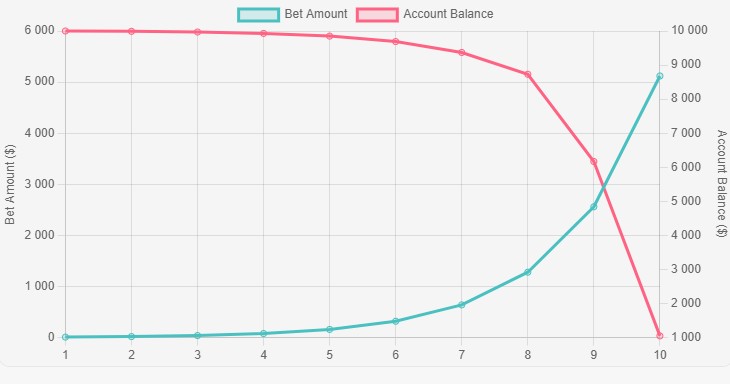
Our trades started small at only $10 risk per trade but doubled after each loss, as the Martingale strategy requires. You can see the trade amounts increasing exponentially along the left vertical axis.
While our account balance, shown on the right axis, decreased slowly at first, things took a turn as our losing streak continued. Larger and larger trades were not enough to overcome multiple losses in a row.
Additionally, it's crucial to note that the Martingale strategy can only potentially work with assets like Forex, which do not have an absolute zero value. In financial markets, where asset prices can fluctuate significantly and are influenced by various factors, there is no guarantee that a losing streak will end in a way that allows the strategy to recover all losses and yield a profit. In summary, knowing how the best Martingale strategy for binary options really works helps traders see both its logic and its real risks before deciding whether it fits their trading approach.
Is Martingale strategy risky?
Yes, the Martingale strategy is inherently risky. First and foremost, it demands a substantial capital base to endure a potential string of losses. A series of consecutive losses can quickly deplete your funds as you double your investment. As a result, proper risk management is necessary. Here are the steps that you can follow to minimize your risks:
Start with micro-investments to limit exponential loss. Start with the smallest possible trades instead of doubling large amounts. This keeps your losses from growing too fast, giving you more room to recover without draining your account.
Set a predefined loss cap before using the Martingale strategy. Plan ahead on how many losses you’ll take before stopping. This stops you from losing more by trying to win it back, a common mistake in the Martingale approach.
Combine the Martingale strategy with trend analysis. Check indicators like RSI to confirm the trend before using this strategy. Going against the trend makes losses add up quickly, so avoid using it in random or choppy markets. Many traders consider blending trend signals with the Martingale strategy for binary options to create more stable setups, taking best advantage of confluence.
Use Martingale only in specific market conditions. Use this strategy only when the market is calm, like during low-volatility periods. Try it with options that have short timeframes to limit risk and improve control over your trades. In these conditions, the Martingale strategy tends to perform better since the odds of recovery under binary options improve when price swings are contained.
Alternative strategies to the Martingale approach
For traders hesitant to take on the risks associated with the Martingale strategy, several alternative strategies provide a safer approach:
Anti-Martingale strategy (Reverse Martingale)
Instead of doubling after losses, traders double their investment after a winning trade. This helps to capitalize on winning streaks without exposing too much capital during losses. Learn the details of the reverse martingale strategy for binary options in our full article. Many investors compare this with the original Martingale strategy in binary options to understand how different capital scaling systems affect returns.Paroli system
A more cautious strategy where you increase your investment incrementally after consecutive wins but reset to the initial amount after any loss.D’Alembert strategy
This involves increasing your trade size by a fixed amount after a loss and decreasing it after a win, offering a slower and steadier risk approach.
These alternatives are often explored alongside the Martingale strategy for binary options to evaluate their sustainability in live trading.
Tools and platforms for Martingale trading
Certain trading platforms provide features that support traders using the Martingale strategy:
Automated Martingale bots. Allow traders to implement the strategy without manual input, reducing stress. These automation features are particularly designed for those experimenting with binary options through Martingale strategy and looking for efficiency in execution.
Risk calculation tools. Some platforms offer calculators to estimate the capital required for Martingale trading based on expected market conditions. Such analytical tools help refine applications of the Martingale strategy in binary options, ensuring traders manage their exposure before doubling positions.
Some of the best platforms for binary options that offer similar tools are:
| CloseOption | Capitalcore | Nadex | Pocket Option | QUOTEX | |
|---|---|---|---|---|---|
|
Foundation year |
2013 | 2019 | 2009 | 2017 | 2019 |
|
Min. deposit |
5 | 10 | 250 | 5 | 10 |
|
Min. trade size |
1 | 1 | 1 | 1 | 1 |
|
Min. Payout (%) |
17 | 60 | No | 50 | 20 |
|
Max. Payout (%) |
95 | 90 | 100 | 128 | 98 |
|
Demo |
Yes | Yes | Yes | Yes | Yes |
|
Copy trading |
No | No | No | Yes | No |
|
Open an account |
Go to broker Your capital is at risk. |
Go to broker Your capital is at risk.
|
Study review | Go to broker Your capital is at risk. |
Go to broker Your capital is at risk. |
Use scaled Martingale and trend tools for safer binary options trading

The Martingale strategy in binary options is not just about doubling after a loss; it’s about careful planning and smart risk-taking. Pick low-risk assets that stay steady, like currencies with low volatility. Start with small trades that can survive several losses in a row. Combine the Martingale strategy with tools like Bollinger Bands or Fibonacci levels to time your trades better. For instance, only double down when the price hits strong support or resistance levels confirmed by these indicators, so you’re not just guessing.
Try a “scaled Martingale” method instead of doubling every time. Increase your trade size by 50% or 75% instead of 100% to make losses smaller while still giving you a chance to recover profits. Use Martingale only when the market is calm, avoiding high-volatility sessions or major news events. With these adjustments, you can turn Martingale from risky into a smarter, more controlled strategy for binary options trading.
Conclusion
In summary, the Martingale strategy can appear enticing for binary options traders seeking rapid recovery from losses, but its inherent risks often outweigh the potential rewards. The approach involves doubling down on losing bets, assuming an inevitable win will cover all previous losses; however, this can lead to exponential losses and even wipe out an account during losing streaks. For example, a trader may recover from one or two losses, but a series of unfavorable outcomes can quickly exhaust their available capital. Ultimately, while the Martingale strategy provides a clear, systematic structure, it demands a level of risk tolerance and capital many traders simply don’t possess. The most powerful takeaway is to approach Martingale with extreme caution and prioritize disciplined risk management above the allure of fast recovery.
FAQs
What are the main limitations of the Martingale strategy in binary options trading?
How do alternative strategies like the Anti-Martingale and D’Alembert compare to the traditional Martingale in risk management?
Can automation tools improve the effectiveness of the Martingale strategy in binary options?
What practical steps can traders take to use the Martingale strategy more safely in binary options?
Editors' Top Picks and Insights






Related Articles
Team that worked on the article
Mikhail Vnuchkov joined Traders Union as an author in 2020. He began his professional career as a journalist-observer at a small online financial publication, where he covered global economic events and discussed their impact on the segment of financial investment, including investor income.
Dan Blystone began his trading career in 1998 as an arbitrage clerk on the floor of the Chicago Mercantile Exchange (CME). He later traded bond and Eurex futures at proprietary firms such as Altea Trading, gaining valuable experience in high-frequency trading and risk management.
Chinmay Soni is a financial analyst with more than 5 years of experience in working with stocks, Forex, derivatives, and other assets. As a founder of a boutique research firm and an active researcher, he covers various industries and fields, providing insights backed by statistical data.
CFD is a contract between an investor/trader and seller that demonstrates that the trader will need to pay the price difference between the current value of the asset and its value at the time of contract to the seller.
Yield refers to the earnings or income derived from an investment. It mirrors the returns generated by owning assets such as stocks, bonds, or other financial instruments.
Risk management is a risk management model that involves controlling potential losses while maximizing profits. The main risk management tools are stop loss, take profit, calculation of position volume taking into account leverage and pip value.
Bollinger Bands (BBands) are a technical analysis tool that consists of three lines: a middle moving average and two outer bands that are typically set at a standard deviation away from the moving average. These bands help traders visualize potential price volatility and identify overbought or oversold conditions in the market.
Day trading involves buying and selling financial assets within the same trading day, with the goal of profiting from short-term price fluctuations, and positions are typically not held overnight.

-
 Afghanistan
-
 Albania
-
 Algeria
-
 Angola
-
 Argentina
-
 Armenia
-
 Australia
-
 Austria
-
 Azerbaijan
-
 Bahamas
-
 Bahrain
-
 Bangladesh
-
 Belarus
-
 Belgium
-
 Bolivia
-
 Botswana
-
 Brazil
-
 Brunei
-
 Bulgaria
-
 Cambodia
-
 Cameroon
-
 Canada
-
 Chile
Chile
-
 China
China
-
 Colombia
-
 Congo
Congo
-
 Costa Rica
-
 Cote d'Ivoire
-
 Croatia
-
 Cuba
Cuba
-
 Cyprus
-
 Czechia
-
 DR Congo
-
 Denmark
-
 Dominican Republic
-
 Ecuador
-
 Egypt
Egypt
-
 El Salvador
-
 Estonia
-
 Eswatini
-
 Ethiopia
-
 Finland
-
 France
-
 Georgia
-
 Germany
-
 Ghana
Ghana
-
 Greece
-
 Haiti
Haiti
-
 Hong Kong
-
 Hungary
-
 India
India
-
 Indonesia
-
 Iran, Islamic republic
-
 Iraq
Iraq
-
 Ireland
-
 Israel
-
 Italy
Italy
-
 Jamaica
-
 Japan
Japan
-
 Jordan
-
 Kazakhstan
-
 Kenya
Kenya
-
 Korea
Korea
-
 Kuwait
-
 Kyrgyzstan
-
 Laos
Laos
-
 Latvia
-
 Lebanon
-
 Lesotho
-
 Libya
Libya
-
 Lithuania
-
 Luxembourg
-
 Madagascar
-
 Malaysia
-
 Malta
Malta
-
 Mauritius
-
 Mexico
-
 Moldova
-
 Mongolia
-
 Montenegro
-
 Morocco
-
 Mozambique
-
 Myanmar
-
 Namibia
-
 Nepal
Nepal
-
 Netherlands
-
 New Zealand
-
 Nigeria
-
 North Macedonia
-
 Norway
-
 Oman
Oman
-
 Pakistan
-
 Palestine
-
 Panama
-
 Papua New Guinea
-
 Paraguay
-
 Peru
Peru
-
 Philippines
-
 Poland
-
 Portugal
-
 Puerto Rico
-
 Qatar
Qatar
-
 Reunion
-
 Romania
-
 Rwanda
-
 Saudi Arabia
-
 Serbia
-
 Singapore
-
 Slovakia
-
 Slovenia
-
 Somalia
-
 South Africa
-
 Spain
Spain
-
 Sri Lanka
-
 Sweden
-
 Switzerland
-
 Syria
Syria
-
 Taiwan
-
 Tajikistan
-
 Tanzania
-
 Thailand
-
 Trinidad and Tobago
-
 Tunisia
-
 Turkey
-
 UAE
UAE
-
 Uganda
-
 Ukraine
-
 United Kingdom
-
United States
-
 Uruguay
-
 Uzbekistan
-
 Venezuela
-
 Vietnam
-
 Yemen
Yemen
-
 Zambia
-
 Zimbabwe
- Forex
- Crypto












